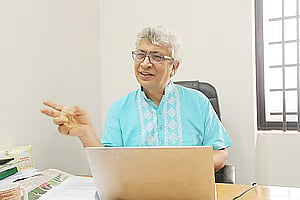
Exclusive Interview: Tanzimuddin Khan
The president said, one person’s ego and arrogance brought everyone down
Professor Mohammad Tanzimuddin Khan of the Department of International Relations at the University of Dhaka was one of the prominent figures among teachers and members of civil society who publicly participated in the July mass uprising. He witnessed many of the events surrounding the uprising and the formation of the post-uprising government. He spoke these experiences, in an interview with Prothom Alo's Razib Hassan
Shortly before the fall of the Awami League government on 5 August 2024, the “Drohajatra” (March of Defiance), organised at the call of teachers and civil society members, added a new dimension to the July mass uprising. What was the preparation for the Drohajatra?
Tanzimuddin Khan: The Drohajatra took place on 2 August. By then, many cultural activists had already been in contact with Professor Anu Muhammad. We held an informal meeting at his residence the previous day, on 1 August. We wanted to understand what we could actually do in the circumstances that had emerged.
There was a discussion about organising a gathering of cultural activists, and after much discussion it was named “Drohajatra” (March of Defiance). Those of us associated with the political and social analytical publication Sarbojonkotha were involved, along with cultural activists. Among them were Samina Luthfa, Maha Mirza, Moshahida Sultana, Kallol Mostofa, Mahtab Uddin Ahmed, and several others.
Ultimately, we reached the conclusion that none of us had any option left but to continue with the movement. Either there would be change, or we would become even more vulnerable and face greater risks to our lives. That was our bottom line.
On 4 August you presented an outline for an interim government.
Tanzimuddin Khan: Our decision was that, in order to boost people's courage and strengthen the momentum of the movement, it was necessary not only to demand the government’s resignation but also to present an outline of what the post-resignation government structure would look like.
Although this discussion had not previously taken such a strong and organised form among us, it began to take a more comprehensive shape on 1 August. Ultimately, on 4 August, we announced the outline for an interim government through a press conference.
The background to this was our 1 August meeting. We realised that the fall of the government itself was not the only important issue; managing the situation after the fall was even more crucial.
During this period, were you in contact with or connected to any of the students?
Tanzimuddin Khan: This communication began developing from 15 July. Mahfuj Alam also came to my home. I believe that was the night of 15 July, rather early 16 July. However, my communication with many of the students had existed since the 2018 quota reform movement.
The contact was established at the beginning of the July movement. As far as I remember, they organised a rally under the banner of the Anti-Discrimination Student Movement on 1 July 2024. That day, Asif Mahmud Shojib Bhuiyan called me from the rally. He requested that I attend the gathering on behalf of the teachers to express solidarity with them.
I told him that we supported the students’ demands. But we did not want to directly attend their rally at that moment. If we went, many people might interpret it as us “inciting” the movement.
You were talking about your communication with Mahfuj…
Tanzimuddin Khan: I got in touch with Mahfuj through Adnan Aziz Chowdhury of the Chhatra Union, a student at Dhaka University. Their movement did not have any central leadership; it was more decentralised and dispersed. At the time, I felt that they had used the organisational experience of the teachers’ network in conducting their movement.
Perhaps about a year before the movement, I once met Nahid Islam while walking near the Arts Building. At the time, Nahid asked me, “Sir, how have you managed to sustain yourselves through so many challenges?” In reality, within the teachers’ network, different people took responsibility at different times. Our organisational structure was not built around any one specific individual.
Perhaps during the second week of July, Adnan called me and said that Mahfuj had been contacted by Bangladesh’s intelligence agencies, NSI, SB, and DGFI. He said that the government had made a proposal to Mahfuj so that the movement would not go any further. The government wanted to reach a resolution.
What was the discussion with you about?
Tanzimuddin Khan: Adnan informed me that Mahfuz wanted to meet with us, that is, with the Teachers’ Network. At that time, it was not possible to get everyone from the Teachers’ Network together at once. He was supposed to arrive around midnight or 12:30 am, but by the time he arrived it was between 2 and 3 am.
The discussion was about whether they should continue the movement or sit down for talks with the government. There was also the concern that, given the way they were being beaten and attacked, if they reached any kind of settlement, they could face questions and even suspicion of financial dealings. If they were to sustain the movement, what strategy should they actually adopt?
From my side, I said that the danger of sitting down with the government was that, at that time, the government’s nature was such that it was not trustworthy at all. I told them that unless any meeting with the government was officially documented, if there were any secret meetings, the government would things publicly in its own way. The actual version would be one thing, while the public version would be something else. Everything would be presented according to its own interests.
In that situation, whatever happened would have to be documented and made public. I assumed the government would not agree to that, and if it did not agree, that would create space for the movement to rethink its next steps.
Were there also pressures or threats against you?
Tanzimuddin Khan: After the press conference on 4 August, I marched to Shahbagh and was returning home when some well-wishers who were teachers told me that I should not stay at home. They said that a list of 10 people had been prepared from the university. My name was on the list, along with Geetiara Nasrin and my colleague Abdul Mannan. Samina Luthfa, Moshahida Sultana, Maruf bhai, and several others were also on it.
They told me that our Vice-Chancellor, the proctor, and assistant proctors had provided these names to the intelligence agencies. They said that two assistant proctors had played a particularly significant role in this regard. I even heard that we might be picked up on 5 or 6 August.
How did you learn about the fall of the government on 5 August?
Tanzimuddin Khan: At around 9:00–9:30 in the morning, a friend of mine called me from the cantonment and said, “It’s decided. She is leaving, Sheikh Hasina will no longer remain in power.” I shouted with joy and went to tell my mother.
Then, around 10 am, I went out and headed toward Shahbagh. At that point, it had not yet become public news, and I could not share it publicly either. I did not know whether it had actually happened; it was not possible to rely only on a verbal message. When I reached Shahbagh, I met people from our circle and gradually began telling them, “Sheikh Hasina is leaving; the game is over.” Later, of course, everyone came to know.
Who contacted you regarding the formation of the advisory council?
Tanzimuddin Khan: Communication began from the night of 5 August. On one side, there were communications from Adnan and the leftist organisations, and on the other side, from Nahid, about how many people should be included in the council and which names should be put forward from our side.
Anik Roy, Ragib Naim, Nazifa Jannat, and others were among those who contacted us. Mahfuj was fully involved, and their involvement had become stronger after the Drohajatra. Nahid, Mahfuj, and Nasiruddin Patwary were also involved. Perhaps this was done with the aim of obtaining names representing minority communities and the leftist groups.
Who were on your list? What considerations led to the selection of those names?
Tanzimuddin Khan: After discussions among ourselves, we collectively proposed around ten names: Anu Muhammad, Salimullah Khan, Sara Hossain, Badiul Alam Majumdar, Shahidul Alam, Tasnim Ara Siddiqui, Prashanta Tripura, Dr. Bidhan Ranjan Roy, Gautam Dewan from the Chittagong Hill Tracts, Sharmin Murshid, Justice Abdul Matin, and Professor CR Abrar. Despite my objections and reluctance, they also included my name.
The consideration was to identify people who embodied the spirit of the movement. This could not be judged by the standards of the caretaker governments of 1991 or later, because this movement was not led by any political party.
Mahfuj and the others came on the night of 5 August. What was discussed?
Tanzimuddin Khan: Mahfuj arrived around midnight. After that, Nasir and Nahid came in several rounds. Professor Kazi Maruf also came on behalf of the Teachers’ Network. Although Nasir became tired and fell asleep, the rest of us sat on the floor and continued our discussions until around 3:30-4:00 am, up to the time of Fajr azan.
They took our list. They also proposed some names from their side, some of which we objected to. But they did not tell us that they had held a separate meeting that very night at Curzon Hall or somewhere else and prepared their own list. The impression was that the list was being prepared through discussions with us.
How did the name of Dr. Yunus emerge as the Chief Adviser?
Tanzimuddin Khan: As a side discussion that night, the question also came up: who in Bangladesh at that moment had the stature to take on this role? A few names were suggested, but we rejected them outright because of controversies surrounding them. Nahid asked me, “Sir, if we bring in Professor Yunus, what could be our argument in his favour?”
I am a person from the field of international relations, so my calculation was straightforward: after a change of government, the reactions we would have to face would primarily come from India and the United States. Who in Bangladesh has the global stature to deal with these countries, along with other Western nations? Managing international politics would be more important than domestic politics in handling the situation that followed.
I also told them that we ourselves were not entirely comfortable with him either. Nahid also said, “Many of us do not feel completely comfortable with this either.” But the discussion ultimately came down to the fact that there was no alternative to him at that moment for addressing these challenges. There was no one else who could handle the complexities of international politics. The same discussion took place before entering the meeting at Bangabhaban on 6 August.
You were also present at Bangabhaban with the students for discussions with the military.
Tanzimuddin Khan: Around 11 am to noon on August 6, Samina Luthfa called me. I believe Nahid had contacted her. She said that two representatives from the Teachers’ Network, a man and a woman, needed to go to Bangabhaban.
My decision was that I would not go. I told her, “You and Professor Geetiara Madam should go.” Later, Manzur Al Matin contacted me, and around 3:30 pm I received a call saying, “Sir, we are in a white microbus. We will pick you up from the Arts Building.” When I went to the Arts Building, I learned that one of the teachers, Professor Asif Nazrul, was already at Bangabhaban, so only one person from our side could go.
Samina Luthfa was unwilling to go. I was arguing quite strongly, but eventually Manzur Al Matin practically pushed me into the microbus by force. Nahid, Akhter Hossain, Nasir, and Mahfuj were in the microbus. Asif Mahmud and Hasnat Abdullah were also there.
At Curzon Hall, I met Sarjis Alam for the first time. I knew him as someone associated with Chhatra League or as a Chhatra League debater, but we had never spoken before. I also met Rifat Rashid, a student from our department. There may have been 15 to 20 people there, including Nazifa, Ashrefa, and students from private universities. We headed to Bangabhaban in a minibus. We arrived around 4:45-5:00 pm, and the meeting was scheduled for 5:30 pm.
What was the atmosphere like at Bangabhaban?
Tanzimuddin Khan: We were taken to a large hall inside and were served food. The meeting was not starting. The President’s Military Secretary came and informed us that the three service chiefs were stuck in heavy traffic and would be delayed. Nahid said, “Come on, sir, let’s do some homework in the meantime.”
The purpose of this “homework” was to discuss who the potential advisers could be and how we should negotiate when we sat down for discussions.
How was it decided who would participate in the negotiations?
Tanzimuddin Khan: We learned that six people would be allowed to take part in the discussion, four from the students’ side and two from the teachers’ side. I have provided a detailed account of this in a television interview. Still, briefly, I would say that from our side, it was more or less decided that Professor Yunus would become the Chief Adviser. The discussion was mainly about who would handle the negotiations.
The students discussed among themselves for 15-20 minutes and informed us that four of them would go: Nahid, Nasir, Asif, and Mahfuj. For strategic reasons, I decided not to go. Nahid was very surprised by this decision. I told him, “Just make sure of one thing, will the four of you be able to handle it?” He replied, “Sir, there is no question of not being able to. If we cannot, we will come back and hold a press conference to say so.”
In the end, none of us from the teachers’ side participated.
What was ultimately decided in the discussion?
Tanzimuddin Khan: There was only one issue, the Chief Adviser. Nahid later gave me an indication that alternative names were being proposed from the military’s side. They would agree to any name other than Professor Yunus, but not Professor Yunus himself. The students remained firm on that point.
He told me, “Sir, we spent six hours on just one name; we did not even get the opportunity to discuss the names of any other advisers.” In other words, at the Bangabhaban meeting on 6 August, only the issue of the Chief Adviser was settled. There was no discussion or announcement that day regarding the other advisers.
When the Chief Adviser arrived, he wanted to include some names of his own choice. In order to accommodate them, several important names were dropped at the last moment, making the entire list more disorganised
What was the process of obtaining the President’s approval like?
Tanzimuddin Khan: It was past midnight when Mahfuj came and said, “Sir, done! The issue of the Chief Adviser has been settled.” Then all of us were called into the conference room. This 10-12 minute session was about informing the President of the decision reached in the discussion and obtaining his approval.
As we entered, the President put his hand on Nahid’s shoulder from behind and said, “Well done, boys, you have all salvaged Bangladesh.” Then, as he sat down in his chair, he said, “One person’s ego and arrogance have brought all of us down.”
There was a conference table, with the President seated in the middle. The three service chiefs were on his right, while 15-20 of us sat on the left, along with another 10-15 members of the armed forces. The President thanked everyone in two or three sentences and wished Professor Yunus well. We were very enthusiastic, but there was no such enthusiasm among the President, the three service chiefs, or anyone from the armed forces. There was a sense of relief at having reached a resolution, but the atmosphere remained tense and heavy. It was clear that they felt some discomfort about the fact that such a person had become the Chief Adviser.
So how and by whom was the list of the remaining advisers finalised?
Tanzimuddin Khan: Different lists came from different sides. First, there was our list from the Teachers’ Network and the left-leaning civil society circles; second, the list from Nahid and his group; third, BNP’s list; fourth, names proposed by the army; and fifth, names received from other sources, including editors of some newspapers.
Later, on 8 August, when the Chief Adviser arrived, he wanted to include some names of his own choice. In order to accommodate them, several important names were dropped at the last moment, making the entire list more disorganised. I do not have a clear understanding of exactly who handled this process of compiling, removing, and adding names, or how it was ultimately carried out.
On 5 August, the army chief invited political parties to the army headquarters, but none of you were invited. Yet, on 6 August, you became the key figures in deciding the Chief Adviser, with no political parties involved. How do you explain this?
Tanzimuddin Khan: I find this mysterious myself, but my personal interpretation is that the main driving force behind the beginning of the July movement was the university teachers and students, under the banner of the Anti-Discrimination Student Movement. Through the continuous killings and police repression, political parties, as well as parents, siblings, workers, and common people gradually became involved, and the movement became a movement of everyone.
If such a driving force was not taken into consideration and was simply left on the streets, it would not have been possible to manage the situation at that time. What happened was that they were brought into the sphere of the then government led by the President, while at the same time the armed forces, the army chief, and the President were given legitimacy and public support was secured for them, through bringing the process to Bangabhaban and formalising it, and through the swearing-in ceremony. The mass movement was successfully moved from the streets into Bangabhaban, and in doing so, the very character of the movement changed; the nature of the mass uprising took on a different dimension.
What role did the University of Dhaka as an institution play in the July mass uprising, and what role did teachers play as citizens?
Tanzimuddin Khan: Previously, during anti-government movements, the teachers’ association would maintain an independent position. On questions of justice and fairness, the university administration could not ignore the association. The teachers’ association would become a key voice on issues of citizens’ rights and fairness. This time, however, it was different. The administration and the teachers’ association were both loyal to the ruling party, unquestioning followers, and under its control. As a result, the university’s traditional role as an institution was absent.
At one point, even paramilitary forces would come onto the campus to load and unload weapons after running out of ammunition while suppressing the July marches. After the closure of the university’s residential halls was announced on 17 July, the campus was effectively used as their base.
Before 1 August teachers from the White Panel (an opposition-aligned teachers’ group) also did not have a strong public presence in their own political identity in that sense. Many of them had survived by compromising with the administration, sharing positions in organisations such as the Asiatic Society and the Teachers’ Club, and participating in joint elections. Although some appeared during 1-5 August, from the afternoon of 5 August onward, many were more focused on taking photographs and promoting themselves on social media.
The advantage of the Teachers’ Network was that it was a loosely organised platform with ideological diversity. Although small in number, the Teachers’ Network created a space for courage and collective action.
Some intellectuals were vocal during the uprising, while a large section remained silent. Two years later, how do you evaluate their roles?
Tanzimuddin Khan: A section of well-known intellectuals made their partisan positions clear to a troubling degree. The injustices committed under the cover of words such as “development” and “Liberation War” became impossible to ignore. Someone who remains firm on the issue of the Liberation War should also remain firm when confronting all forms of injustice, but they failed to do so. They seemed to carry a psychological burden that criticising this government would somehow weaken the forces of the Liberation War.
At the same time, they showered the then prime minister in unquestioning praise while securing personal wealth and privileges for themselves.
Through the uprising, we witnessed the emergence of a small but effective new group of intellectuals, a large portion of whom are liberal. However, just as society was previously polarised through the binary of “freedom fighters versus collaborators,” a new form of polarisation has emerged over the past two years, based on identities such as who is “religious” and who is “anti-religious,” or who is seen as an ally of India and who is opposed to Pakistan.
The very intellectuals who risked their lives on the front lines of the mass uprising are now being character-assassinated on social media with labels such as “Islamophobic.” They are sometimes portrayed as people who deserve to be targeted or harmed.
The objective behind this is long-term: if a new form of fascism emerges in the future, these are the people who would want to protest again. Therefore, the aim is to socially discredit and dehumanise these intellectuals in advance, destroying that possibility. As a result, even their protests have been forced to become selective rather than consistent.
Attacks on shrines, assaults on Baul artists and people of different beliefs, and the perceived lack of effort or reluctance by the previous interim government to prevent attacks on women have further intensified this fear in society. This has created a perception that the government belongs to a particular group.
Before the uprising, the public activities of Islami Chhatra Shibir were not visible, but afterward they emerged openly and won four student union elections. Many Shibir members had also been active under the identity of Chhatra League. How do you view these developments?
Tanzimuddin Khan: The uprising did not belong to any single party. The “non-political” identity of the Anti-Discrimination Student Movement attracted everyone. It was not even possible to distinguish Shibir separately at that time. Moreover, many Shibir members maintained their influence in residential halls while holding Chhatra League identities or positions. Once they came forward under their own name, that influence became much stronger, especially because other student organisations were unable to conduct election campaigns in the same way due to restrictions on political activities in residential halls (political activities were banned there on 17 July 2025).
They won the elections through a specific strategy, welfare activities such as providing water filters, food, and tuition support. At the same time, public universities, particularly the faculties of arts and social sciences, have seen a significant increase in students from rural backgrounds and those facing economic hardship. Shibir recognised this shift, reached out to their families, and provided support through financial assistance and tuition opportunities. One student told me, “My father told me to vote for Sadik.”
In contrast, Chhatra Dal faced an image crisis. There was a strong narrative that “Chhatra Dal and Chhatra League are the same,” and that women were not safe in the hands of Chhatra Dal. In the case of the leftist groups, they were labeled as “Shahbagis,” “atheists,” or “extremists.” Taken together, all of this benefited Shibir.
Moreover, student organisations often look toward instructions from their respective parent organizations, and those political parties did not give student union elections sufficient importance from the beginning. In this regard, Jamaat was more proactive. They also had advantages within university administrations, particularly because many people in offices such as the proctor’s office were sympathetic toward them or showed favouritism.
There have also been broader changes in society. The inability to curb corruption, the lack of political integrity, and the gap between politicians’ words and actions led people to search for “something new” and new alternatives. All of these factors increased the prospects for Jamaat-Shibir.
As for the politics of hidden identities: In the 1960s and 1970s, some people used aliases for security reasons or to evade police attention. But they did not become part of wrongdoing or physical abuse under the banner of another political party. This time, they placed their trust in one ideology while becoming partners in another party’s wrongdoing, they played hide-and-seek with their own political beliefs and engaged in deception. This kind of unethical political maneuvering ultimately raises questions and creates fear among the public.
Even so, they won because, in many cases, students facing social and economic pressures now make decisions based heavily on immediate circumstances. For many, short-term gains and benefits have become more important. However, there are certainly exceptions.
How would you evaluate the interim government led by Professor Muhammad Yunus?
Tanzimuddin Khan: There were some successes in the economic sphere, but not in maintaining law and order. Many incidents could have been prevented if there had been genuine intent; that commitment was lacking. Most importantly, many members of the government remained far removed from the broader aspirations of the mass uprising. Some, after assuming office, did not view power as a responsibility but rather enjoyed it in the same way traditional, old-style politicians have done. Yet the people who sacrificed their lives wanted a transformation, and even a glimpse of that desired change was not established.
Where does the politics of the student leaders who became the face of the uprising, NCP, stand now?
Tanzimuddin Khan: For mysterious reasons, they too have moved away from those aspirations. There are questions about whether there was genuine democratic practice in the process of forming the party. They are our own students; through informal conversations, I have felt that their politics has become confined to a small circle. They have moved away from the principles of inclusiveness, ending discrimination, and creating a new political arrangement with which they began. Instead, they have entered the mold of old politics, including the traditional approach to elections, and have not attempted to break away from that mold. They have gone wherever their own political comfort lies.
BNP is now in power. What is the future of state reform and accountability? How do you view the achievements of the mass uprising?
Tanzimuddin Khan: I want to remain optimistic, but there are fewer reasons to do so. Even in parliament, attention often appears to be focused more on irrelevant discussions than on people’s suffering. Looking at everything, it seems that instead of rebuilding the institutions that were destroyed, the old culture of leader worship, tender manipulation, and the buying and selling of positions and titles has continued once again.
The core crisis is the lack of political integrity across the board, including among the new parties. The gap between political leaders’ words and actions is not decreasing; rather, it is growing. If this gap cannot be reduced, then the question of reform itself loses relevance.
Perhaps there are efforts, sincerity, and public messaging for change at the BNP’s top level. But the question is: Has the mass uprising of 5 August actually brought a change in the mindset of everyone in government and opposition politics? From appointments at Bangladesh Bank to the selection of vice-chancellors at universities, the issue naturally comes up because I was involved with the University Grants Commission, there is still ambiguity about what basis these appointments are being made on. It appears that lobbying, networks, and transactions are becoming more important.
There are achievements, the fact that we can speak so openly today, that the previous ruling group is no longer in power, and that many have fled the country. But the changes people expected in their daily lives are still far away. Instead of focusing on the needs of common people, we remain absorbed in spreading mutual hostility and hatred on social media and elsewhere around identity-based politics. As a result, the crises in our everyday lives are becoming even more severe.
Thank you for your time.
Tanzimuddin Khan: Thank you as well.