Opinion
'Bangladeshi language’ controversy in India, push-in and reactions
West Bengal Chief Minister Mamata Banerjee has expressed her anger after Delhi police referred to the Bengali language as a ‘Bangladeshi language’ in an official letter. She said, “Calling the Bengali language a Bangladeshi language is disgraceful, insulting, anti-national, and unconstitutional. It is an insult to all Bengali-speaking people of India. They cannot use such derogatory language (in the letter) to demean us.”
The letter from Delhi police, in which Bengali was referred to as a Bangladeshi language, was related to the translation of an FIR document in connection with an investigation involving the forced deportation of several Bengali-speaking individuals to Bangladesh.
The letter was addressed to officials at the West Bengal state government's guest house in Delhi, seeking their help with the translation. The letter was dated 29 July. However, Mamata Banerjee had already been protesting for about a month before that against the forced deportation of Indian Bengali-speaking citizens by labeling them as Bangladeshis.
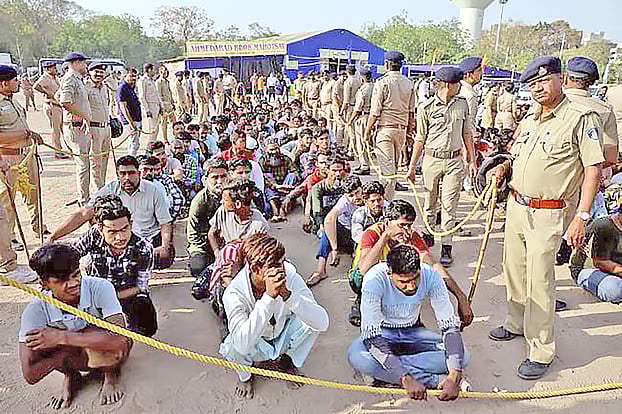
As the state assembly elections in West Bengal and Assam approach, the ruling BJP government in Delhi has begun forcibly pushing out Bengali-speaking Muslim minorities by labeling them as illegal immigrants. As a result, many Indian citizens have been, and continue to be, unjustly displaced and rendered stateless.
Mamata Banerjee's Trinamool Congress-led state government has, in several instances, intervened and successfully brought back individuals who had been forcibly pushed into Bangladesh.
There is no room to question that Bengali is the national language of Bangladesh. However, in the multilingual country of India, Bengali is also the principal language in the state of West Bengal. There are also significant Bengali-speaking populations in Assam, Tripura, and several other states.
Moreover, interstate migration for livelihood is not prohibited in India. Therefore, Bengali-speaking Indian citizens should enjoy equal rights like any other citizen in every state. Yet, the BJP's anti-Muslim political stance is increasingly creating a climate of fear for Bengali-speaking Muslims.
The political tactic of labeling Bengali-speaking Muslims as Bangladeshis is not new. When the BJP first came to power in India, then deputy prime minister and home minister LK Advani began claiming that there were 20 million illegal Bangladeshi immigrants in India who needed to be sent back to their country. At a press conference at India House in London, when I asked him for the source of that figure, he said it had been passed down from the previous government. However, no census or verification process ever substantiated the validity of that claim.
This ongoing practice in India of harassing Bengali-speaking Muslims by branding them as illegal immigrants clearly reveals the political agenda behind raising the issue of illegal infiltration. Even now, the BJP’s response to Mamata Banerjee’s protest reflects the politics of vote-bank strategy in a very apparent way.
Although Bangladesh’s foreign ministry has lodged formal protests with India on multiple occasions, the efforts have yielded little tangible outcome. The reality is that such diplomatic initiatives are unlikely to be effective within India’s current political landscape—particularly when the BJP seeks to exploit ‘nationalist’ sentiments in the run-up to key state elections in West Bengal and Assam.
The head of the BJP’s IT Cell, Amit Malviya, said: “The police are taking legal action against Bangladeshi infiltrators, yet the chief minister of West Bengal is using language as a weapon. All illegal Bangladeshi infiltrators and Rohingyas will be dealt with strictly in accordance with the law of the land. No political drama or vote-bank politics can stand in the way of protecting India’s sovereignty and national security.”
This time, Mamata Banerjee invoked the names of Rabindranath Tagore and Bankim Chandra Chattopadhyay. On social media, she wrote: “Bengali is our mother tongue—the language of Rabindranath Tagore and Swami Vivekananda, the language in which our national anthem and national song (the latter written by Bankim Chandra Chattopadhyay) were composed, the language spoken and written by crores of Indians, the language recognised and upheld by the Indian Constitution. And now, it is being described as a Bangladeshi language!”
On the 84th death anniversary of Rabindranath Tagore, Mamata Banerjee, speaking from Santiniketan, announced the beginning of a "movement against linguistic terrorism." She declared, “We will continue this struggle as long as this hatred against Bengali persists. In English, when a deceased person is dishonoured or their wishes are violated, it is said: ‘He must be turning in his grave.’ Is Rabindranath now writhing in pain for having composed India’s national anthem?”
For Bankim Chandra, the anguish might be even greater. It is often said that his ideals and philosophy form the foundation of Hindutva. The ultra-Hindutva organisation Rashtriya Swayamsevak Sangh (RSS), which has been banned multiple times, has made Bankim’s song “Vande Mataram” mandatory at all its events. This year marks the RSS’s 100th anniversary. And yet, in the same year, the very government that claims to uphold his ideals does not even recognise Bengali as one of India’s major languages.
While Bangladesh has long accused India of political interference, it has never responded in kind—and it is important that this principled stance be maintained. However, the ongoing harassment of Bengali speakers and the trend of forcibly sending Indian citizens to Bangladesh under the label of ‘illegal immigrants’ must be firmly rejected.
No matter how strongly Mamata Banerjee intensifies her movement to end the anti-Bengali repression, the push-in incidents at the border—where Bengali speakers are labeled as Bangladeshis and forcibly sent across—have not stopped. The government itself has acknowledged that the number of people forcibly sent to Bangladesh may exceed 2,000.
Bangladesh's foreign adviser, Touhid Hossain, has admitted that such incidents continue despite the existence of an agreed-upon process between the two countries for identifying and repatriating citizens.
He said, “There is an established procedure between the two countries for exchanging verified lists of individuals after proper identification. Any kind of push-in that bypasses this process is clearly a violation of the rules.”
On a previous occasion, adviser Touhid Hossain also acknowledged the occurrence of push-ins but claimed that preventing them entirely was not realistic. However, this response is not at all consistent with the seriousness of the actual situation.
The question arises: does our foreign ministry truly understand the significance of the growing anger among Bengali-speaking Indian political leaders over these forced repatriations? In BJP-ruled states and even at the national level, the harassment of Bengali-speaking Indian citizens has now reached a critical point.
On 16 July, while leading a protest march in Kolkata, chief minister Mamata Banerjee stated that nearly 2.2 million Bengali-speaking migrant workers are working across various parts of India with valid documentation, such as Aadhaar cards.
She then questioned, “Does the BJP have the right to harass Bengali-speaking people, arrest them, and deport them to Bangladesh? Isn’t West Bengal a part of India?”
Not only has the Indian government pushed Bengali speakers into Bangladesh, but it has also attempted to deport Rohingya refugees—who had taken shelter in India after fleeing Myanmar—by labeling them as Bangladeshis.
Although Bangladesh’s foreign ministry has lodged formal protests with India on multiple occasions, the efforts have yielded little tangible outcome. The reality is that such diplomatic initiatives are unlikely to be effective within India’s current political landscape—particularly when the BJP seeks to exploit ‘nationalist’ sentiments in the run-up to key state elections in West Bengal and Assam.
While Bangladesh has long accused India of political interference, it has never responded in kind—and it is important that this principled stance be maintained. However, the ongoing harassment of Bengali speakers and the trend of forcibly sending Indian citizens to Bangladesh under the label of ‘illegal immigrants’ must be firmly rejected.
Between 2003 and 2005, the then Bangladesh Rifles (BDR)—now the Border Guard Bangladesh (BGB)—implemented a 'push-back' policy. In addition to diplomatic protests, such a strategy should be reconsidered now as well.
The BGB must now be instructed to resist any illegal push-ins and to promptly and decisively send back individuals who are forcibly sent across the border—using any designated border checkpoint. Such actions would send a clear message to New Delhi: Bangladesh expects adherence to international norms, which include repatriation through proper verification of citizenship and consular cooperation.
* Kamal Ahmed is a journalist
*The views expressed are of the writer's own