Opinion
Election in Bangladesh, so why is India, US and Pakistan being discussed?
In Bangladeshi politics, alongside conflict and violence, there is also a long history of lobbying foreign diplomats and knocking on the doors of foreign embassies. A confrontational and self-destructive political culture has, at various times, opened the door to foreign intervention in our internal politics.
As elections approach, such activity intensifies more than at any other time. From the mass uprising of the 1990s to the student–people’s uprising of 2024, within the fragile democracy and the increasingly authoritarian 34-year two-party system in between, we have repeatedly seen the same patterns recur.
Names such as Óscar Fernández-Taranco (former UN Assistant Secretary-General for Political Affairs) and Sujata Singh (former Foreign Secretary of India) have cropped up in discussions. Domestic political problems have been taken to the United Nations, the Commonwealth, or the US embassy. Such realities have created a public perception that attaining power requires the backing of global or regional powers. It is in this context that endless speculation and debate arise over which party is aligned with which “foreign power.” This card is constantly played in election campaigns to undermine opponents.
The context of this election, however, is somewhat different. Awami League, ousted from power in the 2024 mass uprising, is unable to take part in the election. The contest is set to be between the BNP and an 11-party alliance led by Jamaat-e-Islami, its former coalition partner. In this election, there is no visible surge in direct appeals to, or overt intervention by, foreign diplomats and embassies. Yet the “long shadow of foreigners” looms large over the electoral arena. It is being signalled through video content by social media influencers and statements by political leaders.
Although the election is taking place on Bangladeshi soil, Delhi and Washington are powerfully present in the campaign arena. In addition, alongside Islamabad, Ankara has newly entered the discussions.
This election has essentially become a battle over narratives. Party manifestos no longer appear to be a priority for political parties. Instead, candidates are making direct populist promises as they move from constituency to constituency. But the main contest is about capturing voters’ minds through narrative-building. Social media influencers, synchronized messaging by party leaders, AI-generated deepfake videos and images, and bot armies -- these four have become the common weapons in the arsenal of narrative construction.
Two.
Just before the formal election campaign began on 22 January, a report was published in The Washington Post, “The US seems to be friends with Jamaat.” The report said US diplomats in Dhaka believe that Bangladesh Jamaat-e-Islami could achieve its “best-ever results” in terms of votes in the 13th parliamentary election. Based on this assessment surrounding the election, the United States is seeking to move toward “friendship” by strengthening relations with the Islamist party. Citing information from a record of US diplomats, the newspaper reported on increased contact and efforts by US diplomats to improve relations with the party.
Following the Washington Post report, poet and thinker Farhad Mazhar, responding to a question from journalists at an event in Dhaka, said he viewed this (US relations with Jamaat) as a dangerous warning sign. He said, “I believe that every political party in our country is connected with the United States in one way or another, some directly, some indirectly. First of all, I think that after the 5 August mass uprising, the constitutional counter-revolution has been internationally framed as a regime change in favour of the United States.”
Referring to Farhad Mazhar’s remarks, BNP Secretary General and parliamentary candidate for the Thakurgaon-1 constituency, Mirza Fakhrul Islam Alamgir, said at an election rally on 23 January, “A news report was published in the papers today. Farhad Mazhar, a distinguished philosopher, has said that there has been a secret understanding between Jamaat and America. This understanding is not at all good for Bangladesh. It will harm the country.”
Following the Washington Post report, the issue of the United States’ relations with Jamaat has been discussed in political circles and among the public, but the party has not issued any official statement, response or explanation. Ahsanul Mahbub, head of Jamaat’s publicity department, told the online news portal bdnews, “These are just observations by a newspaper and one of their journalists. The country’s situation cannot be fully reflected in a single report.” However, one of the party’s candidates, at an election rally, stated that “America also wants a Jamaat-led government.”
According to Prothom Alo, Sultan Ahmed, Jamaat-e-Islami’s candidate for Barguna-2 (Bamna–Patharghata–Betagi), said, “America does not want an Islamic party to lead the government in any country. But this time, even the US is relying on Jamaat-e-Islami to advance a corruption-free, inequality-free society in Bangladesh.”
After the election campaign began, on 25 January, Jamaat’s ameer held a courtesy meeting with the British High Commissioner Sarah Cook, and on 29 January with US Ambassador Brent Christensen and European union (EU) Ambassador Michael Miller. Regarding the meeting with the US ambassador, Jamaat’s verified Facebook page posted that the meeting was conducted in a very cordial and friendly atmosphere. The discussion covered the existing political and economic situation in Bangladesh, industry and trade, the upcoming 13th parliamentary election, state reforms, the Rohingya issue, and other topics.
On 31 January, Islamic Movement of Bangladesh ameer Syed Muhammad Rezaul Karim, in an election rally in Narsingdi, criticised Jamaat-e-Islami over seat-sharing disputes, saying, “They say one thing publicly but do another. In front of us, they say one thing, but in secret they hold meetings at the US embassy. They say one thing publicly and secretly meet with India. Meetings may happen, but why in secret? There is something hidden in that secrecy. The people of this country understand it.”
Three.
India has given unconditional support to Awami League. After the 2024 uprising, a portion of Awami League leaders and activists are based in India, participating in press conferences, online meetings, and other political activities. Naturally, India has become the most discussed topic in election campaigning and narrative-building. Long before the campaign began, some NCP members and social media influencers started creating narratives portraying the BNP as a “pro-India party.” There were even attempts to claim that the BNP chairman returned to the country after reaching an understanding with India.
On the first day of the election campaign, 22 January, Jamaat-e-Islami’s naib-e-ameer Syed Abdullah Muhammad Taher said that reports had emerged claiming the leader of a rival party signed a three-condition agreement with India. The next day, hinting at the BNP, he said that a party wants to come to power through a secret understanding with India, compromising Bangladesh to India for ruling the country.
Most recently, on 2 February, LDP chairman Colonel (Retd.) Oli Ahmed, a member of the Jamaat alliance, claimed to be the first rebel against Pakistan and said that the BNP is acting as a broker for India. While the BNP relies on India in the election field to corner opponents, Jamaat’s manifesto emphasizes establishing peaceful, friendly, and cooperative relations with India, Bhutan, Nepal, Myanmar, and neighboring and nearby countries on the basis of mutual respect and fairness.
Bangladesh is at another political crossroads. On 12 February, the country’s election is set to take place at a moment when the death knell of the world order that began after World War II has already sounded.
Four.
On social media, attempts are being made to create the narrative that the BNP is “pro-India” by spreading deepfake videos and AI-generated fake images. Last week, four images were circulated claiming that two BNP leaders met with Indian intelligence officials. An investigation by Rumor Scanner revealed that the circulated images depicting the BNP leaders’ meeting were fake. The images had been created using artificial intelligence (AI).
Even though narrative-building strategies were used in the election campaign to portray the BNP as a “pro-India party,” the BNP has been much more restrained on this issue. On 23 January, in an official statement, the BNP called Jamaat-e-Islami naib-e-ameer Syed Abdullah Muhammad Taher’s claims about an agreement with India political propaganda. The party stated that there is no evidence to support the allegation of any agreement between the BNP and India, calling it a baseless and deliberately misleading attempt.
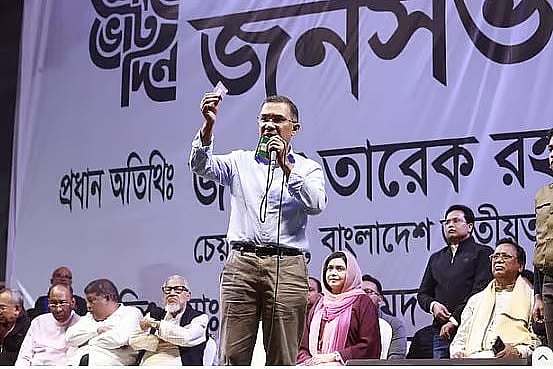
BNP chairman Tarique Rahman has not yet responded on this issue in his election campaign. In his first election rally, which started in Sylhet, he said, “It's neither about Delhi, nor Pindi, nor any other country. Bangladesh comes first. We believe that the people of this country are the source of all our political power.”
BNP’s election campaign is also highlighting Jamaat’s historical collaboration with the Pakistani army in 1971. On 2 February, at an election rally in Thakurgaon, BNP Secretary General Mirza Fakhrul Islam Alamgir said, “Jamaat-e-Islami obstructed the 1971 war. They did not cooperate with us in the Liberation War; instead, they aided the Pakistani army. Can we trust them to keep this country safe?”
Five.
Bangladesh is at another political crossroads. On 12 February, the country’s election is set to take place at a moment when the death knell of the world order that began after World War II has already sounded. Under Donald Trump’s leadership, the United States has clearly shown that there are no permanent allies. As a result, a unipolar world is now an undeniable reality replaced by a multipolar one. Our small territory is home to 180 million people.
The massive unemployment, widespread poverty, and the crisis of insufficient job creation provide enough “gunpowder” at any time to trigger a political explosion. Narrative-building and populist politics cannot offer real solutions to the real problems of people’s everyday lives.
* Manoj De is Assistant Editor, Prothom Alo
* The views expressed here are the author's own.