Opinion
Economy under the dark cloud of violent politics
The recent wave of violence has created deep anxiety in public life. The day after the Bangladesh Election Commission announced the schedule for the national election, on 12 December, young political leader Sharif Osman Hadi was shot by assailants in broad daylight. He later died while undergoing treatment in Singapore. Hadi’s killing sends a stark message, that expressing dissent has now become dangerous.
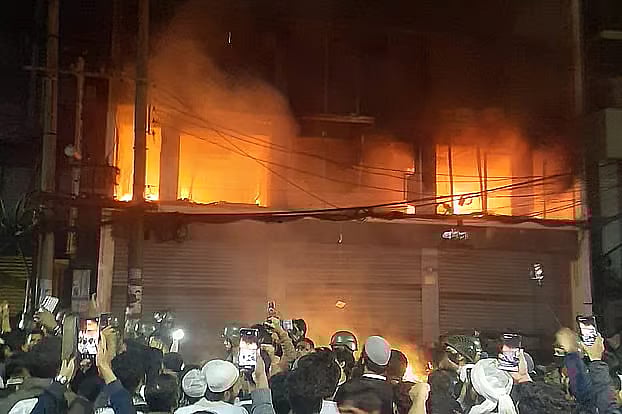
This is not confined to politics alone. Attacks on two leading newspapers and two cultural institutions, along with the public beating to death of a minority citizen, show that the social climate is increasingly being enveloped by violence and fear.
The attacks on The Daily Star and Prothom Alo were not merely assaults on their physical infrastructure. They were attacks on citizens’ rights to know, to question, and to hold dissenting views. A free press holds up a mirror to society. When that mirror is shattered, those in power no longer face scrutiny, and falsehoods spread easily.
Equally alarming are the attacks on cultural institutions such as Chhayanaut and Udichi. These institutions sustain tolerance, human dignity, and progressive values. Music, poetry, and art play a vital role in shaping our collective conscience. That is precisely why such institutions are often among the first targets.
Similarly, the lynching of garment worker Dipu Chandra Das in Mymensingh on allegations of religious insult, followed by the burning of his body, represents another extreme manifestation of intolerance, one in which people took the law into their own hands.
Taken together, these incidents are sending a message to the nation and to the world that intolerance is rising sharply and public security is weakening. A society that silences voices, suppresses culture, and fears difference may continue to exist in a functional sense, but it gradually loses its humanity, its confidence, and its hope for a better future.
These attacks have occurred at a time when Bangladesh is under an interim government formed in the aftermath of a mass uprising. The violence has deeply shaken the conscience of peace-loving and progressive citizens. In many countries, elections are accompanied by anxiety and conflict, and pre-election violence is not new in Bangladesh either. Yet the present situation is different.
Since the interim government assumed office in August 2024, law and order appear to have grown increasingly weak in the face of violence by sections of the public. Intimidation, vandalism, and the deterioration of public order have alarmingly become normal, routine occurrences. The central question now is no longer whether violence exists. Rather, it is why such violence continues under a government whose primary responsibility was to stabilise the country and ensure a credible electoral process.
The government’s weakness in maintaining law and order is deeply worrying, because it does not point to the absence of the state, but to a failure of its moral and institutional resolve.
Therefore, the core problem is not merely the presence of violence, but the response to it. In this regard, the government’s actions have been hesitant and inadequate. Statements have been issued and assurances given, yet visible results have been extremely limited. The lack of progress in arresting the killers of Osman Hadi has further reinforced the perception of institutional paralysis.
Yet the state apparatus does have the capacity to function effectively. Bangladesh possesses capable institutions and experienced administrators. The central challenge, therefore, is one of political will.
The anxiety that now pervades public life in Bangladesh is not rooted in politics alone; it is deeply embedded in everyday economic hardship. For millions of families, the real struggle is not who holds power, but how to survive amid rising prices and shrinking opportunities. Although food inflation has eased somewhat for higher-income groups, it remains severe for low- and middle-income households. The costs of rice, edible oil, vegetables, transport, rent, education, and healthcare are consuming the bulk of family incomes. For wage-dependent workers and small traders, whose earnings have failed to keep pace with inflation, life is becoming increasingly uncertain.
Private investment remains weak. In October 2025, credit flow to the private sector fell to a record low of 6.23 percent, reflecting the persistent weakness in investment. Amid high business costs and uncertainty, domestic investors are focusing on survival rather than expansion plans
In August 2024, the interim government took several decisive steps to rescue the economy from the fragile state left by the previous administration. For this, the government deserves due credit. However, deep scars still remain in the economy. For example, reform efforts are ongoing to restore discipline in the banking sector and to strengthen foreign exchange reserves.
The external sector has shown improvement: compared with fiscal year 2024, exports, imports, and remittance inflows have all increased. Foreign exchange reserves, after a period of continuous decline, have rebounded to USD 27.88 billion as of 18 December 2025, up from USD 19.95 billion on the same date in 2024.
Yet, due to low growth, high inflation, and weak investment, the economy has not fully recovered. Although average inflation fell from 11.38 per cent in November 2024 to 8.29 per cent in November 2025, the prices of essential goods remain high relative to incomes. Even with official statistics suggesting improvement, daily life has not become easier for many because wages have not increased. In November 2025, wage growth stagnated at 8.04 per cent, down from 8.1 per cent in November 2024, placing further pressure on household purchasing power.
The employment situation is also concerning. Job creation in the formal sector has been slow, while informal and short-term work has increased. Many organizations are avoiding permanent hiring, and partial unemployment has become widespread. Among young people aged 15–29, over 20 per cent are outside education, employment, or training (NEET), reflecting deep pressure on the labour market. For young entrants, securing stable and dignified employment is increasingly difficult, fueling frustration and social tension.
Private investment remains weak. In October 2025, credit flow to the private sector fell to a record low of 6.23 percent, reflecting the persistent weakness in investment. Amid high business costs and uncertainty, domestic investors are focusing on survival rather than expansion plans. Foreign direct investment (FDI) remains limited at less than one percent of GDP, with both new and existing investors taking a cautious stance. This is deeply worrying because Bangladesh needs investment to diversify its economy and generate high-quality employment.
The current situation sends a message to the world. Bangladesh is widely recognised for its economic resilience and development achievements. However, images of mob violence and uncertainty in governance are causing concern among international partners and investors. In an interconnected world, political stability cannot be separated from economic credibility. How Bangladesh navigates this moment will shape international perceptions in the coming months.
Therefore, the path forward must be based on political responsibility and economic prudence. What is now at risk are public trust and citizen security. People want to feel that the state stands firmly by their side, that their safety matters, that the law applies equally to all, and that no one is above accountability. At a time when the country awaits a democratic transition through the elections scheduled for 12 February 2026, the interim government’s immediate priority should be to restore law and order to protect citizens.
* Fahmida Khatun is Executive Director, Centre for Policy Dialogue (CPD)
* The opinions expressed are those of the author.