Iftekharuzzaman's opinion
Do not legitimise extortion: Prioritise party integrity from the start
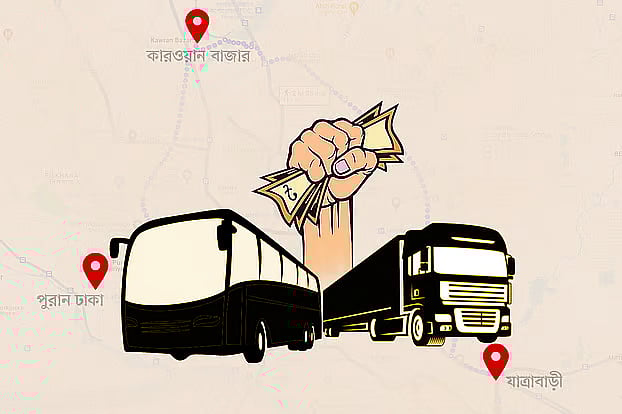
By describing extortion on the roads as a “negotiated transaction,” the new government’s transport minister has sought to find a justification to legitimise a deeply unethical practice, one for which it is difficult to find adequate words of condemnation and concern.
No matter how extortion is framed, whether as a negotiated arrangement or anything else, in reality, as reflected in the transport minister’s own remarks, it can be seen as nothing but an attempt to normalise the abuse of party power, corruption, and various forms of illegality.
The question is, if extortion on the roads is granted acceptability under the guise of “negotiation,” how will the continued application and spread of this same logic be controlled across other sectors such as BRTA, health, education, social protection, law enforcement, the judiciary, passports, land administration as well as government procurement, development projects, banking, electricity, and beyond?
The current government should not forget that in February 2012, based on the same rationale, the transport minister of the then fallen authoritarian government also took steps to legitimise extortion on the roads. For the same reasons that prompted us to strongly protest and condemn that move as self-destructive, we are once again disheartened by the same concerns.
Extortion on the roads has flourished under the protection of politically backed transport owners’ and workers’ associations, along with segments of the police, local administration, and elected representatives. As a result, the public has effectively been held hostage by syndicates of professional partisan enforcers and grabbers. This has not only enabled extortion but has also fostered impunity for all kinds of wrongdoing on roads and highways, including fatal accidents.
We make a special appeal to the honourable prime minister to uphold the expectations already formed among the people, and to ensure full public confidence in the plans he has announced
In protest, the unprecedented movement of school and college students was met with violent force and repression by the authoritarian government, which gradually escalated into the horrors of the July uprising. The people of the country do not, under any circumstances, wish to be driven down that same path of catastrophe again. Nor do we wish to believe that a government elected with an overwhelming mandate, carrying the weight of immense public expectations forged through bloodshed, would allow such a situation to arise.
In line with the ruling party’s 31-point framework for repairing the state structure, and the anti-corruption commitments made in the latest election manifesto and in the Prime Minister’s first address to the nation, it is imperative that these pledges do not turn into empty rhetoric. To that end, the government should immediately and unequivocally reject the transport minister’s position and ensure exemplary accountability. It must be remembered that, following the fall of authoritarian rule, the country has witnessed a widespread transfer of control over extortion, partisanship, and illegal occupation. There is little doubt that the minister’s stance is not an isolated issue.
We make a special appeal to the honourable prime minister to uphold the expectations already formed among the people, and to ensure full public confidence in the plans he has announced, as well as in the clear anti-corruption commitments made in his party’s election manifesto and his first address to the nation. He must give the highest priority to internal party integrity and reform, in order to prevent sections of his own party from taking a self-destructive path.
Otherwise, no commitment will be effectively implemented, and the public will become disillusioned. This, in turn, will create opportunities for forces that, under the guise of alternatives, promote ideologies, doctrines, and objectives that are fundamentally at odds with the core spirit and identity of Bangladesh, nurtured through the sacrifices of 1952, 1971, and 2024. The people have already had bitter experiences of such forces during the tenure of the interim government and around the recent election. Every misstep by the government will only facilitate their further rise. The time to set the government’s highest priorities correctly is now.
* Iftekharuzzaman is Executive Director, Transparency International Bangladesh (TIB)
* The views expressed here are the author’s own.