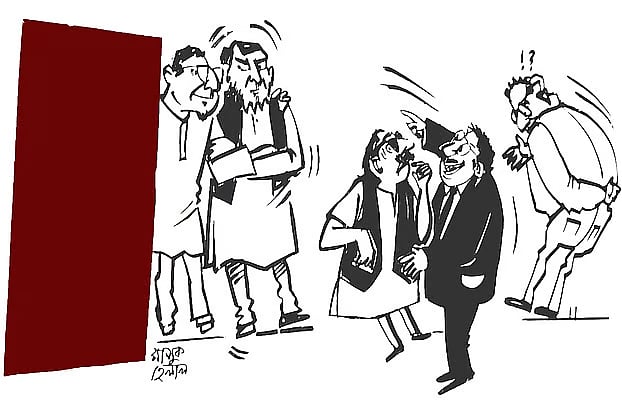
The second anniversary of the 2024 mass uprising is still some way off and already the air is already thick with talk of the ousted party’s return. From village tea stalls to city street corners, the subject keeps resurfacing in conversations. The unease is most visible among those who helped bring the party down, as well as among those who wanted it banned or welcomed its prohibition. In many circles, the debate has turned into a blame game, with everyone pointing fingers at each other.
Curiously, the party itself has no official representation in this national ‘talk of the town.’ As a banned organisation, you won’t see any of their representatives appearing on television talk shows or speaking publicly under their own banner. For now, no media outlet seems to be willing to take that risk. Legal complications remain, so does the fear of public backlash.
Yet the discussions have not subsided. If anything, they have grown louder. On Facebook and beyond, speculation, arguments and rumours are circulating with remarkable intensity. The question is: where is this talk coming from? Is it driven by genuine public fear, by a wavering of political conviction? Or is it a carefully crafted narrative pushed by others?
Before the wounds of the uprising have healed, before justice has been served, before any meaningful arrangement for coexistence has emerged, is such a return really possible?
What is impossible to ignore
Bangladesh has already seen two governments in quick succession. Yet the fire of ‘36th July’ hasn't gone out. In moments as charged as these, it is nearly impossible to have an objective discussion. Such discussions require a healthy distance and detachment in terms of time, place and perspective—conditions that are not possible for us to meet for now.
Those who witnessed the mass uprising, were filled with hope, later became disillusioned by its outcome or were angered by the injustices before and after it, are likely to remain under its influence for a long time. For such a civic space, maintaining a fully neutral conversation on the matter is difficult. Hearing the unvarnished truth is a bitter pill most are not ready to swallow.
Yet, when a political question begins to dominate public conversation, very few can ignore it. The question of the ousted party’s return—whether as an organisation or through individuals—is now that debate.
As time passes, the discussion will likely spread from neighbourhood gatherings and tea stalls to wider circles, perhaps even reaching the capital market. And there is little choice but to engage with it. We seem to have entered such a turbulent phase of political evolution—one marked by deep uncertainty and far-reaching unpredictability.
A maze of rumours and the reality of the street
A starting point for any discussion on this issue is a simple question—Is the party at the centre of so much debate even capable of returning to the political stage? Does it still retain the organisational strength to do so? Or moral authority or ideological clarity?
We do not really have reliable electoral data to measure their organisational strength. There is no clear picture of their support base. For a decade and a half, they did not allow fully free elections to take place under its watch. They could not even participate in the most recent election. So, any assessment of its organisational capacity is, at best, speculative and incomplete.
In the last two years, they haven’t managed a single large-scale rally or march. If they had the capacity or the desperation to return, we surely would have seen it by now.
There is a world of difference between making a noise on social media and showing real influence on the ground. However, the one thing we cannot ignore is the massive crowds at the funerals of their leaders. From Chattogram to Thakurgaon, these recent gatherings have been huge. That, undoubtedly, carries a message.
Bangladesh’s political history has shown that a party can survive on raw emotion even if its ideology is weak. Look at the Jatiya Party in 1991. Only three months after ousting a general who had seized power illegally, the same public that cheered his fall handed him five seats in parliament.
It is still unclear whether the recently ousted party is trying to rely on emotion, ideology, or both. Ideological strength comes from reflecting social demand or offering a credible vision of a better society. Do they currently have any such political offering at all?
Even after a total collapse, a party can find its way back—but only if it can reinvent itself to match what society actually hungers for. You need a ‘magnetic’ pull, an ideology that can still draw in the hearts of the young.
But over the last two years, has the ousted party been able to present any such message capable of appealing to a younger generation? Have they offered a single honest answer for the grievances that set the public on fire?
Although a controversial trade agreement back in February 2025, filled with obligations, did provide the party some room to advance a narrative of conspiracy. Beyond that, however, the accumulation of failures and broken trust over the past 23–24 months has itself become a political asset of sorts. The willingness to push ahead without undertaking ‘reform’ on one side, and the determination to return on the other—Bangladesh appears to be moving between these two impulses.
Then there is the weight of history. Part of their plan is a return to the glory of independence and the Liberation War. But many wonder: do they still have the ‘social capital’ for a political return?
The pride of 55 years ago has been traded and sold so many times that it has been gutted of its value. For whatever reason, the appeal of 1971 is no longer what it once was to Gen-Z, indicating a persistently unfavourable situation for the ousted party.
Politics here does not always behave like religion, bound by fixed loyalty. The way people assess past and present is often fluid and shifting
In the end, when a traveler trips and falls flat on his face, he must look at the ground and ask why he fell. But if the traveler trips over his own shoes and chooses to blame the ‘evil eye’ of a stranger for his misfortune instead—then it’s a problem.
In the decade and a half leading up to 2024, many are now asking whether there were causes of public dissatisfaction and anger in areas such as education, administration, the economy, foreign policy, freedom of expression and even the everyday use of language. Some are even suggesting that the former rulers should prepare their own ‘report card’ of that period.
But if such a report card is built only on the opinions of supporters, escaping the current maze of political narratives would be difficult. However, the question is, within those former rulers the moral confidence or internal drive exists to conduct an honest, independent social audit of their own record? Has Bangladesh seen any indication of that so far?
At the same time, it is also said that Bengalis are a forgetful nation. Politics here does not always behave like religion, bound by fixed loyalty. The way people assess past and present is often fluid and shifting. Those who once embraced ‘Haq Sahib’ with deep affection in 1946 later turned away from him and embraced the Muslim League. Then, just eight years later, they rejected the same Muslim League so decisively that it virtually disappeared from the political landscape of Bengal. In both moments, new forces and new calls replaced the old.
Now, after the ‘Red July,’ has the underlying structure of public preference and rejection been truly shifted for good?
‘Truth and Healing’
Since 2024, the right-wing tide has been impossible to ignore. If this is what a large part of the public wants, domestic and international political actors will, in their own way, recognise it, align with it and seek to use it for their own interests. But if wrongdoing carried out in the name of ‘democracy’ has pushed society to swing 180 degrees the other way, what comes next? will older, unprocessed political forces step in to fill the vacuum? Is there even a vacuum calling them?
At the same time, it is also true that the rise of the right will inevitably create a demand for liberal political space within society. The way several police cars were sent to Brahmanbaria just to stop a simple movie screening makes it clear—BNP is not going to satisfy the hunger for liberal politics. For a large part of the middle class, this is a situation of discomfort and despair. They may be small in size but they play a powerful role in shaping opinion in this country. Whether they are now feeling a political and organizational void is a question worth investigating.
But there is no certain assurance in the archives of history that the ones ousted in 2024 will fill such a void. Rather, their attempt to rise creates anxiety among the forces at the center of power and those around it. It will create an atmosphere of conflict. For valid reasons, the question of the return of the ousted party or any of its leaders brings the fear of violence. International attention toward Bangladesh will also turn negative.
Whether this looming conflict becomes the main struggle of Bangladeshi politics is also making investors at home and abroad think. Thinking of these things, investors still have their hands folded.
In such a political environment, it is difficult at this point to predict whether the current ruling party will remain firmly in control. The debate and tension surrounding the return of the defeated forces may become a trap for those in power—or it could be like the story of the shepherd boy who cried "wolf" over and over.
If economic restructuring is delayed, if the tax burden in the budget increases, if repeated fuel price hikes make inflation unbearable and if the long-standing trend of rising unemployment does not ease, public sentiment may shift once again. High expectations mean high risks. ‘36 July’ has already created a significant risk for the current rulers. If the gap between expectations and delivery continues to widen, there is no reason for the ousted forces not to take advantage of it.
The people of this country are like the silt of its rivers. Carried by rivers, floods or wind, silt easily moves from one place to another, forming new ground as they go. This silt doesn''t stick together easily, the currents of water or air wash it away. And now, with the excessive use of urea and sulfur, the acidity of this soil has grown. Bangladesh’s politics is exactly like the land it stands on.
To reduce this acidity, those who use the land must rethink their ways. Just as soil acidity kills the tiny life-forms in the soil, political ‘acidity’ erodes the social fabric, kills the spirit of a society.
At the very beginning of their 39-page manifesto, the BNP spoke of forming a ‘Truth and Healing Commission.’ It was an indication of a commitment to softening the political terrain. It reflected a centrist understanding within Tarique Rahman’s political approach. Now, will the ruling party move forward with that promise now?
For the sake of the economy, we must find ways to avoid political conflict and it is better to find them before the signs of violence appear. Bangladesh desperately needs a peaceful way to move past the trauma of its historical injustices.
But look at the numbers. Quoting a non-government organisation, the media reports that even in May, 53 unidentified bodies were recovered and 32 people died in various acts of terror. Is there no escape for Bangladesh from the hunt of this trauma? Will the country simply keep returning to the same old arrangements again and again?
Unless the ‘new’ performers do well, how else can we stop the ‘old’ from returning? The sense of helplessness among citizens right now is something entirely new. There isn't even a decent opposition in the country. Fuel prices rise again and again, yet everywhere, the atmosphere remains strangely quiet. What a strange, unprecedented predicament!
* Altaf Parvez is a researcher and political analyst.
* The views expressed here are the writer’s own
*The article appeared in Bangla in Prothom Alo print and online and has been translated for English Online by Ayesha Waresa.