Opinion
When medicines become pollution: Bangladesh’s rivers face pharmaceutical crisis
Bangladesh has every reason to celebrate the remarkable growth of its pharmaceutical industry. The sector has become an important pillar of the national economy, supplying medicines to millions of people at home and increasingly reaching international markets.
But there is a question we have not asked loudly enough: What happens to the medicine after it leaves the factory, the pharmacy, or the hospital?
If pharmaceutical waste is allowed to enter our rivers, canals, lakes, and groundwater, a product designed to protect human life can become a source of environmental contamination and a threat to public health.
This is the uncomfortable side of Bangladesh’s pharmaceutical success story.
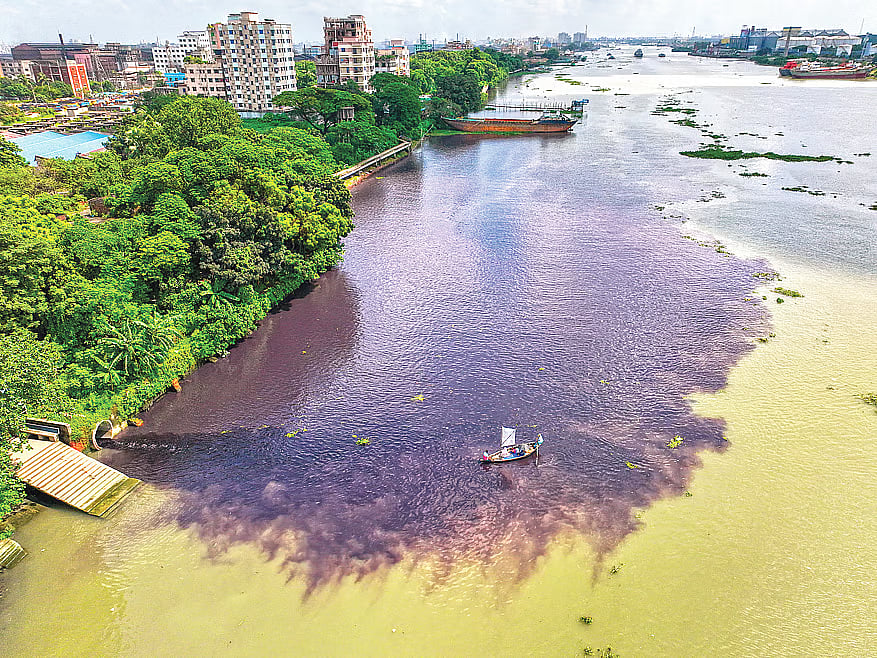
Pharmaceutical pollution is largely invisible. Unlike plastic waste floating on a river or black industrial sludge entering a canal, pharmaceutical residues may be impossible to see, smell or taste. Yet they can remain biologically active in the environment. Antibiotics, hormones, anti-inflammatory drugs and other active pharmaceutical ingredients can interact with aquatic organisms and microorganisms long after they have been discharged.
The problem deserves far greater attention from policymakers, regulators, manufacturers, healthcare institutions and the public.
Bangladesh’s rivers are becoming chemical laboratories
Pharmaceutical contamination is not a theoretical possibility in Bangladesh. Research has already detected pharmaceutical compounds in Bangladeshi river water. A study of the Old Brahmaputra, for example, investigated 12 pharmaceuticals, including 11 antibiotics and one antiepileptic drug, and detected nine compounds in surface-water samples. (PubMed)
More recent research has added another layer of concern.
A 2026 study examining water sources in Gazipur found pharmaceutical compounds and heavy metals in hospital wastewater, pharmaceutical-industry effluents, municipal wastewater and river water. Metronidazole was detected in municipal wastewater and river samples, while lead and copper were particularly prominent in pharmaceutical-industry effluent. The researchers concluded that stronger regulatory measures were urgently needed. (ScienceDirect)
These findings should serve as a warning.
Bangladesh already has some of the most heavily polluted urban and industrial waterways in the region. Adding biologically active pharmaceutical residues to this burden could make the ecological consequences even more complex.
The pollution starts at the factory
The first major source is pharmaceutical manufacturing.
Drug production can generate wastewater containing active pharmaceutical ingredients, solvents, chemical intermediates and, depending on the process, metals and other contaminants. Where effluent-treatment systems are absent, inadequate or poorly operated, these substances can enter surrounding waterways.
The original assessment for this article highlighted the risks associated with pharmaceutical manufacturing waste, including APIs and other toxic chemicals entering water bodies.
This is where environmental regulation must move beyond paperwork.
An effluent-treatment plant existing on a factory premises does not necessarily mean that the wastewater leaving the premises is safe. What matters is whether the system is properly designed for the pollutants being generated, whether it is operated continuously and whether regulators independently verify the quality of the discharge.
A treatment system that cannot remove biologically active pharmaceutical compounds is not an adequate solution simply because it has been installed.
The dangerous journey of discarded medicines
The second source is much closer to our homes.
Unused and expired medicines are frequently discarded with household waste or flushed down toilets and sinks. Inadequate public awareness and the absence of convenient medicine take-back systems make this problem worse.
Once pharmaceutical products enter sewage systems, they may eventually reach rivers and other water bodies, particularly where wastewater treatment is inadequate.
The solution cannot simply be to tell citizens, do not flush your medicines.
The government and pharmaceutical industry must provide an alternative.
Every major pharmacy and healthcare facility should eventually become part of a national medicine take-back system where citizens can safely return unused and expired medicines.
If Bangladesh can build nationwide systems for distributing medicines, it should also be capable of building a system for collecting medicines that are no longer needed.
Hospitals cannot be ignored
Healthcare facilities are another important source of pharmaceutical waste. Hospitals and clinics use large quantities of antibiotics, painkillers, hormones, cancer medicines and other pharmaceutical products. Some medicines inevitably become expired, unused or contaminated. Without proper segregation, collection, treatment and disposal, pharmaceutical waste can enter general healthcare waste streams and eventually reach wastewater systems and surface waters.
The problem is particularly serious because hospitals are also places where antibiotic-resistant organisms may be present.
WHO has repeatedly emphasised that wastewater and poor waste management are important components of the global antimicrobial-resistance problem. Antimicrobial compounds, resistant organisms and resistance genes can enter wastewater from households, healthcare facilities, agriculture and antimicrobial manufacturing. (World Health Organization)
This means pharmaceutical pollution must no longer be treated as an isolated environmental issue.
It is a One Health issue, connecting human health, animal health and the environment.
The antibiotic resistance time bomb
Perhaps the most dangerous dimension of pharmaceutical pollution is antimicrobial resistance, or AMR.
Antibiotics are designed to kill or inhibit bacteria. When antibiotic residues enter the environment, they can create conditions that favour the survival and proliferation of resistant organisms.
WHO has warned that antimicrobial manufacturing, hospitals and other sources can release antimicrobial compounds into the environment, potentially contributing to the emergence and spread of drug-resistant organisms. (World Health Organization)
Bangladesh now has disturbing evidence of this environmental pathway.
A study published in 2026 examined E. coli from effluent-treatment plants and nearby environmental water around six pharmaceutical sites in Dhaka. The researchers found substantial multidrug resistance among the isolates and identified clinically important resistance genes, including blaNDM, blaTEM and blaCTX-M.
Environmental isolates also carried virulence-associated genes. The study concluded that pharmaceutical wastewater can act as an important reservoir for multidrug-resistant bacteria and called for stronger wastewater regulation and One Health-based AMR surveillance. (PubMed Central (PMC))
This should alarm us.
An antibiotic factory should never become a breeding ground for bacteria capable of resisting antibiotics.
What happens beneath the surface?
Pharmaceutical pollution can affect aquatic ecosystems in ways that are not immediately visible.
Some pharmaceutical compounds can interfere with the endocrine systems of fish and other aquatic organisms. Hormonal substances can potentially influence reproduction, development and behaviour. Other pharmaceutical residues can affect microorganisms and alter ecological relationships.
The original assessment also highlighted concerns over endocrine disruption, changes in reproductive behaviour, biodiversity impacts and movement of contaminants through aquatic food webs.
The concern becomes greater when pharmaceutical contamination occurs together with heavy metals, industrial chemicals, plastics and other pollutants.
Bangladesh’s rivers are not exposed to one contaminant at a time. They receive mixtures.
That makes the environmental consequences harder to predict and potentially more serious.
The fish we eat may become part of the problem
Bangladesh is a country of rivers and fish. Millions of people depend on fish for food, nutrition and livelihoods. Fishing communities living along polluted rivers are particularly vulnerable because environmental degradation can simultaneously threaten their health and income.
The original assessment raised concerns about contaminants, including cadmium and lead, in fish from the Buriganga and the potential implications for communities dependent on river fish.
This illustrates a broader principle: Pollution does not remain where it is discharged. A chemical entering a river can move into sediment, microorganisms, aquatic plants and fish. From there, it can move through the food chain. The river therefore becomes a pathway connecting industrial activity to human exposure.
The Buriganga must become a warning, not a sacrifice zone
The Buriganga is already one of Bangladesh’s most powerful symbols of environmental degradation.
But the lesson of the Buriganga should not be that rivers are disposable.
It should be that economic development without environmental accountability ultimately imposes its costs on society.
The same warning applies to the Turag, Shitalakshya, Balu, Dhaleshwari, Bangshi and other rivers and waterways around industrial and urban centres.
Recent research in Gazipur and Narayanganj has again demonstrated serious contamination concerns in surface waters affected by pharmaceutical effluents, including heavy metals. (Nature)
Bangladesh cannot afford to wait for every river to reach the condition of the Buriganga before taking action.
What must Bangladesh do?
The country needs a dedicated and enforceable National Pharmaceutical Waste Management Framework.
First, pharmaceutical manufacturers must be required to identify and monitor pharmaceutical residues in their wastewater, rather than relying only on conventional parameters used for general industrial effluent.
Second, environmental regulators should conduct independent and unannounced inspections and require continuous or periodic third-party verification of effluent quality.
Third, pharmaceutical manufacturing facilities should be required to publicly demonstrate compliance with appropriate wastewater standards.
Fourth, Bangladesh needs a nationwide medicine take-back programme involving pharmacies, hospitals and pharmaceutical companies. Citizens should have an easy way to return unused and expired medicines.
Fifth, hospitals and clinics must establish dedicated pharmaceutical-waste segregation and disposal systems.
Sixth, environmental surveillance should be integrated with Bangladesh’s national antimicrobial-resistance strategy. WHO guidance already recognises wastewater and environmental surveillance as important components of AMR prevention. (World Health Organization)
Seventh, universities and research institutions should be supported to monitor pharmaceuticals, antibiotic-resistance genes, resistant bacteria and other emerging contaminants in rivers, sediments, fish and wastewater.
And finally, the pharmaceutical industry itself must take leadership.
Industry growth must come with environmental responsibility
There is no contradiction between a successful pharmaceutical industry and a clean environment.
In fact, Bangladesh’s pharmaceutical sector has an opportunity to demonstrate that economic growth and environmental responsibility can move together.
The industry should invest in cleaner production, advanced wastewater treatment, pollution prevention, safer chemical management and transparent environmental reporting.
Corporate responsibility cannot stop at producing a quality medicine.
It must extend to the entire life cycle of that medicine.
The principle should be straightforward:
If a company produces a biologically active chemical product, it must also accept responsibility for preventing that product from becoming an environmental contaminant.
We cannot cure disease by creating another one
Bangladesh needs medicines. We need hospitals. We need pharmaceutical innovation. We need a strong domestic pharmaceutical industry.
But we also need living rivers.
The choice is not between public health and environmental protection. The two are inseparable.
A polluted river can undermine public health. Contaminated water can damage fisheries and livelihoods. Antibiotic pollution can contribute to antimicrobial resistance. Chemical contamination can threaten biodiversity and ecosystem services.
The cost of prevention is almost always lower than the cost of ecological restoration and public-health damage.
Bangladesh has already spent decades trying to clean polluted rivers. We should not repeat the same mistake with pharmaceutical contamination.
The country now has sufficient evidence to act.
Research has detected pharmaceutical residues in Bangladeshi waters. Recent studies have identified pharmaceutical and heavy-metal contamination in areas affected by pharmaceutical activities. New evidence is also connecting pharmaceutical wastewater with multidrug-resistant bacteria in Dhaka. (ScienceDirect)
The warning signs are here. What is missing is the urgency. A medicine should heal. It should never become a pollutant.
Bangladesh must ensure that the success of its pharmaceutical industry is not measured only by the number of medicines produced or exported, but also by how responsibly those medicines are manufactured, used, and ultimately discarded.
Our rivers are not drains for industry. They are living ecosystems. They are fisheries, livelihoods, food sources and part of our national heritage. We must protect them before pharmaceutical pollution becomes another invisible environmental crisis that we regret not confronting sooner.
* Prof. Dr. Shahriar Hossain is an Environmental Scientist, Researcher, and Environmental Policy Advocate
* The views expressed here are those of the author.