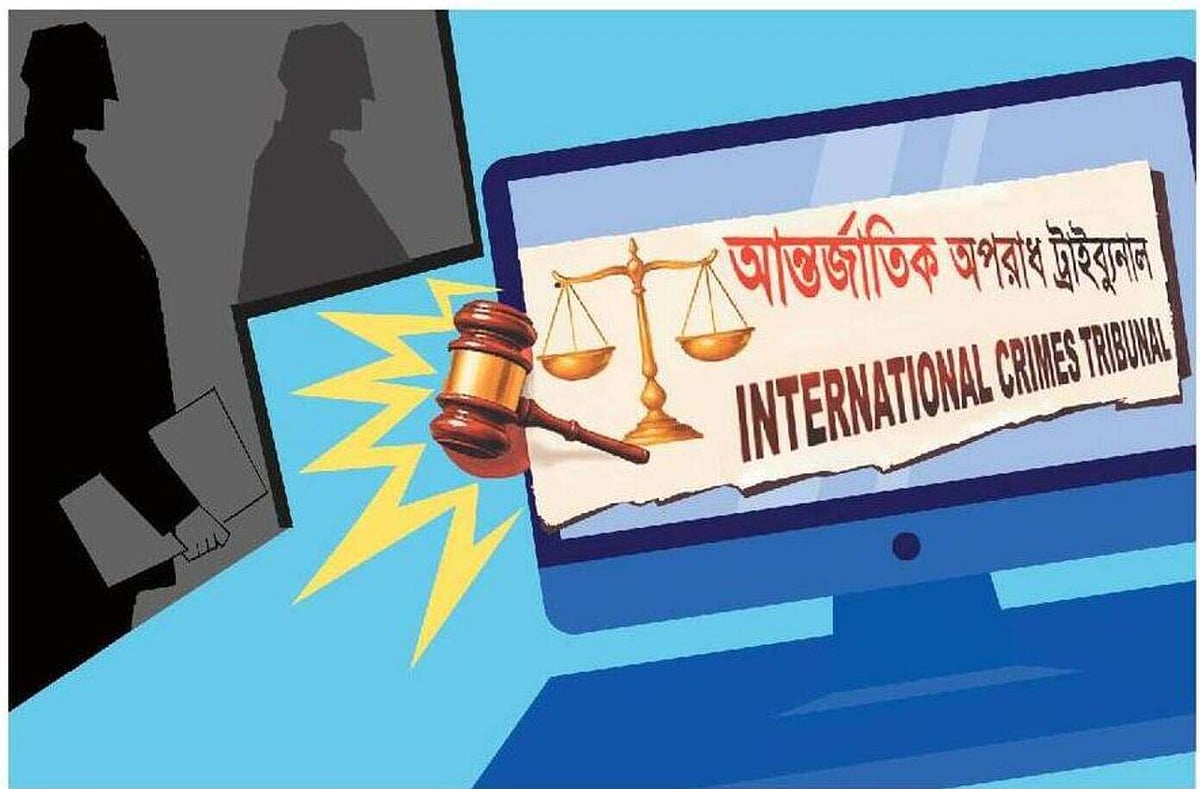
Several provisions of the International Crimes (Tribunals) Act, 1973 have been amended to ensure that the law is up to date for the trial of crimes against humanity committed during the July uprising. In continuation of this process, on 6 October, the law ministry issued a gazette notification adding a new section, 20C, following section 20B of the Act.
According to sub-section (1) of this new section, once a formal charge is submitted against any individual at the International Crimes Tribunal (ICT) for crimes against humanity committed during the July mass uprising, that person will be barred from contesting national or local government elections. That person will also be ineligible for any government employment. However, it also states that if the person is discharged or acquitted by the Tribunal, this provision will not apply to them.
Another important development has emerged at the same time: the investigation agency of the Tribunal has formally initiated an investigation into alleged crimes against humanity committed by the Awami League as a political party during the same period. ICT chief prosecutor Mohammad Tajul Islam has stated, “An officer has already been assigned to investigate the complaint. If names from other parties come up during the investigation, action will also be taken against them.”
Both the amendment to the 1973 Act and the initiation of an investigation into the Awami League as a party carry significant legal and political implications that warrant serious discussion.
According to this principle, every person accused of a crime is presumed innocent until proven guilty beyond reasonable doubt. This means that if the allegation cannot be proven beyond doubt, the accused must be acquitted.
Amending a law to make it time-befitting is part of the normal legal process. However, the particular section of the new amendment that requires attention is the provision that bars an accused individual from contesting in elections or holding government jobs solely upon the submission of a formal charge, even before conviction.
Let’s look at what the original 1973 Act says about verdicts and sentencing. Under Section 20(1), the Tribunal must state the reasons behind its decision regarding an accused person’s guilt or innocence. Section 20(2) states that only after a conviction, the Tribunal may impose the death penalty or any other punishment deemed just and appropriate, in proportion to the severity of the crime. In other words, a person may only be punished if the charges against them are proven.
Not only that, the reasons supporting the proof of the allegations must also be stated. The newly amended Section 20C clearly conflicts with the previously existing Sections 20(1) and 20(2), because it proposes the imposition of punishment even before the allegations are proven.
In addition to being inconsistent with other provisions of the same law, the amended section also contradicts a fundamental legal principle known as the presumption of innocence. According to this principle, every person accused of a crime is presumed innocent until proven guilty beyond reasonable doubt. This means that if the allegation cannot be proven beyond doubt, the accused must be acquitted.
Furthermore, Article 66 of the Rome Statute of the International Criminal Court also enshrines this principle. Likewise, Article 14(2) of the International Covenant on Civil and Political Rights (ICCPR) and Article 11(1) of the Universal Declaration of Human Rights (UDHR) recognise the presumption of innocence as a fundamental human right.
However, the recent amendment to the 1973 Act seems to imply that the mere filing of charges is sufficient to presume guilt and impose punishment.
Bangladesh ratified the ICCPR in 2000 and has also pledged adherence to the principles of the UDHR. This principle is also a core component of International Humanitarian Law (IHL). Therefore, both legally and morally, Bangladesh is obligated to uphold the presumption of innocence.
If we look at the Constitution of Bangladesh, it contains provisions prohibiting the imposition of new penalties retroactively. According to Article 35(1) of the Constitution, no person shall be subjected to a penalty greater than, or different from, that which might have been inflicted under the law in force at the time of the commission of the offence.
Additionally, under Article 26(1), any law that is inconsistent with the provisions of this part of the Constitution shall be declared void. In essence, the Constitution prohibits imposing a punishment that is different from or greater than what was applicable at the time the offense was committed. The supremacy of the Constitution, as enshrined in Article 26(1), protects this principle.
However, the recent amendment to the 1973 Act seems to imply that the mere filing of charges is sufficient to presume guilt and impose punishment. But if, after the judicial process, it is proven that an accused individual is innocent, and yet was already punished under Section 20C, this would be both legally unjustifiable and a violation of human rights. Or is it being assumed here that any accused person is inevitably guilty? If so, that would be a clear example of miscarriage of justice.
There is ample reason to believe that this amendment to the 1973 Act has a political backdrop. It is fairly evident that the addition of this new provision is linked to the upcoming national elections. However, this is not the first time that laws have been used for political purposes. The people of Bangladesh have witnessed similar politicisation of the law under previous governments as well. So, has the spirit of the “new settlement” following the uprising faded in just one year? And once again, are the people of Bangladesh unable to escape this vicious cycle?
In conclusion, given the recent focus on inclusive and participatory elections, it is worth questioning whether the legal amendment, which disqualifies accused individuals from contesting elections, and the initiation of a formal investigation into the Awami League as a party are merely coincidental.
Notably, the chief prosecutor has hinted that investigations into other political parties may follow in the future. If these actions are indeed being driven by election-related motives, then such politically influenced legal decisions could, in time, lead the caretaker government itself to be held accountable before the public.
* Umme Wara is associate Professor, Department of Criminology, University of Dhaka
* The views expressed are the author’s own.