Opinion
Whose streets, whose faith? The fight over Bangladesh’s public sphere
A Hindu youth was beaten to death and burned in the name of “defending faith”. A Baul singer hounded by crowds until the police detained him “for his own safety”. A grave was dug up, and the body was burned on a highway. Women’s football matches stopped. A film star’s programme was forced to run without her. Shrines attacked. Newspaper offices set on fire.
Taken separately, each of these looks like another grim headline from an unstable time. Placed side by side, they begin to tell a different story: a struggle over who owns Bangladesh’s public space and who gets to live fully inside it.
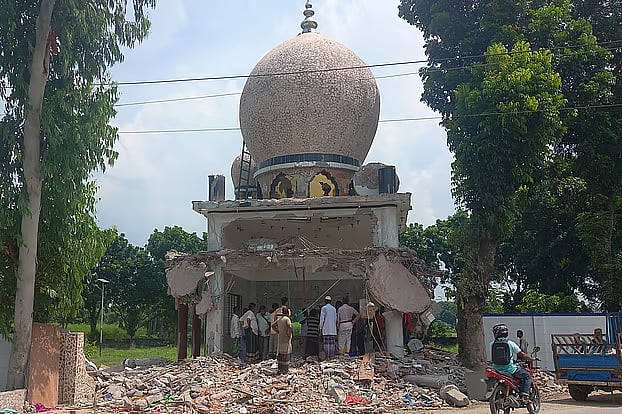
Over the past year, attacks on Sufi shrines have multiplied. Aftab Alam Jilani of the World Sufi Organisation told Deutsche Welle that 185 shrines have been attacked, while the chief adviser’s press wing officially admitted to 40 “confirmed” attacks between 4 August and mid-January. On the ground, this violence has meant a Hindu youth, Dipu Chandra Das, beaten to death and burned in Valuka; Baul singer Abul Sarkar Maharaj hounded in Manikganj until police detained him for his own safety; and the grave of “Nural Pagol” in Goalanda dug up and his remains burned. Under pressure from Tawhidi Janata, women’s football matches in Dinajpur and Joypurhat were cancelled, clashes followed, and in Dhaka Apu Biswas’s programme went ahead without her. Violence in the name of religion is not new in Bangladesh, but since August 2024 its reach and boldness have clearly grown, now extending from shrines to newsrooms and cultural centres like Prothom Alo, The Daily Star, Udichi and Chhayanaut.
The key question is not simply how many shrines or events have been hit, but who is doing this and why. In case after case, the faces are familiar. When asked about the football incidents, the local Upazila Nirbahi Officer told the BBC that the attackers were “probably madrasa students and mosque-goers”. Among those arrested for the attacks on Prothom Alo and The Daily Star are students from public and private universities and from madrasas. Most are rooted in Islamist politics or move within its networks. These groups do not hide behind neutral labels. They call themselves “Islamists” and Tawhidi Janata. I use those terms because they are their own.
Within Islamist politics, there are roughly two streams. One claims to accept democracy and says it wants to work “within the system”. The other openly dreams of sweeping away the present order and building a sharia-based state. In practice, their destination is similar: they want their interpretation of religion to sit above all other beliefs and cultures, and they want exclusive control over the state.
The first stream works through parties and their student and youth wings. They run newspapers, television channels, mosques, madrasas, social-media pages and YouTube channels. Through these platforms, they select enemies – Sufi shrines, Bauls, women footballers, certain newspapers, cultural centres – and patiently build the idea that silencing these targets is legitimate.
Around the assaults on Prothom Alo, The Daily Star, Udichi and Chhayanaut we saw student leaders of Islamist parties publicly call for action. Later, one major student organisation linked to Bangladesh Jamaat-e-Islami issued a statement insisting that any leaders accused of incitement did so in a “personal” capacity, not on behalf of the organisation.
The second stream is rougher but more direct. It works through banners like Tawhidi Janata or “Awakened Muslim People”, appears as “ordinary believers”, and often leads the actual violence. When these groups declare that something is “against Islam” and then attack, they are doing more than expressing religious hurt. They are redrawing the boundaries of public life: who may sing, who may play, who may speak, whose memory may remain in the landscape.
To understand this, it helps to look at another context. In 2016, the International Criminal Court in The Hague sentenced Ahmad Al Faqi Al Mahdi, a Malian jihadist, for destroying ten religious and historic sites in Timbuktu, nine of them on the UNESCO World Heritage list. The court treated the demolition of shrines and libraries as a war crime, not as random vandalism, and later ordered 2.7 million euros in reparations for victims. The case files make it clear that these were deliberate acts aimed at reshaping society. Here, the work of Michel Foucault, the French thinker, is useful. He used the term “governmentality” to describe how rule operates not only through laws and police, but also by shaping daily habits, fears, memories and ideas of what counts as normal. Power works through institutions, expert language, media and security talk as much as through batons and prisons.
Following this lens, one can argue that the attacks in Timbuktu did three things at once. They tried to erase the moral authority that local Sufi traditions had long held. They signalled a new regime in which worship and everyday conduct would be policed by a narrow literalist reading of Islam. And they grabbed control of the “economy” of those sites. The jihadists were claiming ownership not only of buildings but of memory and identity; the community told its past through the stories of those sites.
Every shrine smashed, every Baul silenced, every women’s match stopped, every newspaper office burned is a small step in a longer march: away from a messy, plural Bangladesh and toward a tightly controlled one
In his own words to the court and later in an interview for UNESCO, Al Mahdi said he saw the operation as “correcting deviant practices”. He thought he was cleaning up religion. The ICC read those words as a confession of organised violence. Other movements have behaved in similar ways: the Taliban blowing up the Bamiyan Buddhas, or the so-called Islamic State destroying Palmyra’s temples and arches. The targets were statues and stones, but also rival moral worlds.
Viewed in this light, the Bangladesh pattern looks less like a random series of outrages and more like a project. When Tawhidi Janata attacks shrines, Baul gatherings, women’s sports, minority homes, cultural centres or newspaper offices, it is trying to seize the public space where different Bangladeshis have learned to live together. Destroying a shrine is a way of breaking a local identity and cutting off older lines of authority. Shutting down women’s football is a way of deciding whose bodies and joys may appear in public. Burning newspaper buildings is an attempt to terrorise a profession into self-censorship. In each case, the message is the same: “The public belongs to us. Others may stay only on our terms.”
This is why the issue cannot be reduced to the familiar question of why the police do not do more. Law enforcement matters, but the stakes are larger. If the government genuinely wants to protect the pluralistic nature of the state and achieve democracy, it has to see these attacks as part of a political project to remake the republic.
Protecting cultural cities is not about pampering “elites” or indulging “culture”. It is basic civilian security. When these places fall, it is not only bricks and books that burn. A whole way of being Bangladeshi is pushed out of the public square.
For the same reason, it is a mistake to treat hard-line Islamist violence as a simple list of criminal cases. Arresting a few individuals after each incident may be necessary, but it does not address the deeper project. The goal is to build a new order in which only one model of the “true believer” is acceptable, and everyone else lives in fear or on sufferance.
In such an order, the loudspeaker replaces the constitution as the final word on citizenship. Every shrine smashed, every Baul silenced, every women’s match stopped, every newspaper office burned is a small step in a longer march: away from a messy, plural Bangladesh and toward a tightly controlled one.
* Asif Bin Ali is currently based at Georgia State University in the United States. He is a teacher, researcher and independent journalist. Email: abinali2@gsu.edu