Opinion
How will Tarique Rahman handle the huge public expectations?
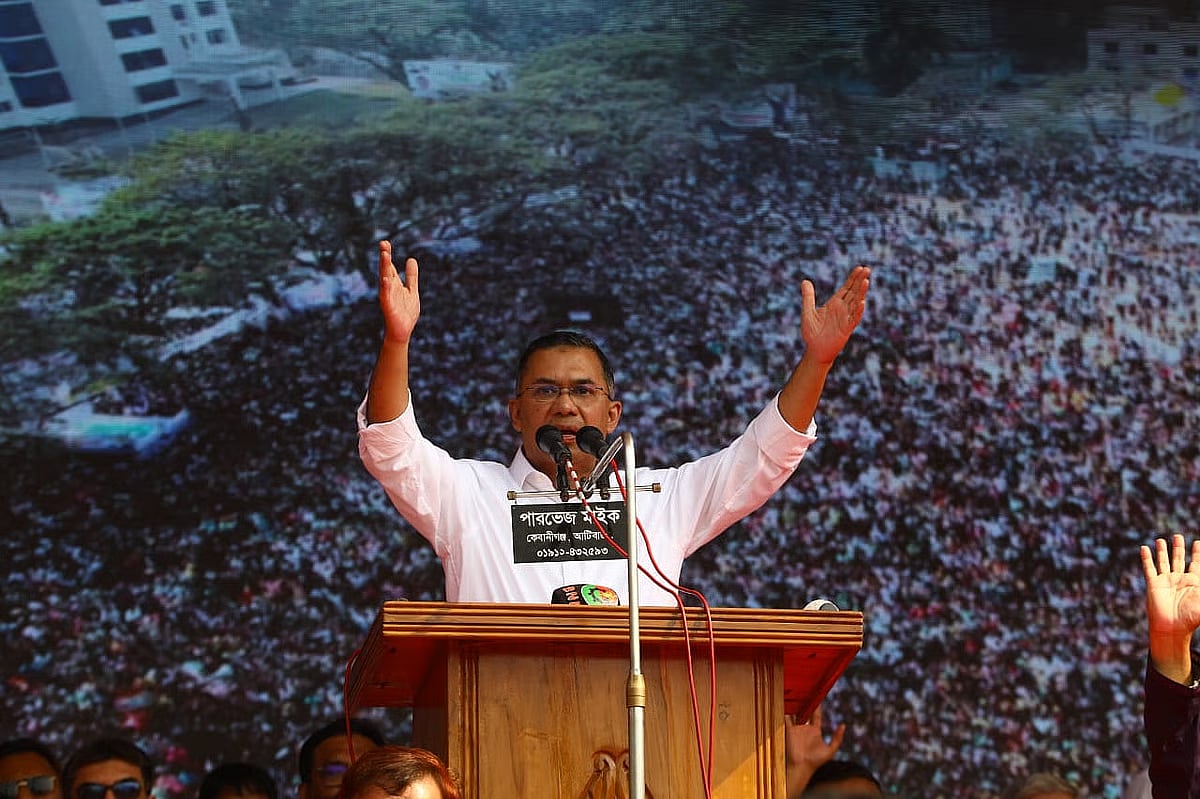
Tarique Rahman is now the permanent chairman of the BNP. Within a few days of his return to the country, a sense of trust in his politics has been noticed. Some may call it a qualitative change, while others may say it is just a temporary facade.
We have to wait a long time to know the final verdict on this. We have seen a sparkle of generosity and a burst of fireworks in earlier times, but those did not last long. However, sometimes it is possible to gauge the trend of a game from the ongoing commentary.
The country's media bosses or editors, whom the people of the country trust the most to find the news within the news. On 10 January, the editors all got together and talked. They spoke about the change in Tarique Rahman and the expectations from him. If we observe Tarique Rahman through their eyes, I would say, it is a matter of great trust and tremendous expectation.
Matior Rahman Chowdhury, editor of Manabzamin newspaper, said, ''I knew a different Tarique Rahman 23 years ago. I was the first to interview him on electronic media. Now I see, in 23 years Tarique Rahman has changed, has undergone a profound transformation.''
Nurul Kabir, editor of News Age newspaper, said, ''We have assembled at a time when an old autocratic system has fallen in the face of a mass uprising. Based on the sacrifices of the people, we are involved in the process of building the people's desired Bangladesh. But it has not yet been realised.''
Toufique Imrose Khalidi, editor-in-chief of BDNews24.com, said, ''You have come; come with dreams; talked about a plan. You have a plan.''
Mahfuz Anam, editor of The Daily Star, said, ''We want democracy, we want free journalism, and we want good governance.''
It is clear from the combined trust of the country's intellectual journalists that to address the political void that exists in the country, they are currently relying on Tarique Rahman.
Just a couple of months ago, there was a great deal of uncertainty in national politics due to a Facebook post by Tarique Rahman about his return to the country. BNP, the largest party in the country, trusted by moderate people of various streams in the country, was greatly disappointed. There were many questions then; Tarique Rahman's return has answered some, but many remain.
The question then was, if the top leader of the BNP can't come to the country, what will happen to the party? Is there anyone else who can lead the party? Or would the BNP's fate be like a sailorless ship drifting directionlessly in the middle of the sea and eventually crashing into the seabed?
During BNP's uncertainty, it was the moderates and centrists in the country who were most worried. There arose a question, why are the middle-ground people relying solely on the BNP, against whom there are allegations of extortion and land-grabbing?
This question has a long answer, and I've written a column about it before. In short, there's no one left to trust. All around, the roaring of the right-wingers and the massive rise of religion-based politics have become noticeable. Before his death, writer-researcher and political philosopher Badruddin Umar said, ''Given the current situation in Bangladesh, the BNP now seems to be the most progressive.''
In Bangladesh, the alternative to the BNP is the right-wing political parties. Therefore, during the uncertainty of Tarique Rahman’s return to the country, the rival party Jamaat-e-Islami was seen to be greatly invigorated. An environment was created in which even discussions started that Jamaat could win the next election. Jamaat's student wing, Shibir, winning student union elections in several universities strengthened this notion further.
Not only political analysts but numerous foreign ambassadors crowding at Jamaat's office also fueled the speculation of Jamaat's inevitable emergence. From September to November 2025, ambassadors of Russia, Turkey, France, Italy, Germany, Turkey, and several other countries had meetings with Jamaat’s Ameer.
A segment of the centrists in the country had hoped that the youth political party NCP would seize this opportunity. They could have shaken off extremism and become a protest force against religious politics, secure the support of the centrists, and offer them reassurance. They didn’t do this, nor could they.
Jamaat leaders' self-assuredness regarding their victory became evident. In a meeting held at the GEC Convention Hall in Chittagong City last November, Jamaat leader Shahjahan Chowdhury said, ''Election is not just about people; you have to bring everyone from the administration in your election area under our control. They will act on our command, arrest on our command, and file cases on our command.''
Many in the political arena became worried, fearing what might happen once they seized power, given their current boasting before securing power.
Leading up to the December Victory Day celebrations, Jamaat leaders surpassed previous records in distorting the history of independence. They claimed that due to the genocides committed by the Mujib Bahini, the Pakistani army initiated the crackdown on 25 March.
The last few months of the preceding year were extremely uncomfortable for those who were centrists or liberals, or those who did not believe in religion-based politics. Many questioned whether Jamaat was indeed the only alternative to Jamaat in elections.
After the murder of Sharif Osman Bin Hadi, spokesman of Inquilab Moncho, the situation in the country had solidified this notion further. The way blazes were set to The Daily Star and Prothom Alo and the vandalism at Chhayanaut and Udichi suggested that we are moving rapidly towards extreme anarchy.
The government and the political parties of the country could not take effective steps against this anarchism; instead, many went with the crowd. The government surrendered long ago.
A segment of the centrists in the country had hoped that the youth political party NCP would seize this opportunity. They could have shaken off extremism and become a protest force against religious politics, secure the support of the centrists, and offer them reassurance. They didn’t do this, nor could they.
Actually, their internal conflicts are so massive that wherever they went, dissent and infighting were inevitable. Eventually, they chose the easy path and made arrangements with a familiar party.
Tarique Rahman’s return to the country has created an opportunity for a major change in politics. Noticeable positive changes have been observed in BNP's politics as well. BNP leaders' rhetoric and actions have become somewhat less extreme. The people of the country feel somewhat reassured. Many believe that the advancement and triumph of middle-ground politics may now become a reality.
Tarique Rahman has yet to take any major initiatives. He hasn’t made any major mistakes either. By moving steadily, he has generated new expectations. Following Khaleda Zia's death, the Speaker of Pakistan's National Assembly and India's foreign minister have visited to offer condolences and discussed building good relations with Bangladesh with Tarique Rahman. This trust from two opposing countries has increased the confidence of the people in their own country.
In electoral initiatives, Tarique Rahman is moving steadily. By speaking with dissenters in the party, he has somewhat cleared the electoral path. He quickly finalised decisions regarding allies’ seats. Tarique Rahman’s favourable personal behaviour has been noted by many and received praise.
BNP is the only political party that has abstained from extrajudicial vengeance over politics involving the Awami League. This might be their electoral politics or their politics of courtesy. However, the people of this country are clamouring to escape mob culture, and it seems BNP leaders have understood that.
Jamaat is trying to promote right-wing politics by forming a large alliance. Religion-based parties have joined their coalition. They have recruited two well-known freedom fighters in this alliance. However, their biggest success has been involving the student leaders' party of the July Movement, NCP, in their alliance.
However, BNP’s sudden visible influence and progress have not escaped Jamaat’s notice. It is quite evident that it has slightly dented Jamaat's confidence. After Khaleda Zia's death, Jamaat's Ameer Shafiqur Rahman met with Tarique Rahman to discuss the need for forming a national government.
The indispensability of BNP in politics and newfound confidence in Tarique Rahman has provided BNP an opportunity to create a new identity for themselves. How long they can retain this confidence by utilising this opportunity will be tested in various ways in the future. BNP has to prove the value of this confidence through their actions. The patience limit of the people of Bangladesh is diminishing.
Since the July Mass Uprising, Tarique Rahman wanted to keep Jamaat with BNP. But then Jamaat decided to go it alone and positioned itself as an alternative to the BNP. Suddenly, the change in Jamaat Ameer's tone has sparked curiosity in political circles. Whether the reason is Jamaat's weakness in the electoral field or a delayed interest in returning to the old political friendship is a topic of discussion as well.
Jamaat’s coalition partner, Islami Andolan, has raised questions about this and exited the electoral alliance.
The indispensability of BNP in politics and newfound confidence in Tarique Rahman has provided BNP an opportunity to create a new identity for themselves. How long they can retain this confidence by utilising this opportunity will be tested in various ways in the future. BNP has to prove the value of this confidence through their actions. The patience limit of the people of Bangladesh is diminishing.
But there is no shortage of people in BNP seeking the vanity and arrogance of large parties. If Tarique Rahman can’t control them, then people will find peace in religion-based politics, and that will offer Jamaat a big opportunity again.
#Saleh Uddin Ahmed is a teacher, writer, and political analyst
Email: salehpublic711@gmail.com
*The opinions are those of the author.
#This article, originally published in Prothom Alo online edition, has been rewritten in English by Rabiul Islam