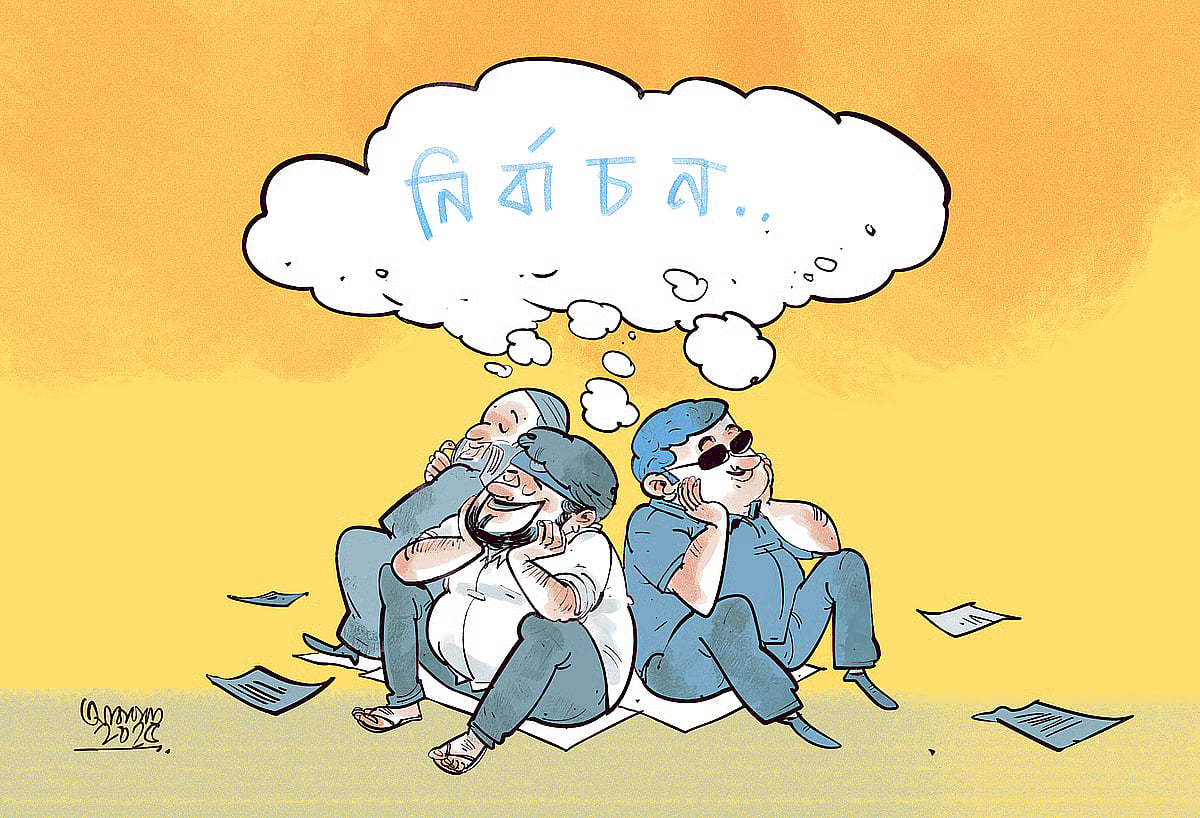
The political parties have failed to reach any consensus on the implementation of the July Charter and the timing of the referendum. The matter will now be decided by the interim government. Many had anticipated that the parties would neither take the initiative nor succeed in forging common ground. Even so, the interim government gave them a week—most likely as a strategic move. The government can now legitimately claim that it gave the political actors the opportunity to agree, while the political parties, likewise for strategic reasons, chose not to make use of that ‘opportunity’.
In Bangladeshi politics, parties typically seek to secure a ‘victory’ before going into an electoral contest. This pre-election victory becomes a source of political capital—without it, parties lack confidence heading into the polls. Post-1990 history repeatedly shows that whoever comes to power is reluctant to ensure a fair election; they attempt to retain power through manipulation. It is the opposition that must take to the streets to win the right to a fair election. And historically, when the opposition enters the election with such a victory behind them, the electoral outcome has been in their favour.
The decade from 2014 to 2024, however, was different. In that authoritarian-to-fascistic phase, elections effectively ceased to have meaning. People and the political forces had to struggle for a prolonged period to secure free and fair election. The July uprising forced the fall of fascism at heavy cost. The defeated forces fled, and the activities of the Bangladesh Awami League now stands banned. The mass uprising in 2024 has renewed the national desire for free and fair elections, and the country now moves towards the February 2026 polls.
The ‘victory’ over authoritarianism is shared among all of them. Therefore, each party now seeks a new pre-election victory to gain advantage. The volatility and tensions of current politics stem precisely from this struggle to secure that advantage.
There are several winners against the toppled fascist order through the July mass uprising. These are the forces that will compete in the coming election. The ‘victory’ over authoritarianism is shared among all of them. Therefore, each party now seeks a new pre-election victory to gain advantage. The volatility and tensions of current politics stem precisely from this struggle to secure that advantage.
Within the post-uprising landscape, three parties have emerged as central: the Bangladesh Nationalist Party (BNP), Bangladesh Jamaat-e-Islami, and the National Citizen Party (NCP), the party formed by the student leadership that spearheaded the mass uprising. The interim government also recognises these three as pivotal actors. All three are now engaged in strategic calculations regarding the July Charter and the referendum—each seeking its own pre-election ‘victory’.
The BNP wants the referendum to take place on the same day as the national election. It also intends to remain firm on the points of dissent it placed regarding constitutional reform proposals under the July Charter.
Jamaat-e-Islami, by contrast, wants the referendum before the national election. The party demands proportional representation (PR) in both houses of parliament. It appears that they will not compromise on PR for the Upper House under any circumstances.
The NCP is less rigid about the timing of the referendum; it is agreeable whether held simultaneously with the national election or earlier. It, too, supports PR for the Upper House and the implementation of the July Charter without accommodating the notes of dissent. Although the NCP has not yet signed the Charter, it insists that the interim government’s chief adviser professor Muhammad Yunus must issue the executive order to implement it.
Since the parties failed to agree among themselves, they must now accept the government’s decision. And, the government’s responsibility is to honour the aspiration of the uprising and the spirit of the July Charter, by delivering a decision that removes uncertainty and leads the country resolutely toward a fair national election.
Jamaat and its allied eight-party bloc have taken to the streets with these demands. The BNP, though actively campaigning for the election, appears to be deliberately avoiding street mobilisation over the referendum issue. The NCP is not holding programmes either, though its rhetoric remains sharp. Altogether, these conflicting positions of the three ‘major’ parties have heightened political tension and cast fresh uncertainty over the February 2026 elections.
The interim government’s one-week window for a consensus among the political parties expired on Monday. As announced, the government will now make the decision itself. Media reports suggest that the decision may be declared by 15 November. But can the government reach a decision while entirely disregarding the demands of any of the three major parties?
It is clear that the government did not simply sit idle during the week. Its advisers have been quietly negotiating and gauging how much room for compromise each party has. The government’s decision will likely reflect that assessment.
As noted earlier, each party needs a ‘victory’ heading into the election. The government’s challenge is to deliver a decision that allows all three to claim ‘victory’—at least in part. But since their demands are contradictory, one party’s gain may appear as another’s loss. In such circumstances, the only workable path is one in which each side concedes something and receives something—with public sentiment and rational considerations also weighed.
There are multiple reasons to consider the demand of holding the referendum before the national election impractical and unreasonable. A referendum requires preparations as extensive as a general election. Attempting to hold it now risks disrupting parliamentary election readiness. There are other risks as well. In a recent write-up, I have said, “Turnout in such referendums tends to be low in any case; any call for boycott by a political camp could make the situation even more dismal.” (Implementation of July Charter: A muddled referendum on constitutional reform, Prothom Alo, 30 October 2025). A low-participation referendum before a national election would be viewed as a political failure.
Therefore, holding the referendum on the same day as the national election is the logical course. If the interim government decides accordingly, that outcome represents a victory for the BNP but a loss for Jamaat.
Jamaat’s victory can instead be secured through ensuring proportional representation in the Upper House. The BNP’s resistance to PR stems from narrow partisan interest—there is little doubt about that. And indeed, without PR, there is no real justification for having an Upper House at all. Ensuring PR in the Upper House would deliver gains not only for Jamaat but also for the NCP. In this way, a workable “win-win” arrangement becomes possible.
Since the parties failed to agree among themselves, they must now accept the government’s decision. And, the government’s responsibility is to honour the aspiration of the uprising and the spirit of the July Charter, by delivering a decision that removes uncertainty and leads the country resolutely toward a fair national election.
* AKM Zakaria, deputy editor, Prothom Alo. He can be reached at akmzakaria@gmail.com
* The views expressed are the author’s own.