Opinion
Why is BNP taking the risk of opening 3 fronts simultaneously?
The 12 February election can be seen as a potential step towards Bangladesh's journey on a democratic path. In this election, the traditional voters of the ousted Awami League played a role in determining the victory or defeat in many constituencies, as the party could not participate in the election following the mass uprising on the 24th.
In this context, the election can also be identified as "leaning to the left." The main competition in the election was essentially between the traditionally centre-right BNP and the right-wing Jamaat-e-Islami and NCP alliance. Strategically, BNP tried to attract votes from its own vote bank as well as from the left, liberal, secular, and ethnic and religious minorities.
As a result, BNP's election campaign emphasised issues such as economic programmes like the family card, farmer card, along with the liberation war, the rule of law, and equal citizen rights for all. On the other hand, in this election, Jamaat-e-Islami appeared to make an effort to step away from its traditional Islamic party stance and become a "mainstream" political party with economic reforms.
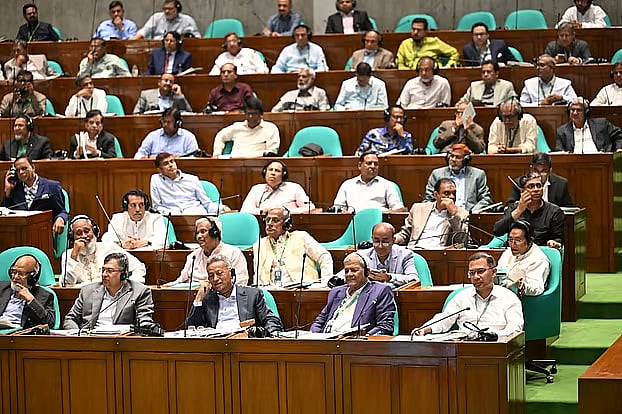
In the thirteenth national parliamentary election, the BNP formed a government by winning the most seats and an absolute majority in its history. Jamaat-e-Islami also secured the most seats and votes in its entire history. The differences in opinion between the ruling party and the opposition regarding the July ordinance, the referendum, and the 133 ordinances promulgated during the interim government raised questions and doubts from the very beginning of the parliament's first session.
Nonetheless, apart from a few walkouts by the opposition, a positive parliament was witnessed in the first session with the participation of both the ruling and opposition parties. However, in the eventful first session, several reforms on the question of fundamental state restructuring have stalled.
The interim government had promulgated 133 ordinances in 18 months. The deadline for determining the fate of these ordinances was 10 April. On the first day of the parliament's first session, these ordinances were presented in parliament. A special committee comprising members from both the ruling and opposition parties was formed to decide the fate of these ordinances.
A total of 110 ordinances have been adopted, both in their original form and with amendments. Seven ordinances have been repealed through repealing ordinances, and 16 ordinances lost effectiveness since they weren't introduced as bills. Out of the special committee's 14 members, 11 were from BNP, and three were from Jamaat, making the dominance of the government's opinion in decision-making natural. The opposition's three members submitted a note of dissent in the report.
Among the ordinances that were passed unchanged, questions remain as to how far some of them will support the country’s democratic transition. Among them is one concerning immunity related to the July mass uprising, and another concerning the ban on Awami League's activities. Additionally, among the ordinances repealed and lost effectiveness were ones addressing fundamental state reforms like the judiciary, prevention of disappearances, human rights commission, ACC, and police reform.
With these ordinances being repealed and losing effectiveness, analysts believe that Bangladesh's old power structure, where all arrangements for any party becoming autocratic and authoritarian are intact, largely remains unchanged. Although the government claims that the omitted ordinances on judiciary, disappearances will be reviewed and reintroduced as bills, the government's stance on fundamental reform issues has raised significant concerns and questions.
The opposition has accused the government of "breaching promises" and warned of "consequences." However, no strong stance from Jamaat-NCP was observed in terms of passing or repealing the ordinances in parliament. They rather cited reasons like not receiving draft bills on time and being unable to prepare.
Nevertheless, the ineffectiveness of the ordinance on disappearances, ACC reforms, the return to old laws on human rights, the return to old judicial systems, and the abolition of police commission before formation is seen as the liability of the BNP which formed the government with more than two-thirds majority. The ruling party’s strategic position is not very clear here. This allowed the BNP to be presented more strongly as an anti-reform party to the public, and also provided the opposition with an opportunity to move towards a movement.
Not just these two political fronts, but intellectual groups that are small in number but influential in forming political opinions and public sentiment also do not find BNP's position regarding reforms acceptable. During Hasina's tenure, they were outspoken. Before the election, they played a strong role in forming public opinion in favour of the BNP. Their shifting position is evident in social media. As a result, it is not clear how the government will manage to open three political fronts within two months of assuming power.
The strategic position behind turning the ordinance banning Awami League activities into law is not clear. This has also created a risk of societal and political instability. It is not understandable why the ruling party is taking the risk of creating and handling unrest on two political fronts simultaneously. History shows many instances where banning a political party does not yield any real benefit other than strengthening that particular politics.
Jamaat-e-Islami, which was banned twice in Bangladesh, is now a significant opposition party in parliament. It would have been necessary to confront the Awami League politically while also ensuring the trial of those involved in the killings and crimes during the July uprising. At present, it is not clear what BNP’s political strategy is in this regard.
The government inherited a broken economy. Due to partisanship, institutions are also fragile. Within just two weeks of taking office, US and Israeli aggression in Iran created an unprecedented war situation in the entire Middle East. The price of not only fuel oil, LNG, and LPG has increased, but its procurement has also become uncertain due to the closure of the Hormuz Strait. Pressure is mounting on the import of essential goods including fertilizers. This could also impact the remittance market.
All in all, fears of increased inflation, reduced foreign exchange reserves, and negative impacts on import-export trade have arisen. Even after a two-week ceasefire, uncertainty remains.
In the first round of US-Iran talks in Islamabad, no agreement was reached. Even if the ceasefire limit is extended, the long-term impact of the damaged energy infrastructure in the Middle East and the changed governance structure of the Hormuz Strait will prevail. In such a vulnerable position, any political instability could greatly increase pressure on the new government.
Not just these two political fronts, but intellectual groups that are small in number but influential in forming political opinions and public sentiment also do not find BNP's position regarding reforms acceptable. During Hasina's tenure, they were outspoken. Before the election, they played a strong role in forming public opinion in favour of the BNP. Their shifting position is evident in social media. As a result, it is not clear how the government will manage to open three political fronts within two months of assuming power.
#Monoj Dey is editorial assistant at Prothom Alo
* Opinions are the author’s own.
This article, originally published in Prothom Alo online, has been rewritten in English by Rabiul Islam