Opinion
What is behind the CUET VC appointment?
Last year, classes and exams were suspended for a long time at Khulna University of Engineering and Technology (KUET) following an allegation that a teacher was physically assaulted. Following continuous student protests, the Ministry of Education relieved the then Vice Chancellor of KUET, Dr. Muhammad Masud, and the Deputy Vice Chancellor, Dr. Sheikh Shariful Alam, from their duties on 25 April of that year.
Afterward, although Professor Md Hazrat Ali of the Civil Engineering Department of CUET was appointed as the acting Vice Chancellor there, he was relieved from his duties within a month.
Recently, Dr. Sheikh Shariful Alam, who was relieved from his duty as Pro-Vice Chancellor of KUET over disputes between teachers and students, has been appointed as the new Vice Chancellor of CUET. Even though Professor Abu Sadat Muhammad Sayem of the Mechanical Engineering Department was appointed to the same position on 27 July this year, he was relieved from that position on 21 September, just 56 days after the appointment.
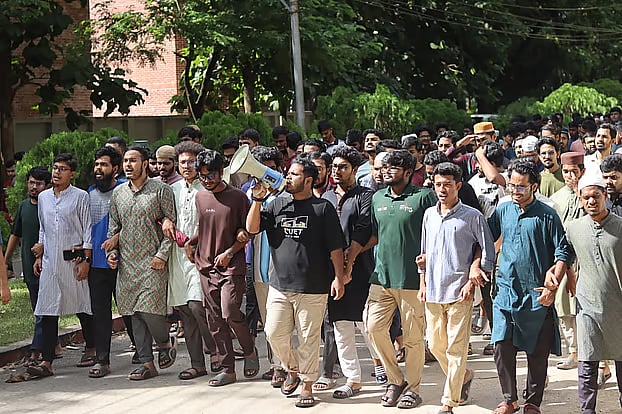
Although it isn't clear why Professor Abu Sadat was removed from the position of 'Vice Chancellor' despite laws being in place for a four-year term, the students of the university have been continually protesting and abandoning classes and exams since the ministry's announcement demanding the reinstatement of Professor Abu Sadat Muhammad Sayem to the position of CUET Vice Chancellor. They have also written an open letter to the Prime Minister.
Who has promised that Professor Sheikh Shariful Alam must be made Vice Chancellor of CUET? If he is ahead in the race for Vice Chancellor based on political credentials, then why didn't the Ministry of Education make him the Vice Chancellor of KUET itself?
The question remains, why are students opposing this Ministry of Education's decision? And why did the Ministry of Education make a teacher from another university the Vice Chancellor of CUET after dismissing the current one?
Before answering these questions, one must know what the university's Vice Chancellor appointment law states. According to Section 10(1) of the Chittagong University of Engineering and Technology Act, 2003, the Chancellor/Academic Council will appoint a senior engineering educator associated with engineering education and research as the Vice Chancellor for a four-year term, and section (3) states that if the position of Vice-Chancellor becomes vacant or if the Vice-Chancellor is unable to perform his duties due to leave, absence, illness, or any other reason, until the newly appointed Vice-Chancellor assumes charge of the vacant position or the Vice-Chancellor is able to resume his duties, the Pro-Vice-Chancellor will act in the position of Vice-Chancellor, unless there is a contrary decision by the Chancellor.
Beyond this, section 10(2) provides that the Chancellor has the authority to relieve the Vice Chancellor from his position without showing any cause. It is essentially under this clause that Professor Abu Sadat Muhammad Sayem of CUET was relieved.
The law does allow for the cancellation of a Vice-Chancellor's appointment in this manner. However, the method of canceling an appointment within two months without any explanation seems to have been influenced more by some authority beyond/above the Chancellor, and the university is bearing the consequences. Who is pulling the strings behind the scenes regarding these appointments? It seems to involve a display of political power.
For about a decade, we have been demanding an end to the charade of appointing Vice-Chancellors in an institution like a university. There is certainly an objection to appointing teachers from other universities as Vice Chancellors instead of the qualified and skilled teachers of one's own university. It is incomprehensible why a teacher from another university would be brought in when there are hundreds of professors in the university.
The newly appointed Vice Chancellor failed to perform his duties in his own university and was relieved during the interim government's tenure. Then the question could arise: Is this re-appointment of a teacher who was relieved from the position of Pro-Vice Chancellor during the interim government merely a gesture of respect? Or is the appointment happening at the whims of a close group within the ministry?
The question is, why does this professor remain firm in becoming the Vice Chancellor despite facing student opposition? Why do they forget that a teacher's respect is found in the classroom and the laboratory? Why is he emphasiing sitting in the chair when students do not want him to perform administrative duties? Is there something sweet hidden in the Vice Chancellor's chair? How will he fulfill his responsibilities amidst student disinterest?
A bigger question is about the university's self-respect. Raising the question of why the teachers and students of that university will consider a teacher from another university as their guardian is not unfounded. When an institution is repeatedly forced to decide its leadership based on external decisions, the question arises—can that institution truly maintain its distinctiveness, autonomy, and educational integrity?
It may not be certain whether this is the consequence of an internal conflict between the two universities. During the interim government, a Vice Chancellor from CUET was appointed to KUET, but he wasn't allowed to stay there, and now a Vice Chancellor from KUET is coming to CUET, but he isn't being given responsibilities. However, it is heard that Abu Sadat Muhammad Sayem has won the hearts of students as a teacher and as a Vice Chancellor in just a short time. Therefore, students should side with such a Vice Chancellor.
Regardless of whether there is conflict in the incident or not, a larger question also arises from such events—what impact does this have on the administrative stability and academic environment of educational institutions. Repeated leadership changes disrupt long-term planning, research supervision, and institutional reform activities while creating uncertainty in students' academic lives, reflected in the ongoing events of suspended classes and exams.
The third condition of the appointment notification of the Vice Chancellor explicitly states that he will reside on the university campus as the chief executive of the university full-time, but news has come out in the media that the newly appointed Vice-Chancellor has joined virtually (Prothom Alo, 25 September 2026).
The question is, why does this professor remain firm in becoming the Vice Chancellor despite facing student opposition? Why do they forget that a teacher's respect is found in the classroom and the laboratory? Why is he emphasiing sitting in the chair when students do not want him to perform administrative duties? Is there something sweet hidden in the Vice Chancellor's chair? How will he fulfill his responsibilities amidst student disinterest?
Who has promised that Professor Sheikh Shariful Alam must be made Vice Chancellor of CUET? If he is ahead in the race for Vice Chancellor based on political credentials, then why didn't the Ministry of Education make him the Vice Chancellor of KUET itself?
Education ministry bears its responsibility in this superficial act. Various complaints have arisen on whom is appointed as Vice Chancellor in which university and when, and if adjustments do not work, such appointments are revoked as well. This is nothing but the arbitrariness of the appointment system. The ministry must certainly cease lining up to fulfill the desires of representatives against the wishes of students and teachers.
By stopping political placements, teachers enthusiastic about education and research must certainly be appointed to administrative positions.
#Nadim Mahmud is a researcher at the University of California. E-mail: nadim. ru@gmail. com
*The opinions expressed here are the author's own.
#The article, originally published in Prothom Alo online edition, has been rewritten in English by Rabiul Islam.