Opinion
Delhi and the difference in exercising power and exercising authority
There is a profound political lesson unfolding on the streets of Delhi that can call for the attention of our police establishment, judiciary, political leaders and of course university students. It is the difference between exercising power and exercising authority. The two may appear identical when a uniformed officer orders a crowd to disperse, but they are fundamentally different when a government begins to lose confidence of the people it claims to represent.
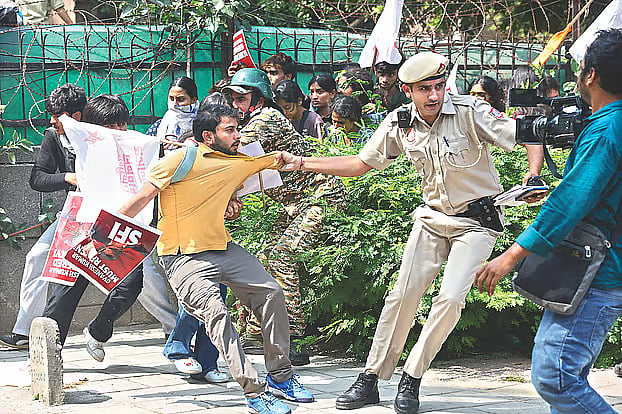
However, the ongoing protests in Delhi demanding the resignation of Chief Election Commissioner Gyanesh Kumar, amid allegations of irregularities in electoral roll revisions, have once again placed this distinction under the limelight.
The Election Commission and the ruling Bharatiya Janata Party (BJP) have disputed allegations of wrongdoing, so the controversy must be judged through evidence, institutional accountability and due process, rather than political accusations alone. Yet the plight of the protesters being detained and demonstrations being contained by the formidable Delhi police raises a larger question: Can the visible strength of the government compensate for a deficit of public confidence?
Reflecting not too long ago , resignation of India's Education Minister, Dharmendra Pradhan, in July following nationwide youth protests over question leak , examination irregularities offers another curious episode. The protesters celebrated his departure as a victory.
Whatever the eventual political consequences may have been, the episode demonstrated that public pressure can compel a government to reconsider its position without unabashedly engaging in a confrontation that ends in bloodshed. I found this noticeable point relevant when I reflect on Bangladesh's own turbulent political events.
It is surely not that Delhi and Dhaka are interchangeable political theatres. Our institutions, circumstances and protest movements with theirs have always differed. But the underlying question is no less than a global issue: What happens when a state machinery becomes more focused on containing public anger than understanding its causes?
I vividly remember the stormy days in Bangladesh from early June to 5 August 2024, when a student movement that began with a dispute over public service recruitment quotas developing into a nationwide uprising against the government of Sheikh Hasina. That said - the eventual collapse of her government was not the consequence of a single incident. It fast culminated into accumulated grievances, political alienation, escalating repression and a breakdown of confidence in the government's willingness to listen.
Peaceful assembly, blocking or lying down on streets must not be treated as a serious crime against the state merely because they annoy those in public office.
The United Nations Human Rights Office subsequently estimated that as many as 1,400 people may have been killed between 1 July and 15 August 2024, with the vast majority reportedly shot by our security forces. It also documented serious violations by state forces and other actors. These findings make it impossible to treat the tragedy merely as a failure in "violent crowd management."
Just imagine this scenario that not 1400, but in case if just 14 lives had been lost during all the recent protests in Delhi, how the government there would have responded? Surely our lives are not cheaper here!
It is right on this point where distinction between power and authority was blurred, perhaps deliberately, during those ominous weeks. The state definitely possessed weapons, uniforms, detention facilities and the legal machinery to enforce orders, but let us not forget the ability to issue an order is not the same as possessing the moral legitimacy to secure compliance.
As I reflect back to the eventful winter of 1990, I am sharply reminded of the anti-Ershad movement. The death of Dr Shamsul Alam Khan Milon, a physician and pro-democracy activist, on 27 November that year became a powerful symbol of resistance and at the same time had united and intensified the opposition movement against the military-regime. It would be too simplistic to attribute Ershad's downfall to that single death alone , but it surely did trigger a broad-based movement, strikes, political mobilisation while eroding public confidence within the state.
Nevertheless, Dr Milon's death demonstrated how one human tragedy could fuel a widespread anger that had been accumulating for years.
Whether in Dhaka or Delhi - a government may imagine that removing a rebellious and troublesome crowd will remove the trouble itself. But history has repeatedly demonstrated otherwise. Sometimes a protest disperses; sometimes the grievance goes home, changes clothes and returns with thousands of companions.
This is where law enforcement agencies, particularly our courts and the police, must draw a clear line between exercising power and exercising authority from the recent Delhi protests. In Delhi , they had arrested numerous protesters , hadn’t imposed travel bans on , kept them in custody , but none got killed due to mysterious and unexplained causes. Police members there had forcefully arrested protesters and physically removed them from the scene without causing serious injury. Even the political opposition party leaders were not spared. Yet, none got killed or framed under politically motivated charges as is almost regularly happening here. The BJP student faction, if one truly exists, was non-existent.
What our politicians, judiciary and the law enforcement agencies have frequently failed to comprehend over the decades is that power can make a person obey out of fear, but authority can persuade that person to comply because the institution is considered legitimate. Neither a live bullet, nor a tear-gas shell can extinguish a legitimate question about accountability.
As far as Delhi protests are concerned, police officers in that country surely have a duty to protect lives, prevent attacks, maintain public order and enforce law. The test, as has been unfolding in Delhi, is not whether the police is using force, but how much of that force is lawful, necessary, proportionate and accountable.
All the recent arrests and conditional releases in Delhi give a clear picture. Peaceful assembly, blocking or lying down on streets must not be treated as a serious crime against the state merely because they annoy those in public office.
As for Bangladesh, the painful lessons of 2024 should be institutional, not merely political. Our police training must widely focus on de-escalation, negotiation, protection of peaceful demonstrators and clear rules governing the use of force.
Officers and members of the police who act lawfully should receive institutional protection, and those who commit abuses should face accountability.
Whoever is in power must also resist the temptation to turn the police into an instrument for defending the ‘fleeting fortunes’ of a sitting government.
Democracy requires evidence, dialogues, arguments and institutional safeguards, not automatic endorsement of whichever crowd happens to be the loudest.
To finish with, the Delhi protests and our own experiences in the past couple of years or so, invites us to reconsider what real strength means in public life. A state does not become weak merely because its police exercise restraint, nor does it become strong simply because it ensures its streets are empty.
The ultimate test of our elite law enforcement agency, judiciary included , is not how efficiently it can make a protesting crowd or an opposition political party disappear, but whether, when the crowd or the political opposition returns, the people still believe that the uniform and black robes standing before them represents the law rather than the fear of those who rule.
* The writer is the senior assistant editor for The Daily Observer.
* The views expressed here are the writer's own.