Opinion
Khaleda Zia's janaza: What message did the massive turnout convey?
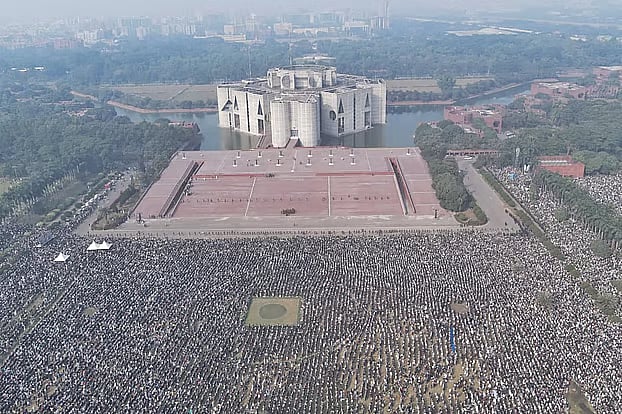
The sky over Manik Mia Avenue was heavy, not only with grief, but with the weight of history. The janaza (funeral prayer) of BNP Chairperson and former prime minister Khaleda Zia began at 3:03 pm. Two minutes later, at 3:05 pm, it ended.
Yet what happened in those two minutes will resonate in Bangladesh’s political history for decades to come.At that moment, Manik Mia Avenue was no longer merely a road. It had turned into a sea of people. From Bijoy Sarani, Khamarbari, Karwan Bazar, Farmgate, Shahbagh, and Mohammadpur, people converged from every direction to a single point.
Khaleda Zia had been outside power, imprisoned, ill, silent. The state narrative sought to render her almost invisible. But this funeral proved that in politics, visibility does not always come with power
No one could count how many were there. Some said two million, some said three million, others said even more.
But numbers are secondary here. One truth is certain. This was an unprecedented funeral prayer in Bangladesh’s history. Even on a global scale, it stands out as a rare gathering among funerals of deceased Muslim leaders.
This scene reminds us of Tehran in 1989. It brings to mind the funeral of Ayatollah Ruhollah Khomeini, where tens of millions were present. That sea of people was not made up of party workers; it was the people’s final utterance toward a political life.
It also recalls Egypt’s Gamal Abdel Nasser, Palestine’s Yasser Arafat, and South Africa’s Nelson Mandela, figures whose funerals drew people not merely to mourn, but to declare their own place in history.
Khaleda Zia’s funeral was such a moment. It was not just the farewell to a leader; it was the answer to a question: where does the public heart stand in Bangladesh’s politics?
For a long time, Khaleda Zia had been outside power, imprisoned, ill, silent. The state narrative sought to render her almost invisible. But this funeral proved that in politics, visibility does not always come with power. Sometimes it emerges through suffering, through silence. The crowd showed that they had not forgotten.
This public turnout carried not only a message of mourning for the BNP, but also one of revival. A party that has endured prolonged repression, division, and fragmentation suddenly discovered that its social roots remain intact.
This funeral gave BNP renewed confidence that politics is not run solely through administrative control; it is also driven by people’s emotions.
At the same time, the scene is a matter of deep concern for Awami League. Despite its long tenure in power, it has not been able to demonstrate such spontaneous mass gatherings for a long time. It serves as a reminder that the state and society are not the same. Even with administrative control, social legitimacy is never permanent.
The impact of this sea of people did not remain confined within the country. It was picked up by the subtle radar of international politics as well. Historically, BNP’s relationship with India has been strained.
These attendances indicate that regional powers no longer see BNP merely as a chapter of the past. They have begun to consider the party as a potential force for the future as well.
Yet at such a moment, India’s External Affairs Minister S Jaishankar met BNP Acting Chairman Tarique Rahman and handed over India’s condolence message to him. It is being described as a courtesy call and an expression of sympathy.
But we know that in politics, courtesy is never meaningless, never without a message, never innocuous. In the language of diplomacy, courtesy often signifies an acknowledgement of the situation, and sometimes, the keeping of a door open for the future.
In that context, delivering the condolence message through Jaishankar and handing it directly to Tarique Rahman is hard to view as mere routine protocol.
The question naturally arises as to whether this was this a subtle signal from the Modi government to the BNP?
Nothing can be said with complete certainty, because diplomacy never speaks in simple sentences. But one thing is clear: India knows how to read realities. And the reality of this sea of people on Manik Mia Avenue is unlikely to have escaped India’s diplomatic attention.
In the past, India’s relationship with the BNP was distant, at times even hostile. But politics recognises no permanent enemies or friends, only possibilities.
Khaleda Zia’s funeral made that possibility visible. And it is against the backdrop of this visible reality that Jaishankar’s condolence message must be interpreted.
This context is made even more significant by the meeting between Pakistan’s National Assembly Speaker Sardar Ayaz Sadiq and Tarique Rahman, and the expression of solidarity.
In South Asian politics, Pakistan’s symbolic presence is always meaningful. This is not merely bilateral courtesy, it is a language of regional balance.
At the same time, the presence of official representatives from Bhutan, the Maldives, and Nepal, along with the participation of diplomats from many countries, together paints a picture of extensive international observation.
It is clear that opposition politics in Bangladesh is no longer just an internal matter. It has entered the calculations of regional powers as well.
These attendances indicate that regional powers no longer see BNP merely as a chapter of the past. They have begun to consider the party as a potential force for the future as well.
The truth this funeral reveals to us is not only about politics; it also exposes the deepest layers of statecraft. It reminds us that power is never merely a machine held in the hands of administration.
The permanence of power cannot be ensured through police, laws, directives, or departmental seals. The true abode of power lies in the consciousness of the people, in memory, in the depths of emotion, in the sense of justice and injustice.
When the state confines its strength solely to structures, it forgets that history is ultimately written in the feelings of the people, not in documents. The sea of people that surged at this funeral was a visible manifestation of that popular sentiment.
When the state seeks to silence the voices of the people, they change the language. They do not chant slogans or raise banners, they speak in the language of history. The funeral ceases to be merely a religious ritual; it becomes a silent referendum.
Yet, it would be wrong to interpret this sea of people as a final verdict. History never delivers its final word in a single day.
* Sarfuddin Ahmed is Assistant Editor, Prothom Alo. He can be reached at sarfuddin2003@gmail.com