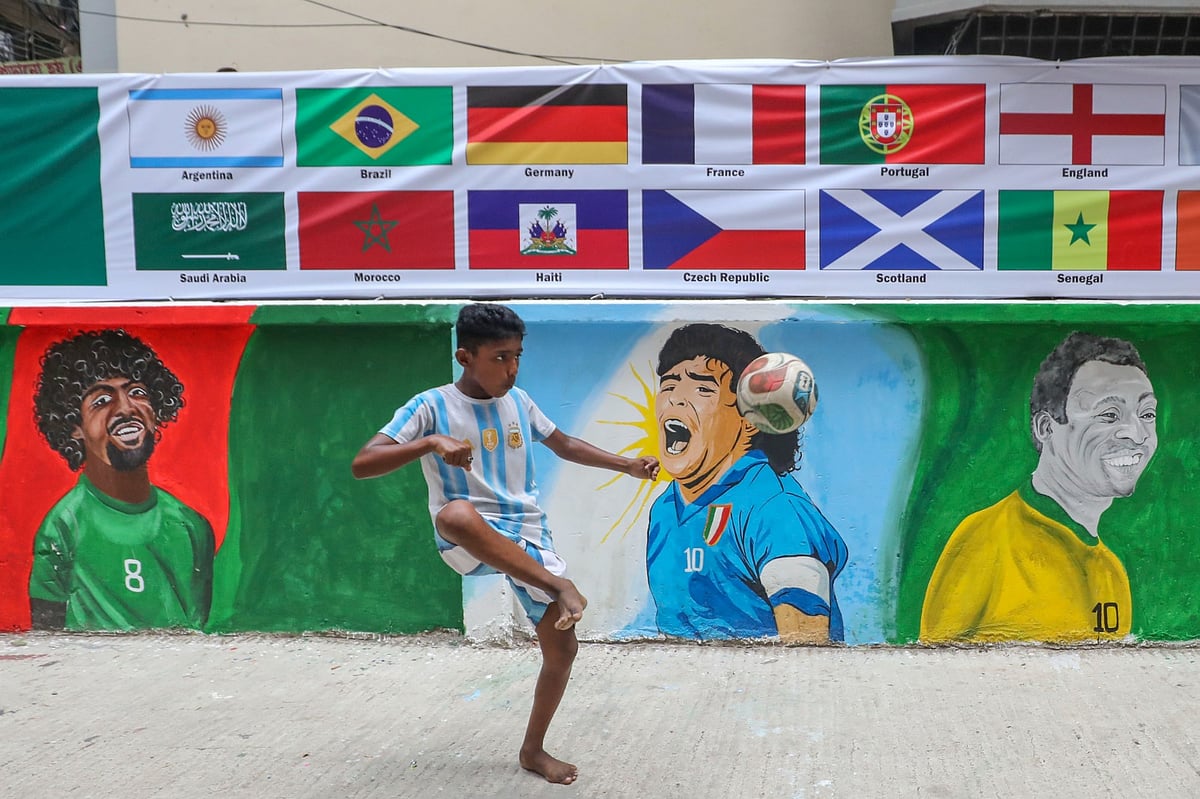
A nation’s stubborn love for a sport way beyond its borders
Every four years, something happens to Bangladesh.
It usually starts with a single flag. One morning, you see a sky-blue and white banner fluttering on a neighbor’s roof. By the next week, the entire city of Dhaka is a sea of yellow, green, and blue. You can’t walk down a narrow alleyway without knowing exactly where everyone stands. Shops close early. Families gather around screens. The entire country divides itself, cheerfully and sometimes violently, into two.
Brazil. Argentina. Pick a side.
Now let’s have a glimpse of the other side of the story. During the 2022 World Cup, 23 people died in Bangladesh because of football. Not one of them was a football player. No one was wearing cleats or standing on a pitch. Seven were electrocuted hanging flags from power lines. Six had cardiac arrests during matches. Five were killed in fights between rival fans! A violent encounter between Bangladeshi Argentina and Brazil supporters was even recorded in an Italian refugee camp. Thousands of miles from home, in a country that was not theirs, still fighting about two teams from a continent neither had ever visited.
This is the part that makes people stop and stare. The part that makes foreign journalists fly to Dhaka with cameras, looking for an explanation. They usually settle on the easy ones, Maradona, 1986 World Cup or the arrival of colour TV.
All of these are true, but it’s like trying to explain a massive flood by pointing at a single raincloud. To understand why a boy in Barishal is willing to risk his life for a flag, you have to look at the ground beneath his feet. You have to look at the history of the very soil he is standing on.
Go back to 1911. A group of barefoot Bengali boys walked onto a pitch to play against the East Yorkshire Regiment, soldiers of the British Empire. The Bengalis won. The crowd that day did not celebrate merely a football result. They celebrated the feeling, maybe for the first time in their lives, that the ‘masters’ could be beaten.
By 1971, Bangladesh was fighting for its independence. The country''s first football team — the Shadhin Bangla Football Dal — toured India playing matches to raise money for the liberation war. Their captain, Zakaria Pintoo, said, "I have nothing but football to offer." The players were later recognised as freedom fighters.
Then came the 1986 World Cup and a short Argentine man named Diego Maradona.
Maradona infamously opened the scoring in the 1986 World Cup final by rising above English player Peter Shilton to palm the ball home, claiming that his goal and Argentina's victory over England was ‘partial payback for the Falklands War.’
For two centuries, the British had held the delta in their grip. We remembered the 1943 famine, where millions of our people starved while the Empire looked the other way.
For a people used to watching the ones in power ignore the rules to suit themselves, Maradona’s audacity felt like a miracle. It was as if he had stolen the wallet of the oppressor while the whole world was watching. In that moment, more than a player, he was a rebel hero for a nation still nursing its colonial scars.
Argentina fans weren't made that night. They have not stopped being made since.
Although Brazil is quite a different story.
In 1963, a photograph appeared in a Kolkata newspaper. Pelé, sitting on a football, was already the most famous player on earth at twenty-two. A boy so poor he played with socks stuffed with newspaper. He became a millionaire. He won three World Cups. He transformed football into something that looked like art.
Not by television, nor by marketing. Brazil's fanbase was built here by a story about poverty that felt personal. Because in Bangladesh, poverty was never abstract.
Pelé's biography later made it into Bangladeshi primary school textbooks. An entire generation read about him before they ever watched him kick a ball.
Although for a brief, golden period, Bangladesh had its own football to love.
In the 1970s and early 1980s, Dhaka Stadium was full. The rivalry between Abahani and Mohammedan was the kind that lasted generations and split families down the middle. There were real heroes. Players like Sabbir, called the Maradona of Bengal, who led Bangladesh to its first international trophy, the President Gold Cup, in 1990. The game was alive. It had roots and names and faces people knew.
Bangladesh might not have a team on the World Cup pitch yet. However, in this delta, the game is never really over. It just waits for the next four years to prove that the heart still beats, even for a flag it doesn't own.
Then corruption crept in. Political interference hollowed out the federation. Cricket arrived with its IPL money and television deals and took everything—the sponsorships, the attention, the young players who might have been footballers. The domestic league collapsed.
But the love did not collapse with it. It had been built over a century, on barefoot. That kind of love does not simply switch off because the institutions fail. It goes somewhere else. It goes outward. Attaches itself to Argentina, Brazil or some other nation with an intensity that bewilders the outside world.
An Englishman supports England because he was born there. A German supports Germany. A Brazilian supports Brazil. None of them chose. It was handed to them.
But a Bangladeshi choses. Builds his or her allegiance out of history and memory and a feeling passed down through generations that the powerful are not always right and do not always win.
The boy on the roof in Barishal, balanced on a bamboo pole above a live wire, clutching an Argentina flag — he is not mad. He is the product of a hundred years of football meaning something here that it does not mean anywhere else. Something that was political before it was sporting, that was emotional before it was rational, that was human before it was anything else.
Bangladesh might not have a team on the World Cup pitch yet. However, in this delta, the game is never really over. It just waits for the next four years to prove that the heart still beats, even for a flag it doesn't own.