Asif Mohammad Shah's column
A promising start for democracy, a fresh struggle for state-building
The minimum condition essential for a transition to democracy is a free and fair election. The right to vote is not merely a constitutional provision, it lies at the very core of civic dignity. For a long span since 2008, Bangladesh has not experienced a genuine transfer of power. This has produced a reality marked by the absence of power alternation, one-party dominance and the gradual institutionalisation of an authoritarian system of governance.
History shows that when the path to changing governments through popular vote narrows, accountability within the political system weakens, and the state apparatus increasingly asserts dominance over citizens. Following recent changes, we now stand at a critical juncture where both the return to democracy and the consolidation of democracy have come to the fore simultaneously.
We have undergone democratic transitions in the past, but have failed to ensure the integration of democratic components. As a result, we have repeatedly fallen back into democratic crises. The mass uprising of twenty-four has once again presented us with an opportunity. This election, therefore, is not merely a process of transferring power; it is also a test of rebuilding the foundations of democracy.
This election has two dimensions. First, it reflects public aspirations. Citizens are being given the opportunity to vote and bring the political party of their choice to power. Second, it serves as a form of public endorsement. The process also tests whether people support the proposed changes in the state structure and political reforms.
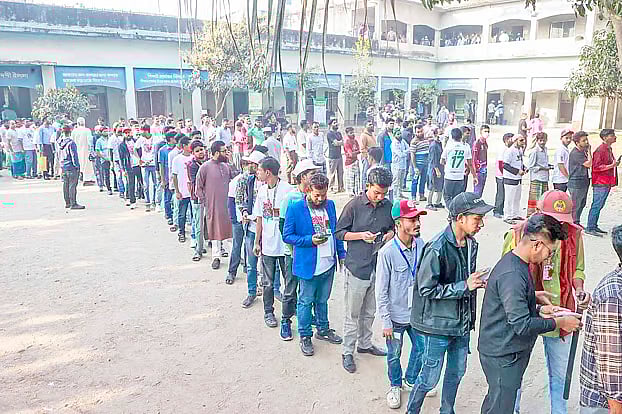
There have been reports of some isolated irregularities on election day. In Bangladesh’s electoral history, it would be difficult to claim that any election has been entirely transparent and flawless. Nor is it realistic to expect that. The key question is whether the scale of irregularities is significant enough to affect the overall outcome. So far, the visible trend does not indicate any major manipulation. This is a positive sign.
At the same time, voter turnout is an important issue. An election must not only be free, fair, and impartial, it must also be participatory. As the activities of the Awami League were suspended by executive order, it could not take part in this election. The absence of a major party in the electoral field naturally affects voter turnout. However, preliminary estimates suggest that turnout may be nearly 60 per cent. If such a rate is achieved despite the absence of a major political force, it is not entirely discouraging. Of course, greater participation would have strengthened democracy further. Still, this can be seen as a promising beginning.
The election concluded without any violence. In the country’s electoral history, this is an unprecedented occurrence. Law enforcement agencies, especially the army, played a responsible role. It is hoped that the outcome of the vote will also be positive. The spontaneity, patience, and restraint shown by political parties on polling day should, it is hoped, be reflected in their response to the results as well.
Whatever the outcome, the role of a responsible opposition is essential for democracy. For a long time, we have lived under a “winner-takes-all” political culture. In the new context, the opposition must be given institutional recognition and an effective role. At the same time, the opposition must also realise that democratic transition is a collective process.
This election is also tied to the question of a referendum. If the “Yes” vote prevails, it will create a constitutional foundation for state reform. The proposals contained in the July Charter, such as the establishment of an upper house, provisions for proportional representation, and reforms in the appointment processes of constitutional bodies, will then have the opportunity to be implemented. If the “Yes” vote wins, parliament will gain a constituent mandate for 180 days, enabling constitutional amendments.
This timeframe is extremely important. Political goodwill, clarity of principles, and inter-party consensus will be essential during this period.
The first challenge for the new government will be to show unconditional respect for the verdict of the referendum. If the public delivers a clear mandate in favour of state reform, any failure to implement it will undermine trust in the government from the outset. At the same time, the opposition will likely take a firm stance.
Whichever party or alliance wins the election, the opposition is unlikely to be weak this time. Therefore, if a deadlock over reforms emerges within the 180-day period, the country may once again slip into confrontational politics. The experience of post-Arab Spring states shows that failure to build consensus during crises can halt democratic progress and allow authoritarianism to resurface.
The people have expressed their aspirations. The responsibility now lies with the political leadership. If they can transform this opportunity into a collective process of state-building, we can take firm steps toward democracy.
The second major challenge is the administration, or bureaucracy. Over the past decade and a half, extensive politicisation has taken place within the bureaucracy. Instead of merit-based professionalism, a culture of loyalty has developed. As a result, morale and neutrality within the administration have been undermined.
Political divisions are now also visible within the bureaucracy itself. Whichever party comes to power will have to confront this administrative reality. Every party has made attractive promises in its election manifesto. Many of these are not implementable, while others can be realised if there is the will. This will depend on administrative competence and neutrality. How the relationship between political leadership and the bureaucracy is redefined, and how policies are reformed, will determine success or failure in the coming years.
The third challenge is the reconstruction of civic space. In a democracy, civil society is not merely a critic; it is an institutional support for ensuring accountability. The government must allow room for criticism, ensure media freedom, and create avenues for participation in policymaking. Unless the contraction of independent voices seen in recent years is reversed, democracy will remain on paper rather than in practice.
Law and order is also a critical issue.
The coercive culture of governance that has developed over a long period cannot be dismantled overnight. The rise of mob-driven disorder witnessed during the interim period will not simply disappear with the arrival of a new government. Therefore, the new government must prioritise controlling violence and disorder. Maintaining a balance between the use of state power and the protection of citizens’ rights will also be essential.
The economy is another major challenge. Although a degree of short-term stability has been achieved, an investment deficit remains. Restoring confidence in private investment, reforming the financial sector, maintaining foreign exchange stability, controlling inflation, and creating employment should be priorities for the next government. Young voters have played a significant role in this election. Their expectations centre on jobs and opportunities. If economic realities fail to meet those expectations, there is a risk of social unrest. However, drafting economic plans on paper is not enough; effective implementation requires a competent and neutral administrative apparatus—bringing us back again to the question of administrative reform.
We must remember that the election of 12 February represents a moment of political possibility. The people have expressed their aspirations. The responsibility now lies with the political leadership. If they can transform this opportunity into a collective process of state-building, we can take firm steps toward democracy. But if this opportunity is neglected, history will confront us with yet another unfinished chapter. Beginning the journey of democracy is difficult; consolidating it is even more so. That more difficult task now lies before us.
* Asif Mohammad Shahan is a university teacher, researcher, and political analyst.
* The views expressed here are those of the author.