In search of history
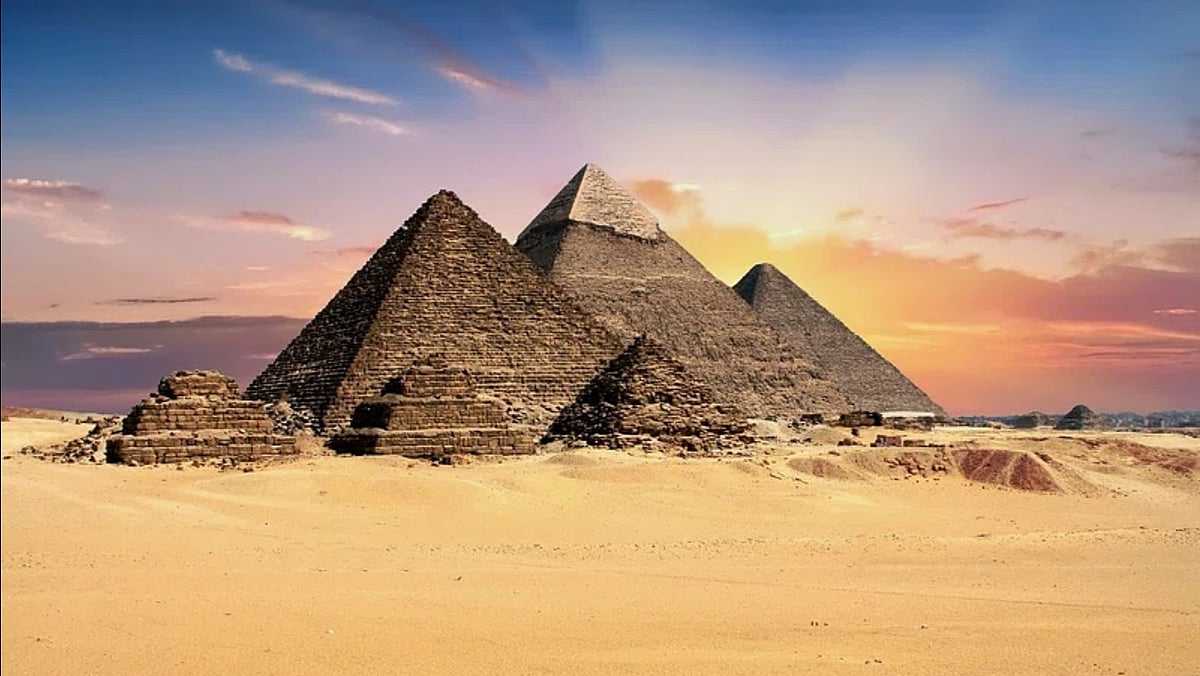
Great Pyramid of Giza: A timeless marvel shrouded in mystery
In the midst of the scorching heat and haunting silence of the Sahara Desert stands the Great Pyramid of Giza—one of the greatest achievements in human history. Built from an estimated 2.3 million limestone and granite blocks, weighing an average of 2.5 to 3 tonnes each, its weathered surfaces and softened edges bear the relentless marks of time, whispering stories of millennia long past.
Although many of the internal blocks are relatively small, some, in particular the granite beams in the King’s Chamber, weigh as much as 80 tonnes, which reflects an outstanding engineering precision in moving heavy stone.
Achieving such an advanced level of engineering and architectural feat invokes questions that still remain unanswered, given the timeline that archaeologists and scientists attach to this enigmatic structure, 2580–2560 BCE during Egypt's Old Kingdom for the Pharaoh Khufu. It is the most ancient among the Seven Wonders of the Ancient World.
Many have come up with different opinions and theories to unravel the mysteries that shroud this ancient monument along the Giza Plateau, yet none has been concrete since its discovery in the 1830s on how it was built with laser-like precision at such an ancient time.
An enigmatic monument, it remains a testament to ancient ingenuity. Even today, it continues to puzzle scientists and researchers, as each technological advancement seems to reveal not answers, but deeper mysteries. The pyramid possesses features so precise and sophisticated that they challenge our understanding of what was possible thousands of years ago.
This article explores some of the astonishing characteristics of this ancient marvel—an architectural wonder that has stood unshaken against the passage of time.
A cosmic connection?
The Great Pyramid of Giza soars to a height of 149.4 metres at the time of its construction, a number that astonishingly mirrors the distance from the Earth to the Sun—149.4 million kilometers. Such parallels invite speculation about the advanced understanding of astronomy that the Egyptians might have possessed, making the pyramid not just a tomb or monument, but a symbol reaching beyond the Earth itself.
At the centre of the 5 ancient continents
The Great Pyramid of Giza sits at a location that aligns astonishingly close, only by a fraction of a degree, to the geographical center of the Earth’s five ancient continents. That deviation too is the result of the changes in the geographical tilts of the earth since the time it was built.
This central position is remarkable, as it places the pyramid almost equidistant from the farthest reaches of Africa, Europe, Asia, North and South America. Such precision in placement has led many to marvel at the possible intent behind it, suggesting that the builders might have possessed knowledge of geography on a global scale. The pyramid’s location continues to intrigue researchers, adding yet another layer of mystery to its enduring enigma.
Aligned with the brightest star
The largest pyramid of the Giza complex appears to stand directly beneath the brightest star in the night sky. This striking alignment has long stirred fascination among observers who see in it a deliberate connection between earth and sky. When darkness falls and the star blazes above the desert horizon, the pyramid seems less like a mere structure of stone and more like a silent marker aligned with the heavens.
Whether symbolic or coincidental, the visual harmony between monument and star deepens the sense that the pyramid was positioned with celestial awareness in mind.
The Great Pyramid's precise alignments with celestial bodies suggest it may have served not only as a monumental tomb but also as an astronomical observatory, reflecting the ancient Egyptians' profound connection with the cosmos. How did they achieve it so many millennia ago?
A dialogue with the stars
One of the most captivating aspects of the Great Pyramid is its celestial alignment. The entrance is oriented toward the northern sky, historically associated with the Pole Star, a fixed point around which the heavens appear to rotate. Deep within the structure, narrow shafts extend from the inner chambers in directions that align with specific stars, including Sirius, the brightest star visible from Earth. Such alignments have fueled enduring fascination, suggesting that the pyramid was not merely grounded in stone, but consciously connected to the movements of the sky above.
Aligned to true north
The Great Pyramid is aligned to true north with extraordinary precision, deviating by only a fraction of a degree. Unlike magnetic north, which shifts over time, true north is a fixed geographical point. Achieving such alignment without modern compasses, satellites, or digital instruments continues to astonish researchers, which we came up with only a few millennia ago.
The accuracy suggests careful astronomical observation and meticulous planning. This remarkable orientation reinforces the idea that the pyramid was positioned with deliberate intent, anchored not just to the earth beneath it, but to the exact geometry of the planet itself.
Symbolism of Pi number
The Great Pyramid of Giza reveals an astonishing mathematical precision: the ratio of its circumference to its height equals 3.14, mirroring the value of pi. This same ratio is reflected in the dimensions of the King's Chamber, suggesting a deliberate design rather than mere coincidence. Such geometric sophistication demonstrates that whoever designed the pyramid had an advanced understanding of mathematics, embedding universal constants into stone thousands of years ago.
Engineering within the heart of stone
At the centre of the Great Pyramid lies the King’s Chamber, and above it rests a remarkable structural system. The roof is formed from massive granite beams, some weighing around 45 tons each, positioned roughly 75 meters above ground level. These stones were not placed randomly. They form part of a series of relieving chambers designed to redistribute the immense weight of the pyramid above. By diverting pressure away from the chamber below, this engineering solution helped prevent the pyramid from collapsing. It remains one of the most impressive examples of load management in ancient monumental architecture.
The hidden eighth side
For centuries, the Great Pyramid appeared to be a perfectly four-sided monument. Yet under specific lighting conditions—particularly during the equinox—an extraordinary detail reveals itself. Each of its four faces has a concave indentation from top to bottom, creating the illusion of eight sides when viewed from above or at a certain angle.
The concavity divides each of the four faces into two halves, creating a subtle shadow only visible at dawn and dusk on the spring and autumn equinoxes.
This phenomenon is invisible from the ground and only becomes apparent when light and shadow strike the limestone with precision.
It is quite fascinating and baffling at the same time as to how such remarkably precise placement of an enormous monument, which required advanced level of applied mathematical and astronomical understanding, be achieved at a time when the earth was roamed by the primitive humans according to written story.
At the same time, how could a feat be achieved which can only be observed from the sky?
It is a reminder that the pyramid does not surrender all its secrets at once. Even after millennia of study, it still reveals new dimensions—quietly, deliberately—beneath the shifting desert sun.