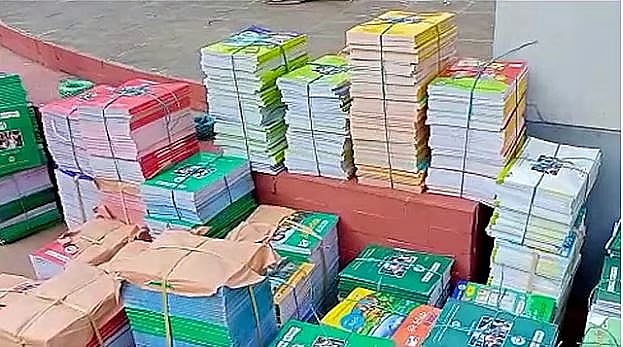
Free textbook demand inflated, leading to major losses
Verification of data from 293 upazilas shows an excess demand of 8.842 million (88.42 lakh) books at the secondary level alone.
If data from all upazilas are reviewed, the figure could approach 15 million (1.5 crore).
Demand is now being reassessed and revised, and books will be printed accordingly.
The demand for free textbooks is being inflated. Schools and field-level officials are requesting more books than actually needed, leading to significant wastage of government funds.
Data from the National Curriculum and Textbook Board (NCTB) show that after verifying information from 293 upazilas, an excess demand of 8.842 million (88.42 lakh) textbooks has been identified at the secondary level alone.
Officials say that if data from all upazilas are analysed, the number could reach nearly 15 million (1.5 crore). The demand is now being reassessed and revised, and printing of the books will be adjusted accordingly.
Every year, allegations arise that more free textbooks are printed than required. According to the NCTB, inflated demand submitted by schools and field-level officials results in recurring financial losses.
Education stakeholders say a reliable method must be developed to determine demand based on actual student numbers and trends. At the same time, proper verification of field-level data must be ensured. Otherwise, wastage will continue every year.
Officials say that if data from all upazilas are analysed, the number could reach nearly 15 million (1.5 crore). The demand is now being reassessed and revised, and printing of the books will be adjusted accordingly.
NCTB sources say textbook demand is determined nearly a year in advance. At that time, educational institutions estimate demand based on projected student numbers. However, these estimates often do not match reality and tend to exceed actual requirements.
Previously, such demand was not thoroughly verified, resulting in excess printing and unused books. Since last year, however, the NCTB has increased scrutiny in determining demand, with officials conducting field-level checks in some areas.
According to NCTB sources, the demand for free distribution at the secondary level this year was more than 213.767 million (21.3767 crore) books. For next year, this figure rose to 223.23 million (223,230,318) copies. Suspecting irregularities in this unusual increase, the NCTB formed 34 teams to verify the data on the ground.
The verification uncovered evidence of inflated demand. An NCTB official, speaking on condition of anonymity, told Prothom Alo that during a visit to an area in Dhaka, he found a large stockpile of books—some from the past three years—stored in the warehouse of the office of a secondary education officer.
Another NCTB source said that as of 23 April, verification of 293 upazilas revealed an excess demand of over 8.842 million (88.42 lakh) books at the secondary level, which has since been revised downward.
Earlier, in the first phase of verification across 110 upazilas, demand was found to be about 8.5 per cent higher on average. Private educational institutions and madrasas accounted for a comparatively higher share of inflated demand, while government institutions showed lower discrepancies.
NCTB chairman (additional secretary) Md Mahbubul Haque Patwari told Prothom Alo that upon receiving the demand figures, they suspected they were far higher than actual requirements. They immediately verified the data in one upazila and found evidence of overestimation.
Subsequently, 34 teams were deployed across 64 districts, covering 168 upazilas. They expect the total number of books to be reduced by nearly 15 million (1.5 crore) once all data are verified, which would prevent substantial government losses, added the NCTB chairman.
For the 2025 academic year, it took nearly three months to complete distribution. For the current academic year (2026), full distribution was completed on 7 February—one month and seven days after it started—according to NCTB sources. Delays in receiving textbooks affected students’ studies.
Target to complete printing by 15 November
After the previous interim government assumed office, it had the opportunity to distribute free textbooks over two academic years. However, in neither year were all books delivered to students at the start of the academic session.
For the 2025 academic year, it took nearly three months to complete distribution. For the current academic year (2026), full distribution was completed on 7 February—one month and seven days after it started—according to NCTB sources. Delays in receiving textbooks affected students’ studies.
In the current academic year, a total of 300.255 million (300,255,154) textbooks were printed and distributed at the primary and secondary levels.
NCTB sources said preparations for printing next year’s textbooks, including tender processes and related activities, have already begun. Chairman Md Mahbubul Haque Patwari said they are working with a plan to complete printing and deliver books to the field by 15 November, so that all students can receive their textbooks at the start of the academic year.