1st year of interim govt
Costs cut in road and rail projects, transport sector remains chaotic
The interim government placed a strong emphasis on reducing project expenses in the road and railway sectors.
As part of this effort, costs have already been cut in several ongoing and nearly completed projects.
Moreover, there has been a conservative approach in approving new projects, and so-called “non-essential” ones have been scrapped.
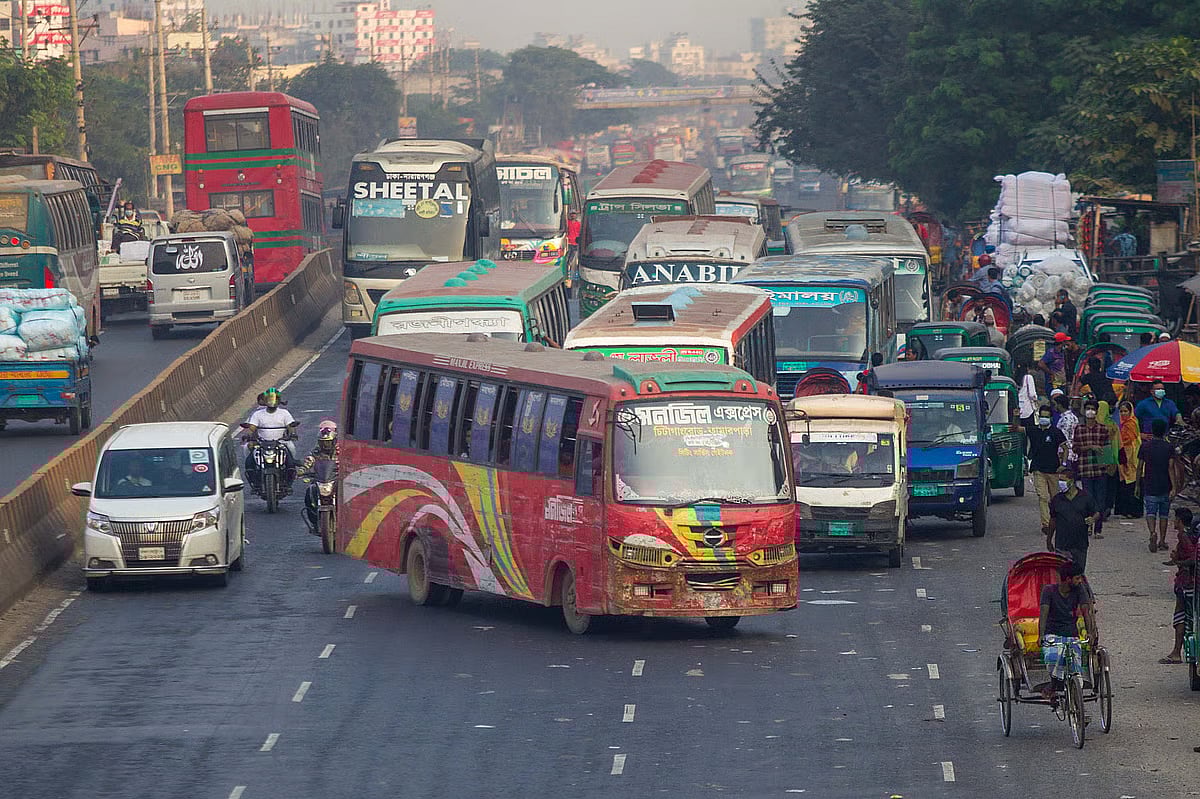
However, the interim government has not seen much success in addressing the chaos that plagued the transport sector during the previous administration.
Road accidents and fatalities continue to rise. Although there have been efforts to remove unfit buses and trucks, those initiatives have largely failed due to resistance from transport owners and workers.
Traffic congestion in Dhaka and disorder in public transportation remain much the same.
Muhammad Fouzul Kabir Khan, advisor in charge of the road transport and bridges ministry as well as the railways ministry, has overseen the drive to reduce expenditure.
To mark the government’s first year in office, a report was prepared detailing the cost savings achieved in these ministries and their affiliated departments.
According to the report, approximately Tk 140 billion was saved over the past year by reducing project expenditures.
Previously, Bangladesh Railway used to spend more than Tk 2.50 to earn just Tk 1.
That deficit has now been narrowed to some extent. The former Awami League government had undertaken a project to build an elevated road from Mithamain to Karimganj over the haor wetlands in Kishoreganj.
In addition to appointing an adviser for the road and railway sectors, the interim government also brought in Sheikh Moinuddin, an infrastructure expert and engineer from the United States, as a special assistant. He focused on finding ways to reduce costs in both ongoing and future projects.
The interim government decided to cancel the project, considering that it was not of significant public importance and would have had an adverse effect on the biodiversity of the wetlands.
The estimated cost of this project was around Tk 56.47 billion.
Experts had previously criticised similar road construction projects in the haor region for damaging wetland ecosystems.
In addition to appointing an adviser for the road and railway sectors, the interim government also brought in Sheikh Moinuddin, an infrastructure expert and engineer from the United States, as a special assistant.
He focused on finding ways to reduce costs in both ongoing and future projects.
The Dhaka Mass Transit Company Limited (DMTCL) is responsible for constructing and operating the city’s metro rail system.
Traditionally, the post of Managing Director (MD) has been held by civil servants from the administrative cadre. Breaking from this norm, the interim government issued an open recruitment call and appointed Faruk Ahmed through a panel of engineering university experts.
The new MD brings experience in metro rail construction and operations from Australia, India, Dubai, and Hong Kong.
Since taking charge, Faruk Ahmed has prioritised reducing implementation costs and minimising technical faults in metro rail operations.
During the student-public uprising, two metro rail stations, Mirpur-10 and Kazipara, were damaged. Under his leadership, both stations were reopened within just three months, at a cost of only Tk 180 million. Under the previous Awami League government, it had been estimated that the repairs would cost Tk 3.50 billion and take up to a year.
Last fiscal year, Bangladesh Railway had to spend over Tk 2.5 to earn just Tk 1. According to railway accounts, this figure has now dropped to Tk 2.09 in expenses per Tk 1 of income in the current fiscal year. This improvement is attributed to austerity in procurement, reduction in fuel costs, and increased income from land leasing.
Speaking to Prothom Alo, adviser Muhammad Fouzul Kabir Khan, said, “I have placed the highest priority on reducing expenses and preventing waste in projects. That effort has yielded success. But we must sustain it. The major challenge was halting the irregularities that occurred under the previous government—and we’ve largely succeeded in doing so.”
Cautious approach to large-scale projects
During the over 15-year tenure of the previous Awami League government, nearly Tk 3 trillion (300,000 crore) worth of development projects were implemented under the Ministry of Railways and the Road Transport and Bridges Division. Many of these projects have been plagued by allegations of cost overruns, corruption, and irregularities.
After taking office, the interim government released a white paper on the economy. According to the white paper, prepared by a committee led by economist Debapriya Bhattacharya, nearly Tk 2.75 trillion (275,000 crore) was wasted or misused in the name of development projects during Sheikh Hasina’s administration.
The caretaker government had the intention but it was not sufficient. Time constraints were also a factor.Professor Shamsul Haque, Department of Civil Engineering, BUET
According to the white paper, up to 40 per cent of the spending on development projects during that period was embezzled.
The first meeting of the Executive Committee of the National Economic Council (ECNEC) under the interim government took place on 18 September last year.
During that meeting, Chief Advisor Professor Muhammad Yunus announced that from now on, the government would prioritise small, high-impact projects rather than mega projects.
Since then, other senior officials, including the economic and finance advisers, have also echoed the stance of avoiding large-scale projects. This approach has been reflected in the road and rail sectors.
Under the interim government, very few large-scale projects have been initiated in these two ministries. Notable among them is the approval of the Kalurghat Rail-cum-Road Bridge project under the Railway Ministry, worth Tk 115.6 billion. The government also approved the contractor selection process for constructing a link road to Matarbari Port in Cox’s Bazar.
Additionally, it has taken the initiative for a proposed 11-km-long bridge between Bhola and Barishal, with an estimated cost of Tk 174.66 billion, though this project is yet to be approved.
Reducing the railways' income-expenditure gap
Last fiscal year, Bangladesh Railway had to spend over Tk 2.5 to earn just Tk 1. According to railway accounts, this figure has now dropped to Tk 2.09 in expenses per Tk 1 of income in the current fiscal year. This improvement is attributed to austerity in procurement, reduction in fuel costs, and increased income from land leasing.
Adviser Fouzul Kabir Khan told Prothom Alo that the target is to reduce the expenditure to below Tk 2 per Tk 1 earned by December. To meet this goal, Bangladesh Railway is working on short-, medium-, and long-term plans.
Full success in bringing discipline to the transport sector has not been achieved.Adviser Fouzul Kabir Khan
Over the past year, the railway ministry conducted 177 eviction drives to reclaim illegal encroachments on railway land, resulting in the recovery of 99 acres and the removal of around 6,000 illegal structures. The interim government also introduced 10 pairs of commuter trains, operating on routes such as Dhaka–Narsingdi, Dhaka–Gazipur, and Dhaka–Narayanganj.
The ministry has compiled a list showing cost reductions in ongoing and completed projects, with total reported savings of Tk 85.94 billion.
Notable savings include: Padma Bridge Rail Link Project: Tk 6.22 billion, Dohazari–Cox’s Bazar Railway Project: Tk 66.98 billion, Akhaura–Laksam Dual Gauge Double Line Project: Tk 8.59 billion, Locomotive Procurement Project: Tk 390 million, Akhaura–Agartala Rail Link Project: Tk 1.92 billion and Khulna–Mongla Railway Project: Tk 1.83 billion.
Railway officials stated that some projects, like the Dohazari–Cox’s Bazar line, had reduced work scopes, leading to cost reductions.
Unnecessary expenditures were also removed. In the Padma Rail Link Project, the cost of constructing a temporary station at Bhanga was reduced. Across other projects, a combination of austerity measures and reduced work volume helped cut costs.
Success in stopping contractor fraud at RHD
The RHD took on a project worth Tk 68 billion to expand a 30-kilometer regional highway in the Brahmanbaria and Habiganj districts. The contractor recruitment process was also finalised.
When the project was sent for approval to the adviser’s office, the Ministry of Road Transport opened an investigation. They found that only 750 meters of road damaged by floods needed to be rebuilt. However, the project was designed as a road expansion to increase expenditure. The road adviser cancelled the project considering it unnecessary.
RHD sources said that after the caretaker government took office, it became mandatory for officials from the ministry to conduct on-site inspections before appointing contractors for any project costing more than TK 5 billion.
Moreover, previously, all procurement tasks were completed under the additional chief engineer’s office, which limited oversight. The incumbent government has transferred procurement responsibilities to the executive engineer.
To bring transparency in procurement, organisations like Transparency International Bangladesh (TIB) and others had been advising this move for a long time.
Analysis of RHD’s contracting work over the last decade shows that 15 firms received 90 per cent of the total work in terms of expenditure. These contractors were supported by ministers and MPs from the former Awami League government. Many secured exclusive contracts by submitting fraudulent documents. Officials from RHD say the caretaker government broke the monopoly of these 15 contractors.
Regarding cost savings, RHD itself has prepared a list claiming that Tk 21.31 billion was saved from 22 recently completed projects in the past year. Ongoing development projects have also reduced expenditure by Tk 37.51 billion.
Road discipline remains elusive, no drop in accidents
According to the Road Safety Foundation, 696 people died in road accidents in the country last June, averaging 23 deaths per day. In May, 588 people died in accidents, indicating a 22.55 per cent increase in deaths in one month.
According to Bangladesh Road Transport Authority (BRTA), 566 people died in road accidents last June, while 490 died in May. This shows a 15.51 per cent rise in deaths in one month. Reviewing BRTA’s monthly accident reports reveals that fatalities have been increasing almost every month.
The previous Awami League government backed away from phasing out old buses and trucks that are harmful to the environment and increase the risk of road accidents. The caretaker government decided to remove these expired vehicles. From 20 July, BRTA started operating mobile courts. By 31 July, 51 buses and trucks were seized. In response, transport owners and workers organisations opposed the crackdown and called a strike on 12 August. However, the strike was withdrawn after talks with the government.
To bring discipline to public transport in Dhaka, the Dhaka Transport Coordination Authority (DTCA) was entrusted with rationalising bus routes or operating buses under a few companies. This authority is under the Ministry of Road Transport. In the past year, the agency has not been able to introduce a single new bus on any route. As a result, Dhaka residents have been forced to travel on old, rickety buses.
In Dhaka and Chattogram, CNG-run auto-rickshaws do not operate with meters. When police initiated legal action against the owners and workers of this sector, various locations in Dhaka, including Banani, were blocked on 13 July. The government stepped back. Thus, the effort to bring order to public transport has been obstructed by owners and labour groups, similar to the previous government’s time as well as during the caretaker government’s tenure.
Adviser Fouzul Kabir Khan admits that full success in bringing discipline to the transport sector has not been achieved.
He further said that during the caretaker government, due to various demands and movements involving road occupation, some concessions had to be made. Time constraints were also a factor. However, efforts are ongoing.
Limited time, more needs to be done
Professor Shamsul Haque, from the Department of Civil Engineering at Bangladesh University of Engineering and Technology (BUET) and an expert on public transport, told Prothom Alo that undoing the mismanagement and corruption in the transport and road sector during the former Awami League government and restoring it correctly is a difficult task.
Pointing out that the caretaker government had the intention, he said, it was not sufficient. “Time constraints were also a factor.”
The most surprising thing is that the bureaucracy used to say they could not take a stand against corruption due to political pressure. But during the caretaker government, although they had the opportunity to play a strong role, they did not. In fact, they also benefited from the chaotic system, he added.
Professor Shamsul Haque congratulated the caretaker government for curbing project expenditures in roads and railways, saying the main reason was that the caretaker government did not make decisions for personal gain. Because of that, some wastage was prevented.
Future political governments must maintain this stance, he remarked.
Professor Shamsul Haque hopes that the caretaker government will take further measures in the long term to stop wastage and prevent expenditure increases in projects. For example, no external official should be allowed to take any benefit (such as cars or foreign trips) from projects. Purchasing expensive vehicles must be stopped. Foreign travel by those who have no role in the project should be legally banned, he added.