Diplomacy
What message did the Turkish foreign minister leave behind?
Announcement of 3 new frameworks, including ‘2+2 dialogues’.
Ankara seeks to institutionalise defence and political cooperation
In December 2020, the then Turkish Foreign Minister Mevlüt Çavuşoğlu visited Dhaka. Highlighting the significance of that pre Covid-19 pandemic visit, the Turkish foreign ministry quoted Çavuşoğlu on its website, stating, “Bangladesh is one of South Asia’s rising stars and a crucial partner in our Asia Anew initiative.”
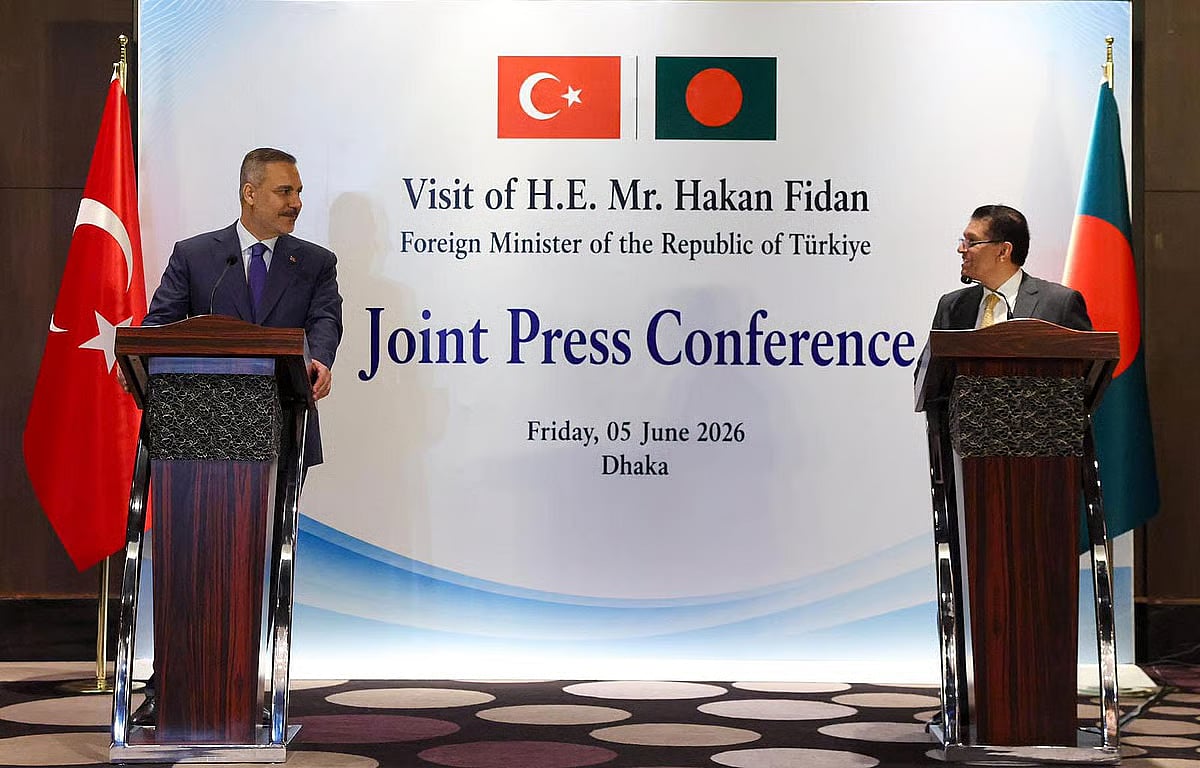
Six years later, Turkey’s incumbent Foreign Minister, Hakan Fidan, arrived in Bangladesh. Following a three-day visit, he has now departed. During his stay, he held talks with Foreign Minister Khalilur Rahman and paid a courtesy call on Prime Minister Tarique Rahman.
In that meeting, three frameworks were announced to elevate bilateral relations to the next level. These include: annual ‘2+2 dialogues’ involving the Foreign and Defence Ministers of both countries; upgrading the annual foreign ministry-level meetings to the ministerial level; and forming a consultative committee under the foreign ministry to further strengthen political, economic, and strategic cooperation.
What Mevlüt Çavuşoğlu said six years ago about Bangladesh’s importance to Turkey has now been reinforced by Hakan Fidan, who, during his first visit to Dhaka, clearly outlined what Ankara intends to do for advancing the relationship with Dhaka to the next level.
At present, major and emerging global powers regularly hold annual ‘2+2 dialogues’ with key partners, bringing together foreign and defence ministers. These meetings address not only bilateral and international relations but also crucial defence and security issues.
Three frameworks were announced to elevate bilateral relations to the next level. These include: annual ‘2+2 dialogues’ involving the Foreign and Defence Ministers of both countries; upgrading the annual foreign ministry-level meetings to the ministerial level; and forming a consultative committee under the foreign ministry to further strengthen political, economic, and strategic cooperation.
Turkey currently holds regular meetings under this framework with four countries—the United States, Japan, the Netherlands and India. Bangladesh has now become the fifth country to join that list. Turkey also holds ‘2+2 dialogues’ with Ukraine and Indonesia, though on a less regular basis.
According to diplomatic observers, the three new institutional frameworks announced during Hakan Fidan’s visit indicate that Ankara no longer wishes to confine its relationship with Dhaka to trade and development cooperation alone.
Instead, Ankara is seeking to place bilateral ties on a more institutionalised and long-term footing by incorporating security, defence and strategic cooperation. The move also reflects Turkey’s growing strategic interest in Bangladesh.
The question now is where does Bangladesh fit within Turkey’s priorities and what is the significance of its Asia Anew policy or initiative? Also how does Ankara intend to advance its relationship with Dhaka forward?
What is Turkey’s Asia Policy?
According to information published on the website of Turkey’s Ministry of Foreign Affairs, President Recep Tayyip Erdoğan’s government unveiled its foreign policy initiative titled Asia Anew in August 2019. The initiative was launched basically to strengthen relations with Asian countries across political, economic, cultural, educational and strategic spheres.
We continue our efforts to further deepen our long-standing partnership across a broad spectrum and elevate it to a stronger and more visionary level on a solid foundation.Hakan Fidan, Foreign Minister, Turkey
Turkey adopted the Asia Anew initiative, recognising that the centre of gravity of the global economy and geopolitics is increasingly shifting towards Asia. Its objective is to make Turkey’s relations with Asian countries more organised, consistent and sustainable through regional, sub-regional and country-specific strategies.
One of the initiative’s key priorities is to increase trade, economic cooperation and investment flows with Asian countries on the basis of mutual interests.
Core priorities of the framework
Turkey’s Asia policy is built around four main pillars: strengthening cooperation at the governmental level; expanding private-sector cooperation alongside trade and investment; enhancing collaboration in education, science and technology; and promoting cultural exchanges and people-to-people engagement.
Ankara is considering ways to increase bilateral trade with Bangladesh from US$1.3 billion (130 crore) to US$2 billion (200 crore).
During his visit to Dhaka, Hakan Fidan said, “We can take steps to expand our cooperation in various fields, particularly in the defence industry.”
Turkey has begun to view Bangladesh not merely as a bilateral partner but as a strategic one. The ‘2+2 dialogue’ framework is generally introduced with countries where security and defence cooperation has reached a significant level.
The Asia Anew initiative places particular emphasis on expanding cooperation in high value-added and technology-driven industries, tourism, the economy, the defence sector, infrastructure, transport, logistics, green energy and sustainable development.
Turkey’s foreign policy initiative towards Asia encompasses South Asian countries including Bangladesh, India, Pakistan, Sri Lanka and the Maldives; all ASEAN member states; East Asian countries such as China, Japan and South Korea; as well as countries in Central Asia and the Pacific region.
Why Bangladesh matters
For Bangladesh, the Asia Anew initiative is becoming increasingly important. It has created a policy framework through which Turkey is expanding Dhaka-Ankara relations to a new level.
Particularly in recent years, emphasis has been placed on defence cooperation, trade and investment, infrastructure development, higher education exchanges, technology and innovation, the blue economy, and maritime cooperation.
Attention would now focus on what specific steps are taken to elevate Dhaka-Ankara relations to a strategic level. Overall, it is clear that cooperation between the two countries is set to deepen in the future.ANM Muniruzzaman, President, BIPSS
Speaking at a joint press conference following bilateral talks in Dhaka, Hakan Fidan said, “We continue our efforts to further deepen our long-standing partnership across a broad spectrum and elevate it to a stronger and more visionary level on a solid foundation.”
From bilateral cooperation to strategic partnership
Turkey has begun to view Bangladesh not merely as a bilateral partner but as a strategic one. The ‘2+2 dialogue’ framework is generally introduced with countries where security and defence cooperation has reached a significant level.
Bringing foreign and defence ministers together under a single framework signals an intention to elevate the relationship beyond trade and development cooperation to include security and geopolitical dimensions.
Turkey seeks to establish a long-term and institutionalised relationship with Bangladesh. Relationships that depend heavily on individuals or particular governments often weaken with political change. By introducing annual foreign minister-level meetings and establishing an advisory committee, Turkey is signalling its interest in placing the relationship on a regular, structured and enduring footing.
Bangladesh’s strategic importance to Turkey has grown considerably.
More broadly, alongside India, Bangladesh has emerged as one of South Asia’s fastest-growing economies, with a significant geopolitical position centred on the Bay of Bengal and an important role within the Muslim world. As a result, under the Asia Anew initiative, Turkey now attaches greater importance to Bangladesh as a regional partner than at any previous time.
Major General (retd.) ANM Muniruzzaman, president of the security think tank the Bangladesh Institute of Peace and Security Studies (BIPSS), believes that the three frameworks agreed upon by the two countries to take relations to the next level will add a new dimension to the partnership.
Speaking to Prothom Alo, ANM Muniruzzaman said attention would now focus on what specific steps are taken to elevate Dhaka-Ankara relations to a strategic level.
Overall, he said, it is clear that cooperation between the two countries is set to deepen in the future.