Illegal stone extraction continues despite crackdowns
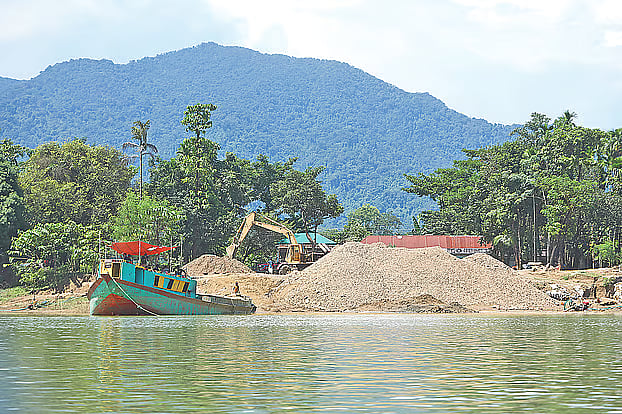
Large vessels locally known as bulkheads were seen lined up in the river, where hundreds of workers were loading stones stored on the riverbank. Nearby, excavators were dredging stones from beneath the water.
Such a scene was witnessed yesterday in the Lova River of Kanaighat upazila, despite ongoing crackdowns against illegal stone extractors in different parts of Sylhet. The Lova, which flows in from across the border, merges into the Surma. Along with the current, stones also drift downstream from the other side of the border.
At the Bangladeshi entry point of the Lova stands a quarry where stone extraction was officially permitted until 2020. After that, the government stopped leasing it out, effectively banning extraction.
However, locals allege that large-scale “looting” of stones continues under the pretence of relocating stones auctioned off earlier. According to them, most of those involved are leaders and activists of the ousted Awami League, working in collusion with some BNP leaders. Contractors who bought the auctioned stones are also said to be part of this arrangement.
The Lova River is about 60 kilometres from Sylhet city and around 8 kilometres from Kanaighat upazila town. From 1:00 pm to 2:30 pm yesterday, a visit by boat through the Surma to the zero point of the Lova on the Indian border revealed workers loading stones onto a bulkhead stationed in the Surma near Kanaighat Bazar.
At least 15 labourers were seen working there. Piles of stones stretched for about half a kilometre around the area, while nearby crushing machines were breaking stones into smaller pieces.
Further upstream, as the boat entered the Lova, hundreds more piles of stones lined both banks. In areas such as Chintarbazar, Mechhar Char, Bagicha Bazar, Nayabazar, Mulagul, Saudgram, Barogram, and near the 26 pillars of Lovachhara, including Bhalukmara and Daukergul villages, at least 100 bulkheads were docked, all being loaded with stones.
Around 50 excavators were observed transferring stones into the vessels, while 30 to 35 crushing machines were breaking them down into smaller pieces.
Stone extraction was visibly taking place at three separate points, with excavators in operation. Some men were even collecting stones from beneath the water with their bare hands and loading them into boats.
A local resident, requesting anonymity, told Prothom Alo that the Lovachhara area is remote and rarely visited by authorities. “That’s why there is no obstruction to stone looting here,” he said. “The stones are usually moved at night when no one sees.”
How stones are extracted
According to local administration sources, after quarry leases were suspended in 2020, mobile courts seized about 10.6 million cubic feet of stones from both banks of the river and surrounding areas.
Of these, 4.4 million cubic feet were put up for auction that same year, though the sale could not proceed due to pending cases. Once the legal complications were resolved, on 29 December last year, the Bangladesh Mineral Development Bureau (BMD) sold the 4.4 million cubic feet of stones at auction.
A company named Messrs Piyas Enterprise purchased them for Tk 215 million.
The contract stipulated that the stones had to be removed only during daylight hours, at the buyer’s own expense and initiative, within 45 days as mentioned in the work order. It was also strictly prohibited to extract or stockpile fresh stones and mix them with the auctioned ones.
Sources said the contractor began stone removal on 7 May. The stipulated 45 days soon expired, after which the company applied for and received a 30-day extension. That extended deadline also ended on 23 July.
Sylhet Deputy Commissioner Mohammad Sher Mahbub Murad told Prothom Alo, “The auction-winning company applied a second time for an extension. But the Ministry of Energy and Mineral Resources dismissed the application and closed the matter without granting more time.”
Asked why stone transfer was still taking place after the deadline, Kamrul Hasan Chowdhury, owner of Messrs Piyas Enterprise, claimed he was not unlawfully removing stones. He argued that he was given only 45 days to move such a huge quantity, which was not feasible. According to him, only 30–40 per cent of the auctioned stones could be shifted within that time. He said he then applied for a further three months, which was rejected, leading him to file a petition with the High Court. The court granted him three more months, though he had heard that the government had appealed against the order. “But no stay order has been issued,” he said. “So there is no bar to continuing stone transfer.”
When asked who was transporting stones at night, Kamrul Hasan Chowdhury replied that he did not know.
Environmental activists in Sylhet, however, said that although the contractor was given an additional 30 days after the original 45, the fresh application for more time seemed to serve a different purpose.
BNP leaders in front, Awami League behind the scenes
Local sources say that the owner of the contracting company that purchased stone through auction, Kamrul Hasan Chowdhury, was once an active leader of the Sylhet City Jatiyatabadi Chhatra Dal (BNP’s student wing). He is being used as the public face, while 20 to 30 Awami League leaders and activists are allegedly involved in stone looting. A few individuals connected to BNP politics are also implicated.
Those accused of involvement and patronage in the stone looting include Kanighat Upazila Awami League’s finance secretary Tamiz Uddin, senior member Kamal Uddin, Awami League activist Mainul (arrested on 12 August in another case), Lakshmiprasad Purba Union Awami League general secretary Nazim Uddin, vice-president Bilal Ahmed, and Kanighat Upazila Awami League’s environment affairs secretary Almas Uddin.
Three of those named—Tamiz Uddin, Bilal Ahmed, and Almas Uddin—spoke to this correspondent. They denied the allegations.
Tamiz Uddin said: “I am not involved in any of this. Has the person who won the auction lodged a complaint? If not, then why should there be allegations against me? On both sides of Lovachhara, there are no stones beyond the auction area.”
Almas Uddin said: “We had a little stone. The government took that away. Now, those who got the auction are collecting. We are not involved in anything.”
However, Nazim Uddin, member of Ward no. 3 of Lakshmiprasad Union Parishad and joint secretary of the local Union BNP, said: “Along with the company that got the auction, Awami League leaders and a few BNP activists are jointly extracting stones now. The deadline for removing auctioned stones has already passed, yet the extraction continues. On top of that, new stone is being extracted, damaging the local environment.”
Auction papers used as a shield
Stone looting has been ongoing in different parts of Sylhet for a year. The most recent looting took place from the Sada Pathor tourist site in Bholaganj upazila. Amid widespread criticism, the government launched a forceful crackdown from Thursday.
Local administration reported that joint forces and taskforce teams conducted operations for the fifth consecutive day yesterday to recover looted stone. By 5:00 pm, around 39,000 cubic feet of stone had been seized in Sylhet Sadar, Companiganj, and Gowainghat upazilas. Two people were detained for questioning in the Salutikor area of Sadar upazila.
Amid the crackdown, allegations have emerged that stones are being removed from the Lova River using auction papers as cover.
Commenting on the matter, Shah Saheda Akhtar, divisional coordinator of the Bangladesh Environmental Lawyers Association (BELA) in Sylhet, told Prothom Alo: “A syndicate is using valid auction papers as a shield to indiscriminately loot quarries and surrounding areas.”