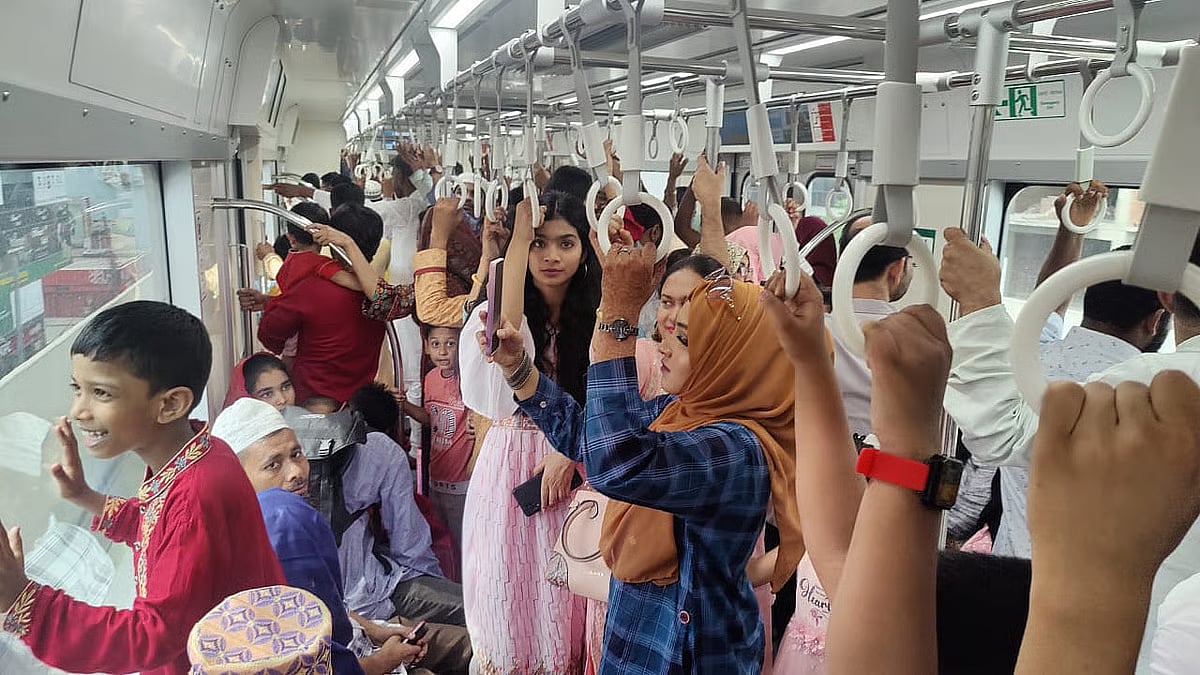
Metro Rail: Nearly 500,000 passengers a day, how much revenue generated?
Passenger numbers on Dhaka’s metro rail have reached close to expectations. More than 313.5 million passengers have travelled on the metro rail since its launch. On 10 September this year, the number of passengers in a single day came close to 500,000 —the highest recorded so far.
Revenue from ticket sales is also increasing as passenger numbers grow. However, operating and maintenance costs will rise in the coming years, while the authorities will also have to repay instalments on substantial loans.
Against this backdrop, Dhaka Mass Transit Company Limited (DMTCL) has taken initiatives to increase revenue from sources other than ticket sales, alongside increasing passenger numbers by adding more trains and extending operating hours.
The metro rail began operating on the Uttara–Agargaon section on 28 December 2022. The Agargaon–Motijheel section opened on 4 November 2023. Passenger services along the entire Uttara–Motijheel route began on the last day of that year.
Metro rail has now become an important part of daily public transport in Dhaka. It has become a preferred mode of transport for many people, particularly those travelling between Uttara, Mirpur, Farmgate, Shahbagh and Motijheel.
The opportunity to save time, avoid traffic congestion and reach destinations within a set timeframe has increased public interest in the metro rail. As a result, passenger numbers have risen every year since its launch. The fact that daily passenger numbers have recently come close to 500,000 is another reflection of its popularity.
Kamal Hossain, a technologist at Dhaka Medical College Hospital who lives in Diabari, Uttara, told Prothom Alo that he takes the metro rail every day at 8:00 am. As he boards at the starting station, he gets a seat.
He easily reaches his office after getting off at Dhaka University station in about half an hour. He returns home comfortably in the afternoon in the same way. However, passengers boarding at stations along the route travel in overcrowded conditions, he said.
Revenue from ticket sales has increased alongside the rise in the number of metro rail passenger. However, the financial performance of the metro rail cannot be assessed based on revenue alone. The system required substantial investment to build, a large portion of which came from foreign loans. Repayment instalments on those loans will increase over the next few years.
At the same time, operating and maintenance costs will rise as the metro rail infrastructure ages. Therefore, alongside increasing passenger numbers, finding ways to generate more revenue from existing infrastructure has also become important.
Although passenger numbers have reached close to the initial estimates for the project, the metro rail’s full capacity has yet to be utilised. Although the system has the capacity to run trains every three and a half minutes, this was not possible for a long period because of staff shortages. The plan to operate trains from morning until midnight has also not been fully implemented.
Once the extension to Kamalapur opens, it will bring in new passengers and connect the metro rail with the railway network. This will create opportunities to increase both passenger numbers and revenue in the future.
Mohammad Nazrul Islam, director (operations and maintenance) of DMTCL, told Prothom Alo that staff members have now been recruited. Metro rail operating hours at night will gradually be extended. The interval between two trains will also be reduced.
Which days, stations see most passengers?
According to the latest data from the Dhaka Mass Transit Company Limited (DMTCL), a total of 313,546,306, passengers have travelled by metro rail since its launch. On 10 September this year, the metro rail carried a record 499,756 passengers in a single day.
The number of metro rail passengers has increased in recent months. For example, 480,620 passengers travelled on 13 September, 478,280 on 20 August, 476,815 on 14 September and 474,635 on 21 May. These were among the days with the highest passenger numbers since the service began.
DMTCL officials said the daily number of passengers now always remains above 450,000. When the project was undertaken, it was estimated that 500,000 passengers would travel between Uttara and Motijheel every day. The current passenger numbers are close to that estimate.
Motijheel station has so far recorded the highest number of passenger entries and exits. On average, 51,542 passengers enter the station and 51,036 leave it each day. The station is being used as an important destination because of its links with the office hub, the Secretariat and surrounding commercial areas.
DMTCL officials said other stations carrying the highest numbers of passengers include Uttara North, Pallabi, Mirpur-10, Karwan Bazar and Secretariat stations. Uttara South, Bijoy Sarani and Uttara Central stations have fewer passengers. Residential areas are somewhat farther from these stations.
Scope to extend operating hours
DMTCL officials said the metro rail has the capacity to run trains at intervals of three and a half minutes. When the project was undertaken, there were also plans to operate trains from morning until midnight. However, this capacity could not initially be fully utilised due to a shortage of staff. Operating hours are now being extended gradually, while more staff are being recruited.
According to the authorities, annual revenue from ticket sales could reach around Tk 5 billion (500 crore) by increasing the number of trains and extending operating hours. This would not only allow more passengers to be carried but also increase the utilisation of the existing infrastructure.
Work is underway to extend the metro rail to Kamalapur. Once the extended section becomes operational, daily passenger numbers are projected to reach 677,000. The opening of the Kamalapur section will also create a direct connection between the metro rail and the country’s railway network.
An updated estimate of how many additional passengers this will bring and how much it will increase ticket revenue would provide a clearer picture of the financial outlook.
Revenue rising, but large instalments lie ahead
During the partial operation of the metro rail in the 2022–23 fiscal year, ticket sales generated more than Tk 220 million (22 crore). In the 2023–24 fiscal year, this increased to around Tk 2.44 billion (244 crore). In the latest 2024–25 fiscal year, unaudited revenue stood at around Tk 4 billion (400 crore).
Meanwhile, Tk 197.18 billion (19,718 crore) was borrowed from JICA through five loan agreements for the MRT Line-6 project. The loans, including interest, must be repaid over the next 30 years. The instalment amounts in taka may also change if the foreign exchange rate fluctuates.
During construction of the metro rail, there was a grace period of up to 10 years for repayment of the principal instalments. Limited repayment began in June 2023. More than Tk 37 billion (3,700 crore) in instalments will have to be paid over the five years through 2030–31, averaging around Tk 7.4 billion (740 crore) a year.
Efforts to increase revenue beyond fares
The construction cost of the metro rail was Tk 334.72 billion (33,472 crore), around 59 per cent of which came from JICA loans. Experts believe there is limited scope to increase revenue by raising fares because of the high construction cost. VAT is also currently waived on metro rail travel.
Professor Shamsul Hoque of the Department of Civil Engineering at Bangladesh University of Engineering and Technology (BUET) said the number of trains and operating hours would have to be increased to boost metro rail revenue.
He said the metro rail serves Dhaka’s most important route and it was known even before construction that the route would have the highest number of passengers. Therefore, three years after its launch, the system should be operating at full capacity.
Metro rail services should be increased at night and on holidays. At the same time, attention should be given to reducing unnecessary expenditure, as maintenance costs will rise over time, added the professor.
According to DMTCL sources, efforts are underway to increase revenue beyond ticket sales by allocating unused space at stations for shops. There are also plans to make use of opportunities for using car parking and commercial spaces near the stations.
More than Tk 1 billion (100 crore) was spent on salaries and allowances, electricity and other expenses in the last fiscal year. Until December last year, a large part of the maintenance and equipment upkeep was carried out through contractors. Since January, DMTCL has taken responsibility for these expenses. As a result, operating costs are also increasing.
The number of metro rail passengers has reached close to the project’s estimate. There is scope for further growth in passenger numbers once the line is extended to Kamalapur and operating hours are increased. The key challenge in the next phase of metro rail operations will be to determine how much additional revenue can be generated from those passengers while managing operating costs and loan instalments.