9 May to 6 August
Roads blocked for 36 out of 90 days
Members of ‘Traffic Alert’, a Facebook group, very often post asking information whether there is any demonstration or rally in the city the next day in a bid to avoid that road.
Traffic congestion is nothing new in Dhaka city. The new addition is holding demonstrations, rallies, and similar programmes that block the roads almost daily, which has resulted in immense suffering for the city dwellers.
Analysing reports published on different news media, it has been learnt that from 9 May to 6 August, protests or rallies blocked roads in the capital on at least 36 out of 90 days.
During these days, roads were blocked 54 times. In some places, the same road was kept blocked for several consecutive days. On some days, multiple roads in different parts of the capital were blocked at the same time.
The analysis further shows, 26 of the 54 road blockades were done during programmes held by different political parties. Students from various educational institutions staged 13 of these protests. Roads were blocked six times over job-related demands, while the remaining nine blockades occurred for other reasons.
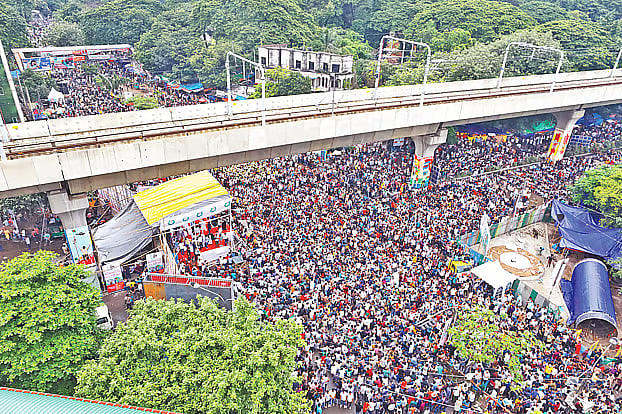
Most recently, on last Wednesday, the BNP brought out a victory procession from its party office in Naya Paltan to mark the first anniversary of the July mass uprising.
The procession started from Naya Paltan and passed through Bijoynagar, Purana Paltan intersection, the National Press Club and Matsya Bhaban, before ending at Shahbagh in the capital. Thousands of people joined the procession.
Apart from the procession, the students of seven colleges blocked the Science Lab intersection demanding the prompt issuance of the Dhaka Central University ordinance.
I left home seeing light traffic on Google Maps, but once on the road I suddenly found roads are being blocked creating congestion. It feels like all the suffering is only for us, the common people.Milita Mim, apprentice physician at a private hospital
Meanwhile, the leaders and activists of Jatiya Ganotantrik Party blocked roads in the capital’s Badda last Wednesday demanding deposed prime minister Sheikh Hasina’s repatriation from India. They declared to besiege the Indian High Commission in the city to realise their demand.
Overall, traffic congestion spread across the entire city and lasted until late at night. Although the BNP apologised over the matter, the sufferings of the people seemed endless.
Milita Mim, an apprentice physician at a private hospital, is a daily commuter from Demra to Mohammadpur.
Speaking to Prothom Alo, she said, “I left home seeing light traffic on Google Maps, but once on the road I suddenly found that the roads are being blocked creating congestion. It feels like all the suffering is only for us, the common people.”
Shahbagh is blocked the most
The analysis shows that in Dhaka, Shahbagh intersection was blocked at least 22 times in the past 90 days. Roads such as those in Kakrail, in front of the National Press Club, and at Science Laboratory intersection were blocked four to five times each. Some of these areas were also under restrictions imposed by Dhaka Metropolitan Police (DMP).
Earlier this year, the DMP issued several public notices prohibiting all kinds of meetings, rallies, gatherings, processions, and marches in and around the chief adviser’s official residence, Jamuna, the Bangladesh Secretariat, and surrounding areas. Before the public notice issued on 10 May, Shahbagh was also under this restriction.
Shahbagh is home to Bangladesh Medical University (formerly BSMMU) and BIRDEM Hospital. People from the northern part of Dhaka have to pass through Shahbagh to reach Dhaka Medical College Hospital (DMCH). When this road is blocked, traffic congestion increases on the alternative routes to Dhaka Medical.
A blockade in Shahbagh resulted in severe traffic congestion over a large part of the city on one end, endless public sufferings on the other. Besides, political programmes using loudspeakers all day near the two important hospitals also cause sufferings for the patients.
Willing to be unnamed, a physician from the Bangladesh Medical University told Prothom Alo that the intensive care unit (ICU) is located in the building next to the place where gatherings and demonstrations are usually held. In addition, patients in other wards also face various problems due to noise pollution.
The physician said that nowhere else in the world would such programmes be held beside a hospital. Shahbagh should be declared a silent zone. Instead, the silent zone has been declared around the Secretariat, where the officials work.
Analysing reports published on different news media, it has been learnt that from 9 May to 6 August, protests or rallies blocked roads in the capital on at least 36 out of 90 days. During these days, roads were blocked 54 times. In some places, the same road was kept blocked for several consecutive days. On some days, multiple roads in different parts of the capital were blocked at the same time.
The sufferings from traffic congestion are multidimensional. Traffic congestion causes delays for employees trying to reach their workplaces and creates difficulties for students heading to educational institutions. Due to political programmes, many people often avoid leaving their homes, which harms businesses and trade.
On Wednesday, Ziaur Rahman Azad, managing director of Azad Products Gulshan, posted in the ‘Traffic Alert’ group about the sufferings caused by political programmes. When contacted later, he told Prothom Alo that his home is in the Paltan area, where meetings and rallies frequently take place, leading to road closures and traffic jams.
He said, “This (road blockage) has now become a frustration for the city’s residents.”
Declining traffic speed
According to the 2023 population and housing census report published by the Bangladesh Bureau of Statistics (BBS), some 10.3 million people live in the city corporation area of the capital. For this vast population, public transportation is insufficient, while the number of private vehicles is quite high. In comparison, the road area is significantly smaller.
City residents may never get a well-organised, planned, and liveable city again because those in charge lack the knowledge, manpower, and the courage to solve the problems.BUET Professor M Shamsul Haque
It was stated in the National Parliament on 11 February 2024 that at least 25 per cent of a city’s area is needed for roads to maintain proper traffic management. Dhaka has only 9 per cent of its area covered by roads.
As per the figures of the Accident Research Institute (ARI) of the Bangladesh University of Engineering and Technology (BUET) and the World Bank, the average traffic speed was 21 kilometres per hour in 2007. By 2022, it reduced to 4.8 kilometres per hour. Due to traffic congestion, 8.2 million work hours are lost daily in Dhaka, with an economic cost of approximately Tk 13.9 billion in 2022.
Billions have been invested for the constructions of flyovers across the city. However, people have to wait for hours on those very flyovers due to road blockades and traffic congestion.
This (road blockage) has now become a frustration for the city’s residentsZiaur Rahman Azad, managing director of Azad Products
To reduce traffic congestion in Dhaka, experts have been advising to increase public transportation, bring discipline to transport management, and control small vehicles and private cars. Instead, previous governments focused on building large infrastructures. The metro rail has made travel easier from Uttara to Motijheel. However, the past government allowed battery-operated rickshaws to operate on the roads uncontrollably, and now they are difficult to regulate.
The interim government is yet to take any initiative to curb the number of sedans. The initiative to lift expired and unfit vehicles from the roads is highly opposed by the owners.
Professor M Shamsul Haque, a transport expert at BUET, told Prothom Alo that development has indeed taken place. The metro rail and flyovers have been built, but there is no integrated plan. He said that city residents may never get a well-organised, planned, and liveable city again because those in charge lack the knowledge, manpower, and the courage to solve the problems.
Where should the rallies be held?
Political gatherings and rallies have increased after the July uprising. In many cases the programmes were held on the main roads. At the same time, on days for a rally in a venue like the Suhrawardy Udyan, the city comes to a standstill to ensure a massive gathering.
City residents and experts are giving three suggestions in this regard. First, assemblies should be discouraged in places other than fields, parks, or open spaces. Such gatherings should only be allowed on holidays. Second, the government must take a strict stance against road blockades without valid reasons. Third, if demands are made through other means without blocking roads, the government should pay attention. It is often seen that if roads are not blocked, the government does not take the issue seriously.
However, the government hardly takes a strong stance. Sources say that on 31 July, the police contacted the government seeking approval to evict those blocking the road under the name ‘July Warriors’ at Shahbagh.
However, no response was received that day. The ‘real July Warriors’ attacked the group blocking the road the next day. The police also charged baton on them and removed them from the road.
Speaking regarding holding political programmes blocking the roads, DMP additional commissioner (traffic) Md Sarwar told Prothom Alo, “They discourage holding rallies like this because they also struggle to manage the subsequent traffic jams. However, the decision on this matter must be made by the political parties and organisations.”
‘Parties should not hold programmes that cause public sufferings’
There has been discussion for over two decades about avoiding public hardship caused by political programmes. However, political parties have neither made any commitments nor taken initiatives in this regard, although recently they have expressed regret.
When asked, Mahmudur Rahman Manna, president of Nagorik Oikya, told Prothom Alo, “Political parties should not organise programmes that cause public distress. Sometimes parties are compelled to hold certain programmes due to circumstances, but even then they can avoid causing public hardship.”
He added that with the increasing use of the internet, there is no need to hold such frequent large rallies.