“My father has become the sky,” Muntaha says, pointing a finger upwards
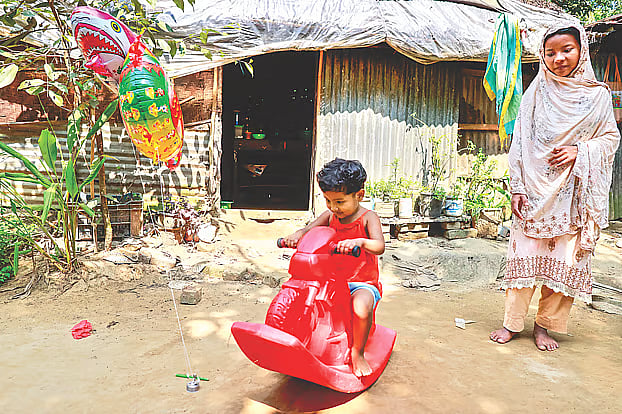
Two balloons float in front of the house. One is shaped like a chicken, the other like a shark. Four-year-old Muntaha Zaman Pranti says the chicken-shaped balloon is hers and the other belongs to her younger brother. Their father bought them the balloons.
Asked where her father is, Muntaha looks up at the sky. Raising one finger, she says, “My father has become the sky.”
Muntaha repeats that her father has gone to Allah. But she is still too young to understand that he will never return.
Muntaha’s father was journalist Lutfuzzaman Alif Fakir. On the night of 15 October, assailants shot him dead at Telunjia in Durgapur upazila of Netrokona. He was shot near his in-laws’ home, where he lived with his wife and two young children.
When this correspondent visited his in-laws’ home on Friday afternoon, Muntaha was playing in the yard in front of the tin-roofed house. She wore a red T-shirt and blue shorts. The curly-haired child had a smile on her face. The presence of unfamiliar visitors did not make her shy. She moved between playing and talking.
Her father’s memory is woven into this world of toys and play. Muntaha was the apple of Alif’s eye. He would indulge her little requests. She loved chicken fry. Whenever she did well in her studies, she would ask her father to bring some home. He would buy it for her on his way back. Her happiness was his happiness.
Toys of different colours lay scattered across the yard: a red rocking motorbike, dolls, a teddy bear, a plastic lion and a toy cooker. Open books and notebooks lay nearby, too. At one moment, Muntaha was rocking on the motorbike, gripping its handlebars with both hands.
A little later, she climbed down and sat beside the toys. She played sometimes with the teddy bear, sometimes with a doll. She gently stroked one doll’s head with great care.
The shadow of a tree fell across one corner of the yard. Tin-roofed houses stood all around. Above her head floated the two balloons her father had bought. This yard is now where Muntaha spends her days.
Her father’s memory is woven into this world of toys and play. Muntaha was the apple of Alif’s eye. He would indulge her little requests. She loved chicken fry. Whenever she did well in her studies, she would ask her father to bring some home. He would buy it for her on his way back. Her happiness was his happiness.
That father is gone now. But the toys and balloons he bought remain. Muntaha’s little world is still filled with them.
Muntaha’s mother is Khadija Akter, a woman from the Garo community. She and Alif fell in love and married. Before the marriage, she converted to Islam and took the name Khadija Akter; she had previously been known as Anandita Sangma.
With visitors at the house, Khadija brought out water, tea and biscuits. Little Muntaha seemed to take on the task of hosting guests alongside her mother. With her tiny hands, she repeatedly came forward carrying biscuits and offering them to visitors. Watching her busy herself like this, one could hardly imagine the terrible tragedy that had struck the family only days earlier.
Khadija does not know how she will manage once the money runs out. She is haunted by worries about how she will pay for her children’s food, healthcare and education.
Whenever Khadija spoke about her husband, she repeatedly broke down in tears. Muntaha sat beside her, silently watching her mother’s face. She listened as her mother spoke. At one point, when Khadija began to cry, Muntaha moved closer and pressed her little cheek against her mother’s. She stayed beside her. It is impossible to know how much she understands about her mother’s grief, but she would not leave her side.
Muntaha’s younger brother, Ayan Fakir Safwan, is only one and a half years old. He lay on a bed inside the family’s dilapidated house. He, too, is far too young to understand what it means to lose his father. When he grows up, he may not remember how his father held him in his arms or showered him with affection.
Now, with two young children to care for, Khadija is at a loss about what to do. The family had already been struggling financially before her husband’s death. Alif’s earnings from journalism had barely been enough to keep the household going. Thinking about their children’s future and the family’s needs, the couple had planned to move to Dhaka.
Khadija had studied nursing and intended to look for a job in the capital. The couple had been preparing to move there from November. To help them make the arrangements, Alif’s mother-in-law had borrowed Tk 40,000.
But before they could move to Dhaka, Alif was shot dead. All their plans changed. The Tk 40,000 they had borrowed to begin a new life is now the family’s only financial lifeline.
Khadija does not know how she will manage once the money runs out. She is haunted by worries about how she will pay for her children’s food, healthcare and education.
The man with whom she had built a home and dreamed of raising their children is gone. The responsibility for their future now rests entirely on her shoulders.
Four-year-old Muntaha understands none of her mother’s worries. She is still absorbed in her toys. Pointing to the two balloons floating in front of the house, she says her father bought them. And when asked where he is, she has an answer of her own: “He has become the sky.”