The latest earthquakes have once again exposed how vulnerable the capital, Dhaka, is to a major seismic disaster. Earthquake experts say the city’s proximity to the epicentres, unplanned urbanisation, and high risk of casualties all point to serious danger.
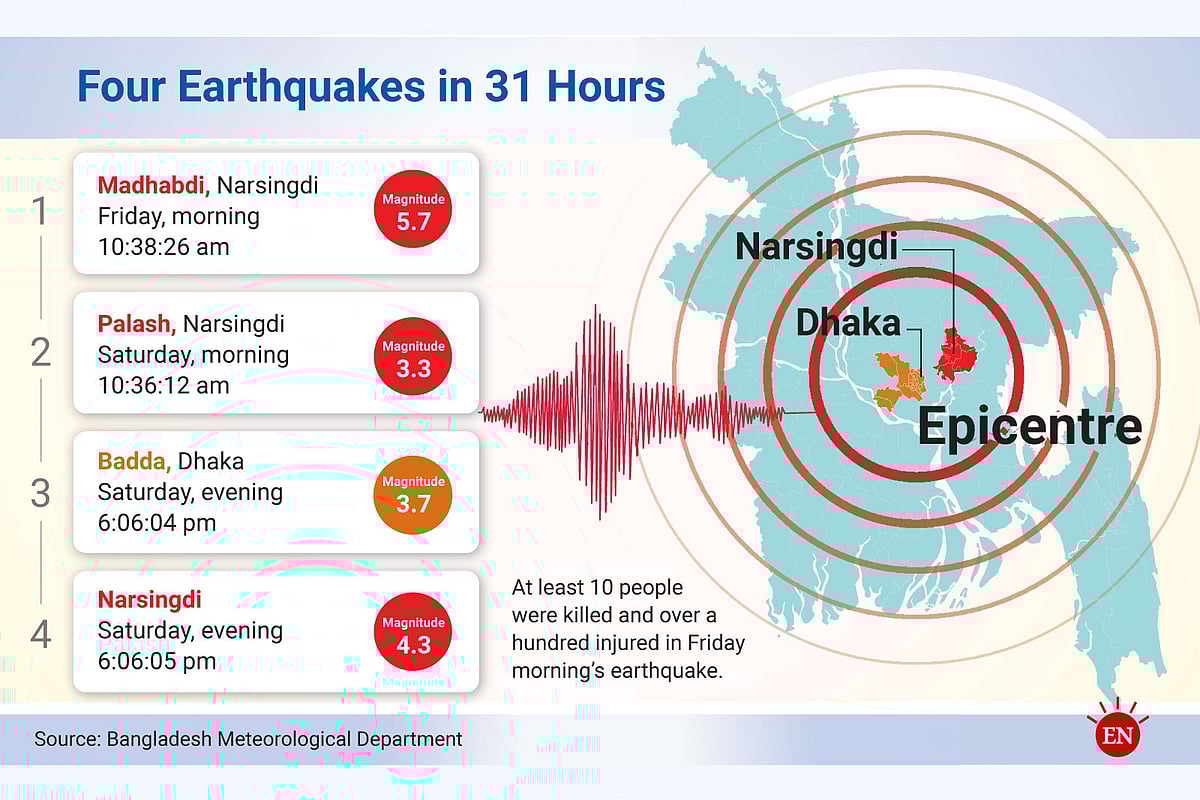
In the span of about 31 hours between Friday and Saturday, four earthquakes struck Dhaka and its surrounding areas, bringing the threat into sharper focus. Of these, Friday morning’s 5.7-magnitude quake on the Richter scale originated in Madhabdi of Narsingdi, around 25 km from Dhaka. The hypocentre was just 10 km below the surface.
The shallower the hypocentre, the stronger the shaking. Friday’s quake was one of the most intense in recent memory. Strong tremors were felt in Dhaka and many other regions of the country. Ten people, including children, were killed and more than 600 injured.
Within 24 hours, at 10:36 am yesterday, another quake of magnitude 3.3 struck, followed by a 4.3-magnitude quake around 6:00 pm. Both originated in Narsingdi.
Around the same time in the evening, yet another tremor shook the capital, with the epicentre in Badda—this one measuring 3.7. Experts view these mild to moderate tremors as warning signs of a larger earthquake.
Bangladesh Meteorological Department (BMD) data from the past five years reinforce this growing concern.
These aftershocks are significant because the fault line—locked under immense pressure for years—has begun to slip and release energy. Such aftershocks often precede a major quake. It could be very near.Professor Humayun Akhtar, Earthquake Expert
An analysis of BMD-recorded earthquakes between 17 February 2021 and 22 November 2024 shows that 39 earthquakes occurred within Bangladesh during this period.
Eleven of these—more than 28 per cent—originated within an 86-kilometre radius of Dhaka. Their magnitudes ranged from 3.3 to 5.7, with Friday’s event being the strongest. The second strongest, a 5.6-magnitude quake, originated in Ramganj, Lakshmipur. The remaining 28 quakes occurred within 100–267 kilometres of Dhaka.
In five years, earthquakes were recorded across 18 districts, including Dhaka, Narsingdi, Narayanganj, Tangail, Sylhet, Netrokona, Dinajpur, Habiganj, Rangpur, Cumilla, Lakshmipur, Pabna, Rangamati, Chuadanga, Shariatpur, Jashore, and Kurigram.
Md Mominul Islam, former acting officer of BMD’s Earthquake Monitoring and Research Centre and now a director at the department, told Prothom Alo yesterday that small tremors have occurred in Narsingdi before, but their magnitudes were low.
Bangladesh sits close to three active tectonic plates, and small earthquakes occur regularly. Large quakes are usually expected near plate boundaries, he added.
Mominul Islam added, “There is a sub-fault in Narsingdi. Earlier quakes were small, so they received little attention. Now it appears this sub-fault is much larger, extending toward Dhaka. This latest quake confirms that Dhaka is under significant risk.”
More quakes occur at night
BMD’s analysis also shows when the 39 earthquakes occurred. Most took place at night. Between 6:00 pm and 6:00 am, 23 quakes were recorded. The remaining 16 occurred during the day.
Experts warn that since most people sleep or remain indoors at night, the risk of casualties is higher during nighttime quakes.
Earthquake expert Prof Humayun Akhtar told Prothom Alo last night that less than one per cent of the energy accumulated in the subduction zone (the meeting point of two tectonic plates) has been released so far. “These repeated tremors are opening the path for a major earthquake,” he said.
He added that after Friday’s quake, aftershocks were expected. These aftershocks are significant because the fault line—locked under immense pressure for years—has begun to slip and release energy. “Such aftershocks often precede a major quake. It could be very near.”
Four reasons for heightened risk
BUET civil engineering professor Raquib Ahsan identifies four key reasons Dhaka faces severe danger.
He told Prothom Alo that the first is proximity to the epicentres. The fault near Dhaka was not previously understood so clearly, but now it appears to be opening up, potentially causing more earthquakes.
The second reason is soil composition. Dhaka’s newer areas were developed on low-lying land filled with loose soil, which amplifies quake intensity.
Third, many buildings in Dhaka do not follow building codes or seismic design standards.
Fourth, the population density of Dhaka means damage and casualties would be extremely high.
When asked about preparedness, the Director General of the Disaster Management Department, Rezwanor Rahman, said equipment is being procured for earthquakes and other disasters.
Preparedness: Where things stand
Although Bangladesh signed an agreement with China in 2016 to construct a National Operation Centre for earthquake disaster management, no progress has been made in nearly a decade. Land had even been allocated in Tejgaon.
Abu Daud Md Gulam Mustafa, joint secretary at the Disaster Management and Relief Ministry, said Tejgaon had one acre of land, but an additional 25 square metres was needed for storing construction materials—space that was not available.
When asked about preparedness, the Director General of the Disaster Management Department, Rezwanor Rahman, said equipment is being procured for earthquakes and other disasters.
He said the armed forces and fire service are deployed during major disasters, and procurement of additional equipment for various agencies is ongoing.
“We are trying to complete this as quickly as possible. We have 80,000 volunteers in coastal areas for cyclone response and 48,000 in urban areas. We will engage them in raising awareness on earthquakes.”
However, Disaster Forum's member secretary Gowher Nayeem Wara, believes the preparedness is still insufficient.
He said the ministry sent letters yesterday asking districts to report disaster-related information, which should come automatically during such events. “Why should letters be needed? In disaster management, time is critical. It took more than a day for information from Narsingdi to arrive.”
He added that local government bodies have almost no role in disaster management in Bangladesh. Countries that involve local governments are more successful in disaster response.
He stressed the need to include disaster awareness in the curriculum. “Students jumped from dormitory buildings out of fear—why should that happen? Universities do not practice these drills. This should be taught from school.”