Anthrax in Gaibandha: Patients struggling afford treatment
In Sundarganj upazila of Gaibandha, patients showing symptoms of anthrax are struggling to bear the costs of treatment. Many without finding adequate care at government hospitals are being forced to consult dermatologists at private clinics instead. Many are taking loans to buy medicines.
Patients complain, despite they visited the Upazila Health Complex right away after developing anthrax symptoms, they were not admitted. Physicians only prescribed medicines from a distance and sent them home without providing any medication. So, the patients are treating themselves at home by purchasing medicines themselves.
On 27 August, an anthrax-infected cow was slaughtered in Kishamat Sadar village under Belka Union in Sundarganj. Eleven men who participated in the slaughter developed blisters on their skin two days later, showing symptoms of anthrax.
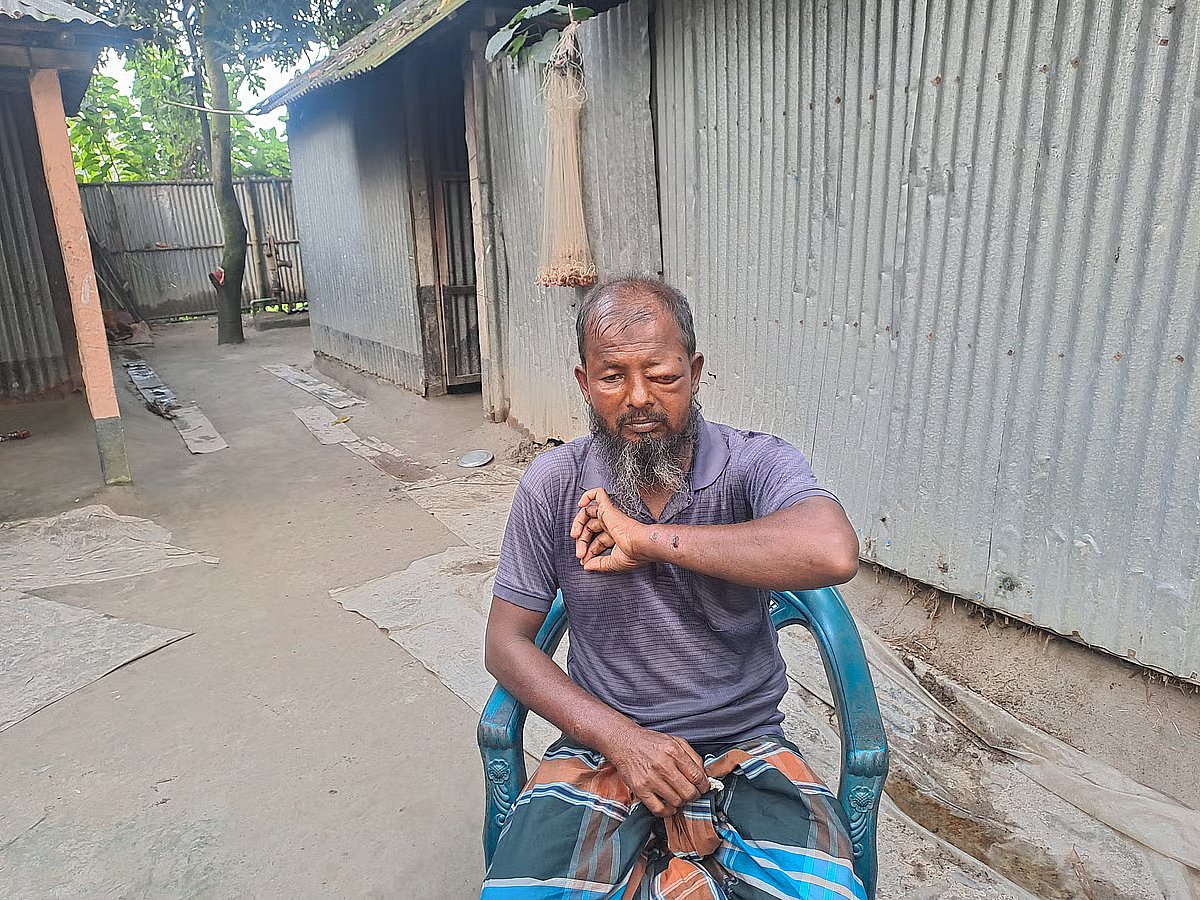
Those men are Mozzafar Ali, 50, Mojahar Ali, 60, Shafiul Islam, 35, Golzar Mia, 25, Khatib Mia, 35, Hasan Ali, 15, Nurunnabi Mia, 16, Faridul Mia, 20, Maruf Mia, 16, Kuddus Mia, 16, and Mithu Mia, 16. Of them, Mozzafar Ali said he has lost vision in his left eye for past 10 days.
A few days after the incident, Rozina Begum, 45, a housewife from nearby West Belka village, slaughtered a sick goat and processed its meat. On 4 September, she was admitted to Rangpur Medical College Hospital with anthrax-like symptoms. Later, she died there.
However, Sundarganj Upazila Health and Family Planning Officer Dibakar Basak claimed that the woman was not infected with anthrax. He told Prothom Alo that she had anthrax-like symptoms and was brought in a critical condition, suffering from heart disease, lung complications, low blood pressure, and breathing difficulties. After giving initial treatment she was referred to Rangpur Medical College Hospital, where she died while undergoing treatment.
On Wednesday morning, Prothom Alo visited Kishamat Sadar village and found farmer Mozzafar Ali sitting in his yard with a swollen eye and blisters on his left hand. He had been directly involved in slaughtering the cow, and its blood splashed into his eye. Other infected individuals had blisters on one or both hands, yet many were still trying to do household chores despite their condition.
Mozzafar Ali told Prothom Alo that when he went to the Upazila Health Complex to get admitted, the physician just wrote a prescription and sent him away. Even after taking the prescribed medicines for two days, the blisters did not heal. Later, he consulted a dermatologist who came from Rangpur to Gaibandha last Friday. He has been following his prescription since.
He hasn’t been able to see with his left eye for 10 days. He added, “I need advanced treatment for my eye, but where will I get the money? So far, I’ve spent Tk 10,000, half of it borrowed. The physician said I’ll need to continue medication for two months. The medicines are expensive, and I have to take them daily.”
Another patient, Shafiul Islam said, “The blisters on both my hands haven’t healed yet. So far, I’ve spent Tk 8,500, including Tk 5,000 borrowed at high interest. I don’t know whether to repay the loan or buy more medicine. I support my family by farming leased land and sometimes pulling a rickshaw in other districts. Now that I’m sick, I can’t even do that. I’m in real trouble.”
Golzar Mia, another villager, said, “I support my family by working as a day labourer. I’ve already spent Tk 9,000 on treatment, all borrowed. Every day I have to buy medicine. Between household expenses and buying medicine, I don’t know what to prioritise anymore.”
Nurunnahar Begum, 56, mother of Nurunnabi, one of the affected men said, “My son developed blisters on his right hand. We wanted to get him admitted to the Upazila Health Complex, but the physicians refused. They prescribed medicine from a distance. Later, we consulted a dermatologist in Gaibandha, and he’s now improving under that treatment.”
Commenting on the matter, Upazila Health and Family Planning Officer Dibakar Basak said, “Among the patients who came to the hospital with anthrax symptoms, none were severely infected. Therefore, hospitalisation was not necessary.”