Sabujchar
Fish harvested from paddy fields generate Tk 10m daily
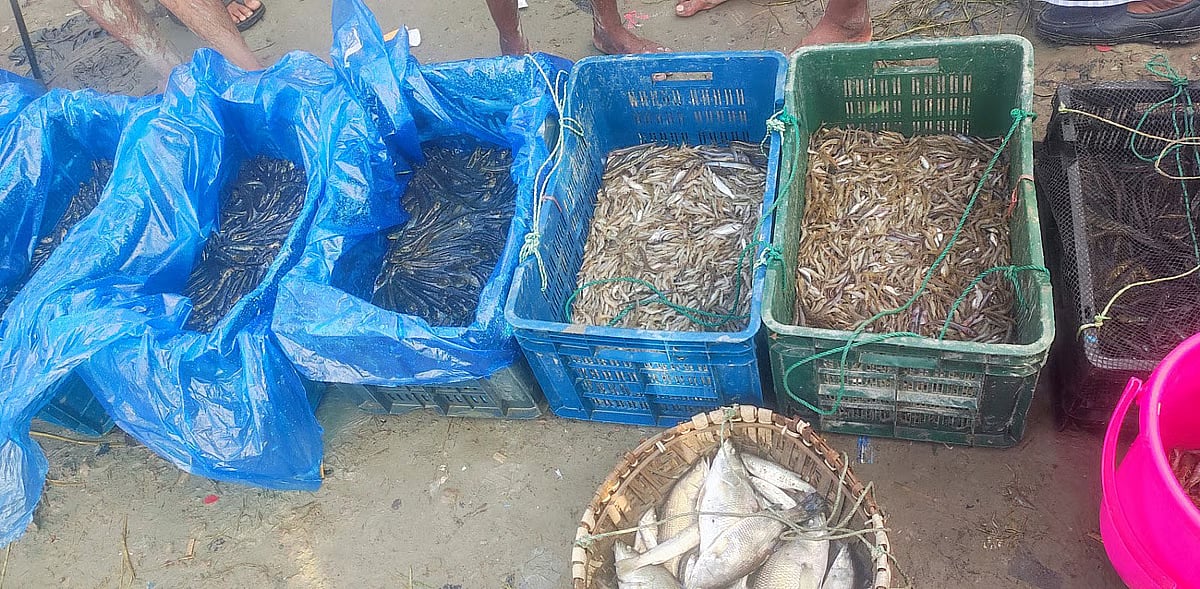
Water spreads across every corner of the green paddy fields. In these fields, farmers are catching fish such as koral (Asian sea bass), shrimp, and chiring, using small traps placed in the field ditches. This has been a daily scenario in Sabujchar of Sandwip upazila in Chattogram.
Although fishing in the sea is currently banned by the government, nearly Tk 10 million worth of fish is being harvested every day from the paddy fields of Shobujchar. Farmers say they primarily cultivate paddy for the purpose of fish farming, which allows them to earn higher profits with less labour.
It has been learned after talking to the farmers that Shobujchar remains dry during the winter. From the end of the Bengali month of Chaitra, the char gradually gets flooded with tidal waters. Sea fish also enter the char along with the tidal water. These fish lay their eggs in the water retained in the char.
The eggs start hatching from the beginning of the month of Jaistha. When Aman paddy is sown, the fish grow alongside the rice. As the monsoon ends, the fish are caught and brought to the Ekta Badh market locally. It is a festive time when the fish are sold.
Visiting the area early Thursday and Friday mornings, farmers were seen bringing in koral, shrimp, and various other marine fish in groups to the Ekta Embankment area of Dirghapara of Sandwip upazila. Fish traders from various markets in the upazila also flock there. Along with local wholesalers, thousands of people come to buy fish for their families.
Local farmer Nur Hossain told Prothom Alo, “During the ban on fishing in sea, these fish caught from the paddy fields has been a blessing for us. On one hand, it meets people’s demand, and on the other, farmers also benefit.”
Another farmer, Nizam Uddin, 60, said, “Shobujchar is one of the major Aman rice-producing areas of the country. Still, the farmers here cultivate rice not for the rice itself, but for the fish.”
Earning millions from fish
Shobujchar in Sandwip, known as Rajasail, is famous for its paddy production because this paddy variety yields well on the island. About 3,500 farmers cultivates paddy on around 5,000 hectares of land. Farmers catch fish from the paddy fields using small traps called ‘chai’ in the field ditches and locally made ‘bindi jaal’ nets.
It has been learned after speaking to farmers and shopkeepers that after the monsoon, 20 to 25 tonnes of fish—including koral, shrimp, tangra, and bata, and chiring—are sold daily. Among them, chiring fish sells at Tk 400–600 per kg, shrimp at Tk 500 per kg, and coral at Tk 600–800 per kg retail. In this way, fish worth nearly Tk 10 million is sold daily.
Local resident Jahangir Alam told Prothom Alo, “The busy fish market starts at six in the morning and continues until nine. Thousands of maunds of fish are exchanged non-stop during this period.”
Trader Md Zahed, 22, said, “No one keeps exact records of sales, but judging by the price and turnover, it is estimated that around Tk 10 million worth of fish is sold every day.”
Farmer Jamal Uddin, 54, told Prothom Alo that Aman cultivation on a three-hectare land costs him Tk 200,000, which he recovers by selling the rice and straw. On top of that fish harvested from this land bring him several more lakhs, and the entire income from fish sales is his profit.
Where the fish goes
Traders said that the fish harvested from Shobuzchar is sent to Noakhali, Dhaka, and other parts of the country. Every day, wholesalers from Noakhali and other areas come to this market. The fish is then packed in boxes and loaded onto trawlers.
Worker Alauddin came to buy fish for a trader. He told Prothom Alo that he sent 70 maunds of fish to Noakhali in a single trawler on Friday.
Farmers say that there is no fish preservation system in Shobuzchar. If such a system were in place, they could earn even more.
When asked about this, Upazila Executive Officer (UNO) Mangcingnu Marma told Prothom Alo, “I do not know the details about this matter. Once I learn the details, I will instruct the fisheries officer to take necessary action, and appropriate measures will be taken accordingly.”
Upazila Agriculture Officer Maruf Hossain said, “A coordinated government initiative is essential to make farmers more profitable from the vast Aman rice and fish resources of Shobuzchar. The agriculture department is ready to provide necessary support, and necessary measures will be taken.”