Metro rail accident
Kalam laid to rest, 'Where will I go now with my children?' asks grieving wife
The village of Ishwarkathi is about two kilometres away to the west from Naria Upazila in Shariatpur. Normally a serene and pristine settlement by the banks of the Padma and Kirtinasha rivers, the village is now in mourning.
The second Namaz-e-Janaza (funeral prayer) of Abul Kalam, who was killed Sunday when a metro rail bearing pad fell on him in Dhaka, was held this morning at the playground of Poragacha Islamia Dakhil Madrasa in Ishwarkathi.
Kalam was buried around 10:00 am today, Monday at the Naria municipal graveyard. Relatives and locals bade him farewell with tearful eyes.
Abul Kalam was from Ishwarkathi village in Moktarer Char union under Naria upazila. His sudden and untimely death has left his relatives and villagers in disbelief. He was the son of the late Jalil Chokdar and Honufa Begum of that village.
Among his four brothers and six sisters, Kalam was the youngest of the brothers. Both his parents died about 20 years ago, after which he was raised by his elder brothers and sisters.
Abul Kalam lived with his wife and two young children in Pathantuli area of Narayanganj, and worked with a travel agency based in Motijheel area of Dhaka. For his work, he commuted between Narayanganj and Dhaka every day.
Naeem Chokdar, a resident of Ishwarkathi who attended the funeral, said, “Kalam Bhai was known in the area for his gentle and calm nature. He was friendly with everyone. We just can’t accept such a tragic death.”
Earlier, the ambulance carrying Kalam’s coffin reached Ishwarkathi at around 2:00 am last night. Family members and many locals broke down in tears at the time.
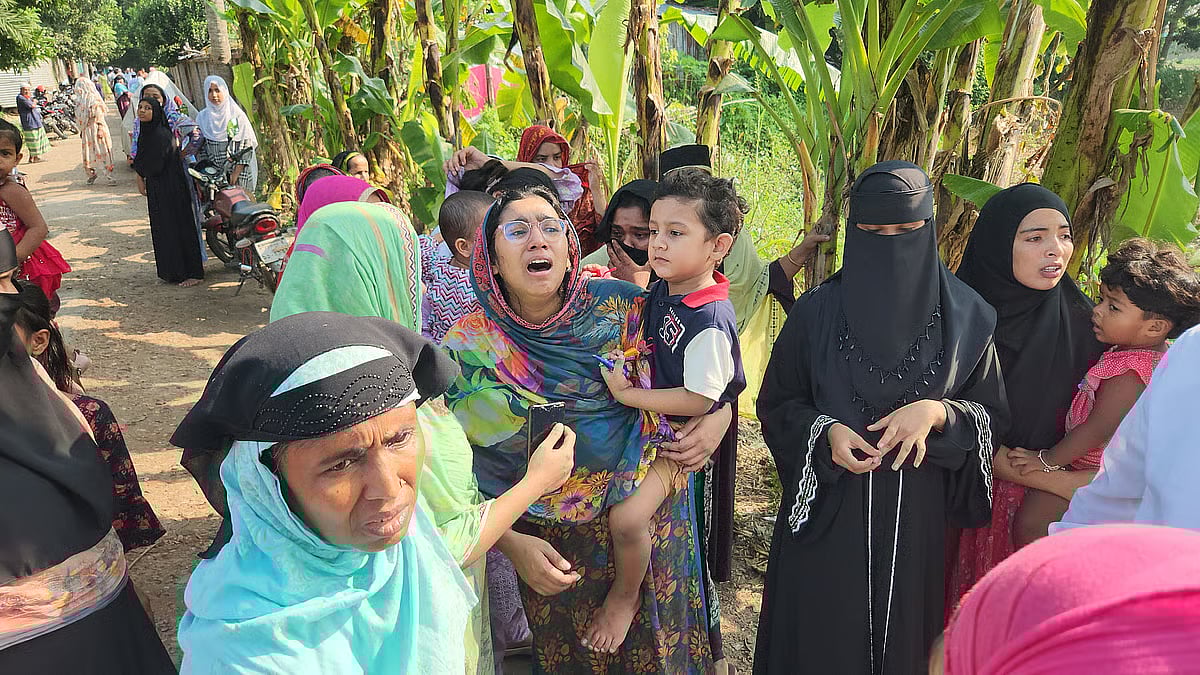
While visiting Abul Kalam’s village home this morning before the funeral, villagers were found gathered at the house to pay their respects. Many came for one last glimpse, eyes filled with tears. Family members sat in the courtyard weeping.
His wife, Irene Akter, was seen running around in anguish, clutching one of their children in her arms. Relatives tried to console but failed to calm her down. When the funeral prayer was over, Irene, holding her child, kept running after the coffin until relatives gently brought her back.
Speaking to Prothom Alo, Irene Akter said, “Yesterday, when he (Abul Kalam) left for work, I stood by the door. Even after he walked away, I couldn’t close it. I don’t know why, but I suddenly felt an overwhelming urge to cry. That had never happened before. Now, Kalam has left me in tears for a lifetime. Where will I go with my two children? Who will be there for us?”
Sitting in the courtyard, Kalam’s sister-in-law (his elder brother’s wife) Asma Begum wept bitterly while recalling memories of him. “After my father-in-law and mother-in-law passed away, I raised Kalam like my own son. He also treated me like a mother.”
“Yesterday around 11:00 am, he called me and said that the hilsa fishing ban was over and asked me to buy some for him. He said he’d come on Thursday to collect them. He was supposed to visit this Thursday, but instead his body came back now. Who knew that would be our last conversation? How do we endure this grief now?” she lamented.
Naria Upazila Nirbahi Officer (UNO) Abdul Qaiyum Khan told Prothom Alo that the administration coordinated all burial arrangements for Abul Kalam’s body and would continue to support the family. Discussions are underway at higher levels of government regarding assistance for the bereaved family.
As usual, Abul Kalam left his home in Narayanganj for Motijheel on Sunday morning. Later, he went out for work. Around 12:15 pm, a bearing pad from a metro rail pillar came loose and fell off, instantly crushing him to death in Farmgate area of Dhaka. The family learned of his death from media reports later in the day.