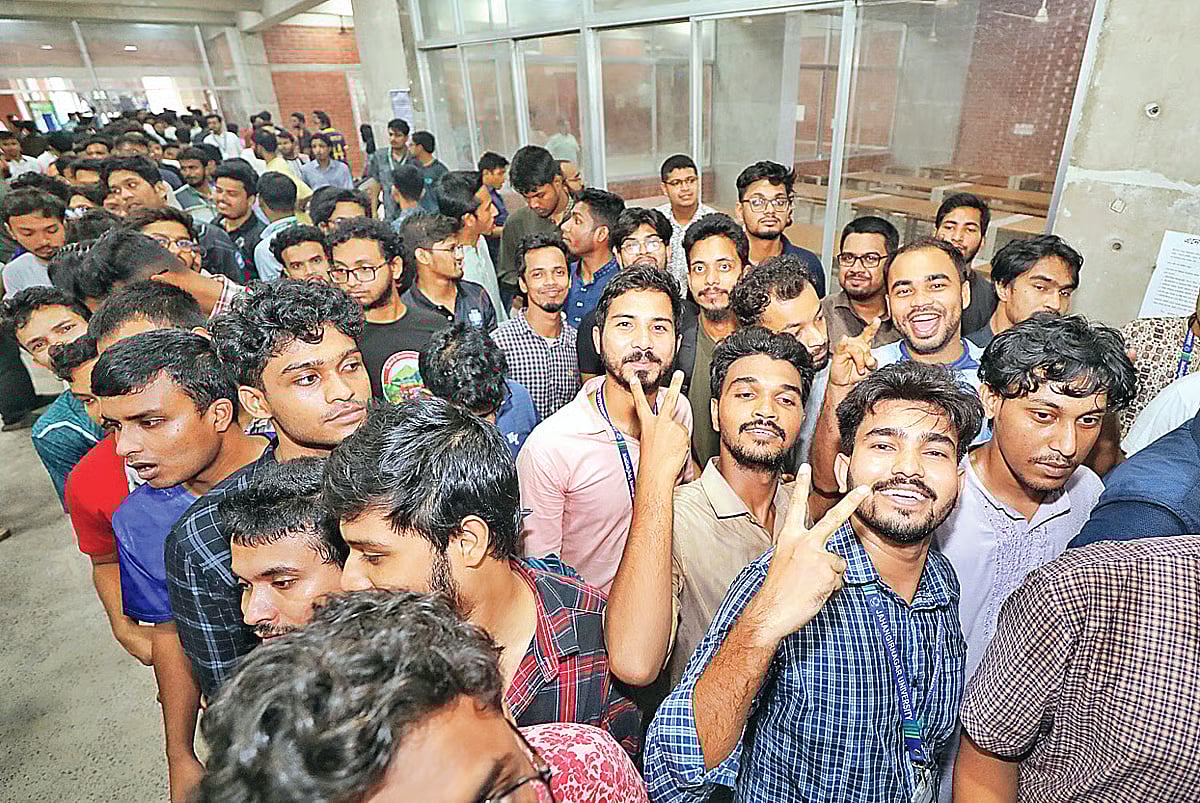
JUCSU polls: Peaceful voting overshadowed by boycotts, mismanagement
The Jahangirnagar University Central Students’ Union (JUCSU) and hall union elections were held peacefully yesterday, Thursday. However, mismanagement was evident. In some halls, voting continued even after evening.
As of 1:00am, when this report was being written, counting was still underway. Votes were being counted manually instead of electronically because several panels had objected to machine counting. Initially, it was decided that both machine and manual counting would take place. At 11:30pm, Professor AKM Rashidul Alam, member secretary of the JUCSU Election Commission, told Prothom Alo that the counting would take all night. They hoped to announce results by Friday noon.
Earlier, the panel backed by Chhatra Dal boycotted the election before voting officially ended, citing irregularities and bias. After voting ended, four more panels announced boycott.
This year, JUCSU saw eight panels, some full and some partial. Among them, Chhatra Dal’s panel, the Pragatishil Shikkharthider Sampritir Oikya, the “Sangshaptak Parishad” (5 candidates for 25 positions) of Chhatra Union and Chhatra Front, the independent “Ongikar Parishad” (8 candidates), and a faction of Chhatra Front (3 candidates) all boycotted. Several independent candidates also boycotted the election.
Meanwhile, the election still featured the Jamaat-e-Islami student wing–backed “Samannito Shikkharthi Jote,” the Bangaldesh Ganatantrik Chhatra Sangsad–backed “Shikkharti Oikya Form,” and the “Swatantra Shikkharthi Sammilan” led by former Anti-Discrimination Student Movement coordinator Abdur Rashid Jitu.
Criticising Chhatra Dal, Md Mazharul Islam, GS candidate of the Shibir-backed panel, told Prothom Alo last night that Chhatra Dal has the right to boycott, but perhaps they felt it was better to withdraw than to lose. It seems that’s why they pulled out.
This was the first JUCSU election in 33 years, the last being held in 1992. There was widespread enthusiasm about it. According to the election commission, voter turnout might reach around 68 per cent.
Voting began at 9:00am. In the morning, turnout was relatively low but increased steadily throughout the day, with even off-campus students returning to cast ballots.
At 9:15am, student Md Shahid Uz Zaman came from Dhaka to vote. He told Prothom Alo that a JUCSU election is being held after so long. This is one of the main ways to realise students’ rights. Those living off-campus should all come back to vote.
Mismanagement from the start
Polling centers were set up in 21 halls. But due to poor management, not all started on time at 9:00am. For example, in Nazrul Islam Hall, voting began 16 minutes late, and in Fazilatunnesa Hall, after 9:30am.
Rules also varied across halls. In some, voters’ fingers were marked with indelible ink, such as in Shaheed Salam-Barkat Hall and AFM Kamaluddin Hall. In others, like Nazrul Hall, no ink was used. There, ballot papers also contained errors—voters were instructed to select only one candidate instead of three for executive member positions.
There were no Braille ballots for visually impaired students, who had to rely on others’ assistance.
Complaints started coming after noon
After midday, allegations began pouring in. Around 12:00pm, chaos broke out in Hall No. 15 after reports of fake votes. Voting was suspended for nearly 45 minutes.
Witnesses said rumors spread that Shibir-backed activists were casting fake votes, prompting Chhatra Dal VP candidate Sheikh Sadi Hasan and supporters to storm inside the center.
However, Hall 15 provost Shamima Sultana told reporters the disruption was because the ink being used on voters’ fingers was not lasting. Voting was paused while new ink was brought, during which unrest erupted.
At a press briefing on 2:00pm, Shibir-backed VP candidate Arif Ullah accused the election commission of poor preparation, saying they failed to ensure a fair election.
Chhatra Dal boycott in the afternoon
At 4:00pm, Chhatra Dal GS candidate Tanzila Hossain Boishakhi announced their boycott at a press briefing in Maulana Bhashani Hall. She alleged that ink marks disappeared, ballots were found on the floor, their VP candidate was barred from entering a center, ballots were printed at a Shibir leader’s press, and their polling agents were not allowed in most halls.
She further questioned why 10 per cent extra ballots had been printed and whether 10–20 per cent were secretly handed to Shibir-backed panel. She also claimed that Jamaat leader’s company was given responsibility for installing CCTV at polling centers, accusing the administration of colluding with Shibir to rig the polls.
At 6:45pm, four panels also announced their boycott, citing widespread irregularities and failures by the commission and administration. Reading from a statement, candidate Sharan Ehsan detailed numerous flaws: ballot box chaos the night before, late appointments of polling agents, male candidates entering female halls, voter lists without photos, and eligible voters missing from lists. They demanded cancellation and a new election under proper arrangements.
Earlier at 3:00pm, candidates of Sampritir Oikya panel alleged that voting was not fair.
At 1:30pm, GS candidate Abu Touhid Md Siam of the Ganatantrik Chhatra Sangsad–backed panel also alleged insufficient administrative preparation.
Half an hour before voting ended, three teachers—known as BNP-leaning—resigned from election duties, citing extra ballot printing and lack of ink use.
During the vote, Chhatra Dal’s central vice-president Hafizur Rahman (Sohan) was detained inside Rabindranath Hall and later released after signing a bond.
Voting continued into the evening
Delays and suspensions meant some centers kept voting after the official 5:00pm. At Nazrul Hall, polling went on even after dark.
At 6:45pm, Election Commission member secretary Rashidul Alam told Prothom Alo that overall participation was spontaneous and turnout was around 68 per cent, with only minor issues. He dismissed most allegations, saying not applying ink alone could not be considered malpractice.
A disappointing outcome
This year, 11,743 students were eligible to vote for 25 central posts contested by 177 candidates (9 for VP and 8 for GS). In the 10 female halls, 59 of 150 seats went uncontested, and 67 had single candidates, meaning only 24 required voting.
More than 1,500 police and Ansar personnel were deployed, to keep the law and order situation under control. By 9:30pm, no violence had been reported, though Chhatra Dal held protest marches after announcing their boycott.
Professor Rayhan Rhyne of the Philosophy Department told Prothom Alo in the evening that everyone had long awaited this election. Students wanted representatives who would speak against terrorism, discrimination, and oppression. But from the start, mismanagement and flaws appeared, leading many panels to withdraw. It is deeply disappointing.