One can’t contest elections without Tk 100-200m, so we must think carefully: Asif Mahmud
Adviser Asif Mahmud Shojib Bhuyain has expressed concern that the influence of black money will persist in the upcoming election like before.
This is why he, like others, must think carefully before entering the race, he added.
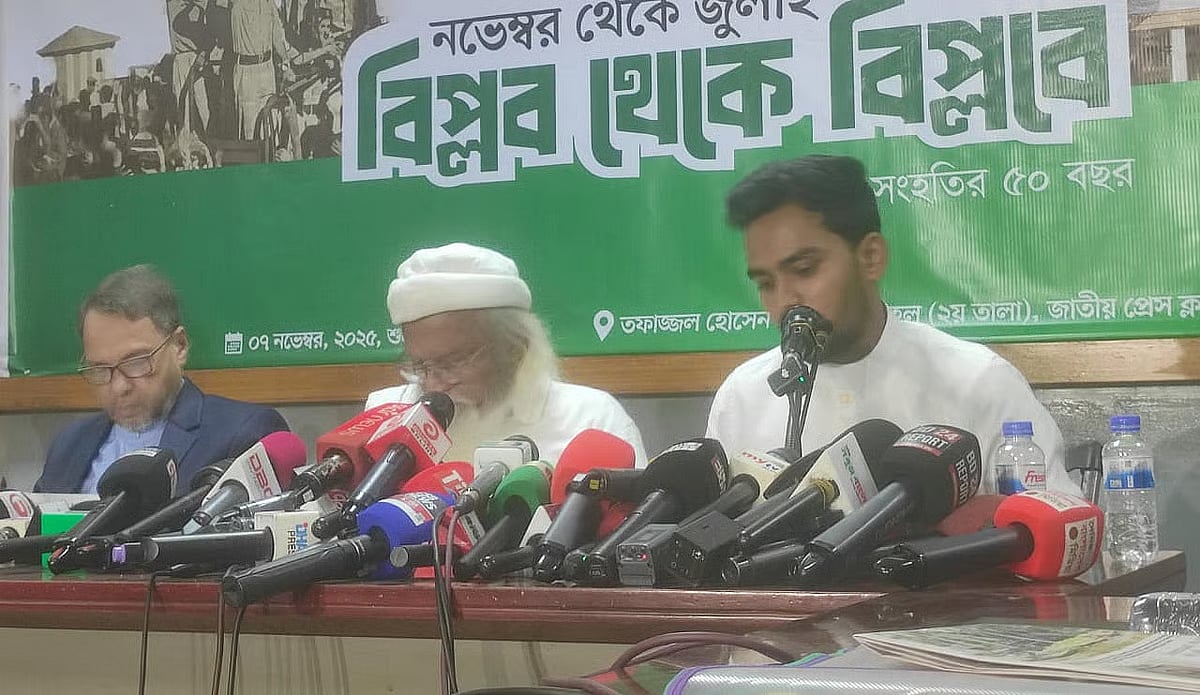
Asif Mahmud made the remarks at a roundtable at the National Press Club today, Friday. The discussion was organised by the Anti-Discrimination Student Movement under the title, ‘From November to July: From Revolution to Revolution’.
Commenting that under the present reality in Bangladesh it is not possible to contest a parliamentary election without Tk 100–200 million, Asif Mahmud said, “In this reality, those who have black money are the ones who really have the opportunity to take part in elections.… That is why we too must repeatedly consider whether we will contest the election or not. If we do, how we will contest, whether people will vote without money.”
Asif Mahmud, one of the coordinators of the Anti-Discrimination Student Movement that led the July uprising, currently serves as adviser to the interim government on local government and youth and sports.
While another coordinator, Nahid Islam, has entered politics by assuming leadership of a new party, Asif Mahmud has not yet given any clear indication. He has only said that if he contests the election from any party, he will resign from the advisory council.
The interim government has announced that the 13th parliamentary election will be held in February. National Citizen Party (NCP), the party formed by his comrades of the July movement, is preparing to contest the election.
‘Mistakes were made after the uprising’
Alongside accusing political parties of failing to extend cooperation following the fall of the Sheikh Hasina government during the July uprising, Asif Mahmud acknowledged that there were also mistakes in their own decision-making.
“On 5 August, barely an hour or two after Sheikh Hasina had fled, our political leaders went and sat in the lap of the establishment. As young people, we too made mistakes; we were a group of 25- or 26-year-olds responsible for policy-making. But when our elders handed the responsibility to the establishment, asking them to form an interim government, at that point, there was not much left in our hands,” Asif Mahmud said.
Asif Mahmud claimed that they had told political leaders at the time not to go to the establishment. But their appeal was not heeded. In the unfolding situation, considering the circumstances of the country at the time, the student leaders agreed to the quick formation of a government.
He further said that the student leaders of the mass uprising between 5 and 8 August did not take any decision bypassing the political parties. For the young student leaders, it was difficult to foresee the consequences of making any completely unilateral decision without political backing.
Asif Mahmud claimed that between 5 and 8 August, he had proposed organising a discussion at Dhaka University as a “middle ground”. That did not take place. In his words, “We were told to go to the cantonment. We said it was not possible for us to go to the cantonment. Then the venue of discussion had to be arranged at some middle point, where we too had to go.”
Taking part in the discussion, poet and political thinker Farhad Mazhar said, “On 8 August 2024, a constitutional counter-revolution took place. The young people who were in leadership at that time made certain mistakes. Those mistakes can still be rectified by the young generation if they wish. However, there is not much time left for that.”
The roundtable was moderated by Rifat Rashid, president of the Anti-Discrimination Student Movement.
Among others, AB Party chairman Mojibur Rahman Manju, Jahangirnagar University’s professor of government and politics department Abdul Latif Masum, Colonel (retd) Hasinur Rahman, NCP joint convener Jabed Raseen, PUSAB (Private University Students Alliance of Bangladesh) standing committee member Fahmidur Rahman, and online activist Mohammad Sajal spoke.