Prothom Alo roundtable
Under whose pressure and in which direction is the government moving: Rasheda K Choudhury
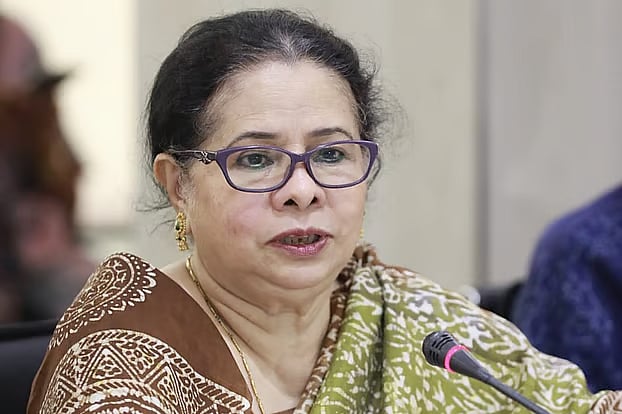
Former caretaker government advisor and executive director of the Campaign for Popular Education, Rasheda K Choudhury, raised the question of which direction Bangladesh is heading towards when it comes to women’s participation and empowerment in politics, and whether it is regressing.
She said, “We women are being told to exert pressure -- then under whose pressure, and in which direction, is this government moving? The Consensus Commission must certainly consider which way women’s empowerment is going to head.”
She made these remarks on Saturday at a roundtable on “Women’s Seats in Parliament and Women’s Political Empowerment” held at the Prothom Alo office in Karwan Bazar, Dhaka. The event was organised by Prothom Alo and moderated by its associate editor Shumana Sharmin. At the roundtable, Prothom Alo senior correspondent Naznin Akhter presented the concept paper on women’s seats in parliament.
Rasheda K Choudhury said the interim government must prove that it is not biased towards any particular group, individuals or anyone in particular. “If people simply assume that it is, then it will be difficult for the interim government to function,” she said.
Expressing her disappointment with the Consensus Commission, Rasheda K. Choudhury remarked, “It feels as though we are not even in Bangladesh.” She also voiced the hope for another Maitree Jatra (Friendship Journey) at women’s initiative.
She questioned why all decisions regarding women in the country should be taken solely by political parties. “We have been here for a long time, working on the ground. We know, because we work on the ground, which groups the political parties work for, why they work and with what agenda. We need to go into that space and place our demands before them,” she said.
Rasheda K Choudhury remarked that women’s empowerment in Bangladesh exists only “as a myth.” She said, “If participation alone meant empowerment, then where is the partnership?”
She added, “The issue of 50 per cent representation of women in parliament has come up. We will stand by that. A couple of people even called me about it. One person said, ‘Fine, you’re asking for a cannon, maybe you’ll get a gun.’ I’ve had to hear things like that as well.”
Rasheda K Choudhury said that without 50 per cent representation, women will fall even further behind. “Why should we be bargaining with political parties? If we do that, it should not be now, it should be after the parliament is in place,” she said.
Rasheda K Choudhury demanded that the Consensus Commission take responsibility for bringing all political parties to agreement. She said, “We work as non-partisan actors. We represent civil society. If you call us, we will come. We have demanded that you convene without delay.”
This former advisor expressed dismay at women not having the scope to take decisions on women's affairs. Addressing the Consensus Commission, she said, "Now when it comes to implementation, they will sit with me. Why were we not part of the discussion from the beginning?"
The roundtable was moderated by Shumana Sharmin, Associate Editor of Prothom Alo.
The participants included Shireen Parveen Huq, head of the Commission on Reforms on Women’s Issues; Badiul Alam Majumdar, head of the Electoral System Reform Commission; Rasheda K. Choudhury, Executive Director of the Campaign for Popular Education and former adviser to the caretaker government; Fauzia Moslem, president of the Bangladesh Mahila Parishad; Shaheen Anam, Executive Director of the Manusher Jonno Foundation; Khondaker Golam Moazzem, Research Director of the Centre for Policy Dialogue (CPD); Khushi Kabir, coordinator of Nijera Kori; Gita Das, chairperson of Naripokkho; Taslima Akhter, president of Garment Workers’ Solidarity; Ilira Dewan, member of the Local Government Reform Commission; and Nazifa Jannat, a key organiser of the July Movement and a student.