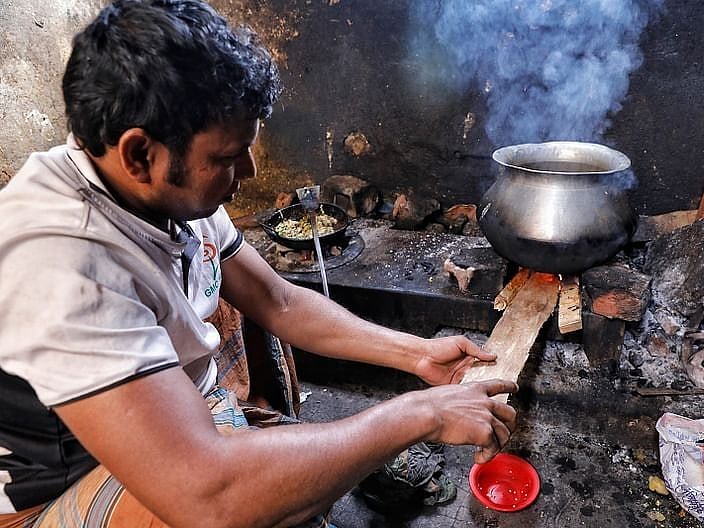
Gas crisis deepens, disrupting cooking, transport and industry
Bangladesh’s gas sector has been grappling with a persistent gap between demand and supply for the past one and a half decades. Domestic gas production has been declining steadily in recent years, increasing the country’s reliance on imported liquefied natural gas (LNG).
The situation worsened after a fire broke out at a floating LNG terminal last Tuesday, cutting LNG-based gas supply by nearly half. As a result, the gas shortage has intensified. Households in many areas are unable to use their gas stoves, CNG-powered vehicles are facing fuel shortages, and industrial production has been disrupted.
According to sources at the Bangladesh Oil, Gas and Mineral Corporation (Petrobangla), the country’s daily gas demand is 3.8 billion cubic feet. A supply of around 3 billion cubic feet is generally enough to avoid severe shortages. However, average daily supply has remained at around 2.7 billion cubic feet since last year. Following the terminal fire, total gas supply has fallen to 2.2 billion cubic feet.
Bangladesh imports LNG through two floating storage and regasification units (FSRUs) located at Moheshkhali in Cox’s Bazar. One terminal is operated by the US-based company Excelerate Energy, while the other is run by Summit.
LNG accounts for 35 to 40 per cent of the country’s daily gas supply. Before the fire, LNG contributed an average of 1.05 billion cubic feet per day. After the fire at Excelerate’s terminal, LNG supply dropped to just 560 million cubic feet yesterday.
Expert teams from the United Kingdom and the United Arab Emirates have already begun work. The Energy Division, Petrobangla and other relevant government agencies are closely monitoring the situation
On Thursday, Petrobangla officials held a meeting with Excelerate representatives to discuss restarting the damaged terminal. Two senior Petrobangla officials told Prothom Alo that there is no shortage of LNG itself. A newly arrived LNG carrier has been moved away from the damaged terminal and will return once repairs are completed.
The terminal has two boilers, one of which was damaged in the fire. If the undamaged boiler can be brought back online, an additional 300 million cubic feet of gas could be supplied daily. Petrobangla has urged the company to restart it as quickly as possible. Technical experts from abroad have already arrived at the terminal, and following inspections late Thursday night, they were expected to decide on the next steps.
State minister for Power, Energy and Mineral Resources Aninda Islam Amit told Prothom Alo that there is no shortage of LNG and that the supply disruption is solely due to the terminal accident. Expert teams from the United Kingdom and the United Arab Emirates have already begun work. The Energy Division, Petrobangla and other relevant government agencies are closely monitoring the situation. He expressed hope that gas supply would return to normal soon.
No Gas for Cooking, Long Queues at CNG Stations
The sharp decline in LNG supply has left many households unable to cook, particularly in Dhaka. On Tuesday, Titas Gas Transmission and Distribution PLC, which supplies gas to the capital and surrounding areas, issued a public notice apologising to customers. The company warned that all categories of consumers within its service area would continue to experience severe low gas pressure until the situation improves. Titas serves more than 2.7 million residential customers.
Residents of Mohammadpur have been suffering from an acute gas shortage for several days, and the nationwide decline in supply has worsened the situation.
Many households are now buying electric stoves. Members of a Facebook group called Amra Mohammadpurbashi shared their frustrations yesterday. Tanzina Ahmed said there had been no gas in the Housing Society area for five days. Shereza Tajin Jaman reported gas problems on Zakir Hossain Road for five to six days.
Sajeda Akter said she has been forced to buy LPG cylinders despite paying monthly pipeline gas bills. Iffat Putul said there had been no gas on Tajmahal Road for the past three days.
Long queues have also formed at CNG filling stations across Dhaka and other parts of the country. Private cars, passenger vehicles and freight transport have been waiting for hours to refuel.
Farhan Noor, secretary general of the CNG Filling Station and Conversion Workshop Owners’ Association, told Prothom Alo that gas pressure at most stations has dropped to one PSI, two PSI or even zero, making it impossible to supply gas. Some stations have remained completely shut.
According to Titas, its daily demand is 2.2 billion cubic feet, while 1.7 billion cubic feet is considered sufficient for smooth operations. Normally, it receives between 1.5 and 1.55 billion cubic feet, but yesterday supply fell to just 1.2 billion cubic feet, leaving the company unable to provide adequate gas across its network.
Yesterday, supply dropped further to 750 million cubic feet. Electricity generation from gas-fired plants has declined to around 4,000 megawatts, down from more than 5,000 MW just a few days ago.
Power Generation Falls, Industries Under Pressure
The power sector requires 2.52 billion cubic feet of gas daily. During peak demand, the Bangladesh Power Development Board (BPDB) needs between 1.1 and 1.2 billion cubic feet, although it usually receives only 900 million to 1billion cubic feet.
Yesterday, supply dropped further to 750 million cubic feet. Electricity generation from gas-fired plants has declined to around 4,000 megawatts, down from more than 5,000 MW just a few days ago.
Continuous rainfall has kept electricity demand relatively low, limiting the impact for now, although 500 to 600 MW of load shedding is still being carried out. If temperatures rise again, power outages could increase.
A BPDB official told Prothom Alo that gas-fired power generation is the cheapest option. Reduced gas supply is forcing greater reliance on oil-fired power plants, increasing BPDB’s losses and placing additional pressure on government subsidies.
Industries have also been struggling with gas shortages for a long time. Business leaders say existing factories are facing severe operational difficulties, while new domestic and foreign investments are being delayed.
Even companies that have already paid for gas connections have yet to receive supply. The continuing decline in gas pressure is making it increasingly difficult to keep factories operating.
Khorshed Alam, director of the Bangladesh Textile Mills Association (BTMA), said gas-fired generators require a pressure of 10 PSI to produce electricity, but current pressure is below 1 PSI.
Through solar power and other alternatives, his factory has managed to maintain around 70 per cent of its production capacity. Many factories have shut down, while others are relying on expensive alternative fuels to continue operations.
Although the new government is drilling new wells and has invited bids for offshore oil and gas exploration, domestic production is unlikely to increase significantly in the near future. LNG imports also cannot be expanded until new terminals are built.
Import Dependence Behind the Crisis
Industry experts say Bangladesh has not discovered any major new gas fields over the past three decades, and exploration activities have remained slow. Domestic gas production stood at 2.7 billion cubic feet per day as recently as 2017, but has declined steadily since then and is now below 1.65 billion cubic feet. LNG imports began in 2018.
Although the new government is drilling new wells and has invited bids for offshore oil and gas exploration, domestic production is unlikely to increase significantly in the near future. LNG imports also cannot be expanded until new terminals are built.
Heavy dependence on LNG imports carries significant risks. When global LNG prices surged in 2022, the previous government suspended spot-market LNG imports for seven consecutive months starting in July, triggering a severe gas crisis. Imports resumed only after gas prices were increased by an average of 82 per cent.
At a press briefing on Wednesday, the Energy Division also acknowledged that the country’s long-standing dependence on imported energy has made the situation more severe. The government is pursuing several initiatives, including building new LNG terminals, importing LNG from Malaysia, transporting unused gas from Bhola to other districts, drilling new wells, rehabilitating old ones and diversifying energy import sources.
M Shamsul Alam, energy adviser to the Consumers Association of Bangladesh (CAB), told Prothom Alo that LNG was never a long-term solution. He said import dependence has repeatedly caused supply disruptions and that global price spikes often make LNG unaffordable. He warned that LNG imports could again be disrupted during the Ashwin (Bengali month) storm season, while the government continues to increase reliance on LNG. As a result, he said, there is little prospect of relief from the country’s gas crisis in the near future.