The fuel theft syndicate appears impossible to stop. Incidents of oil going ‘missing’ from depots and accounting mismatches in tankers have already come to light.
This time, an attempt has been made to steal fuel by puncturing the much-talked-about pipeline built to supply diesel from Chattogram to Dhaka. This incident has once again raised questions about how effective the country’s fuel security system really is.
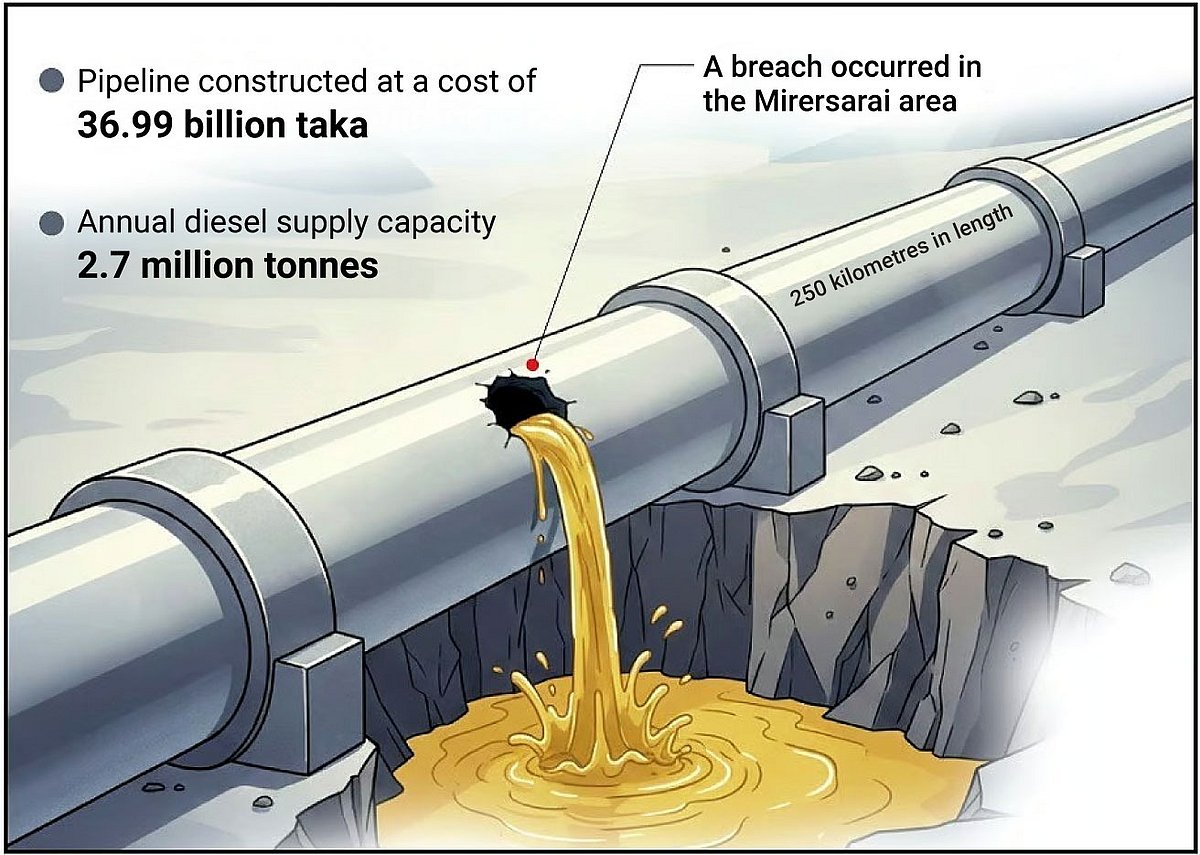
The incident occurred on the western side of Hadi Fakirhat Road in Ward No. 15 of Wahedpur Union in Mirsharai upazila of Chattogram. A hole was made in the diesel pipeline buried about 10 feet underground. When diesel began leaking uncontrollably through the puncture and spread onto the road, the matter came to light on 8 January.
Considering the security risk, fuel supply through the line was suspended immediately. The diesel supply resumed again on Sunday morning once the situation was brought under control.
According to sources at Bangladesh Petroleum Corporation (BPC) and the police, a local resident, Md Afsar, had built a tin-shed structure directly above the pipeline. He later rented it out to Amirul Islam, son of Nasir Uddin from Sonadanga of Khulna City Corporation area.
Although no one was caught red-handed with stolen fuel in this incident of the pipeline being punctured, serious questions have been raised about how digging could have continued for such a long time to reach a pipeline buried so deep underground.
Allegedly, after renting the structure, Amirul deliberately dug down to the pipeline and punctured it. He then installed a separate pipe and meter connected to the main line in preparation for stealing diesel.
Several BPC officials visited the site to inspect the punctured pipeline. One official, speaking to Prothom Alo on condition of anonymity, said the theft syndicate had tried to attach another pipe and a meter to the main pipeline.
However, they lost control while welding the connection. Due to high pressure in the pipeline, a large volume of diesel gushed out through the hole. Realising that the situation has gone out of hand, the accused fled the scene, leaving the fuel spilling onto the road.
Although no one was caught red-handed with stolen fuel in this incident, serious questions have been raised about how digging could have continued for such a long time to reach a pipeline buried so deep underground.
There is no clear explanation as to how such preparations went unnoticed by the local administration, BPC, or the security system. BPC has formed an investigation committee, but its report has not been submitted yet.
BPC director AKM Azadur Rahman said the incident is being treated with utmost seriousness. A case has already been filed and the investigation committee is working. If negligence or negligence of duty is found, disciplinary action will be taken against those responsible.
Why did the sensors fail to detect it?
The Dhaka–Chattogram pipeline project was built at a cost of Tk 36.99 billion (3,699 crore) using modern technology.
According to BPC, a sensor-equipped cable is installed along the pipeline, which is supposed to send automatic signals to the control room if there is any change in pressure, crack or puncture. However, BPC officials have confirmed that no signal or automated alert was received during this latest incident.
When asked, project director Aminul Haque said the technology has not yet been fully operational. It will take another year to complete the installation of all technological systems, including the sensors. Once that work is finished, the entire system will function effectively.
For now, one person is assigned to monitor every five kilometres of the pipeline. Besides, structures built over the pipeline have been identified and are being removed in phases.
Officials concerned say one of the main objectives of building the pipeline was to prevent fuel theft and ensure safe transportation. But questions are now being raised about how far that objective is being fulfilled. Complaints have already emerged that the volume of diesel sent from Chattogram has decreased by the time it reaches Dhaka.
The three state-owned oil companies, Padma, Meghna and Jamuna, have all supplied diesel through this pipeline. Several investigation committees have also been formed in response. One such committee submitted a report to the energy ministry on 7 December, identifying discrepancies in fuel accounts.
Where is the risk?
Currently, Bangladesh’s average annual demand for fuel oil is around 6.5 million (65 lakh) tonnes. In the 2024-25 financial year supply stood at 6.8 million (68 lakh) tonnes, of which diesel alone accounted for about 63 per cent. Power generation, irrigation, industry and transport all rely most heavily on diesel.
The pipeline between Dhaka and Chattogram has the capacity to supply up to 2.7 million (27 lakh) tonnes of diesel annually. In other words, a single pipeline carries a large share of the country’s total demand of diesel.
As a result, even minor disruptions to this infrastructure could have major consequences for the national economy and daily life, believes people concerned.
BPC officials said the approximately 250-kilometre-long pipeline is currently guarded by personnel stationed every five kilometres.
However, experts argue that relying primarily on human surveillance for such a critical installation questions claims of technology-driven security.
Energy specialists warn that illegal structures over the pipeline, the dominance of local influential groups with vested interests, and weak monitoring together have created a risky situation.
They say eviction drives or future technological upgrades alone will not be enough to reduce the risk. Without prioritising security now, similar incidents could occur again.
M Shamsul Alam, energy adviser to the Consumers Association of Bangladesh (CAB), said the Mirsharai incident is not an isolated crime. Rather, it reflects long-standing mismanagement, hasty decisions and weak oversight in the energy sector.
If a project worth tens of billions of taka cannot ensure its security, then the sustainability of such development is now in question. The most urgent task right now is to make the pipeline genuinely secure and to ensure accountability without any leniency, he added.