July Mass Uprising
RAB helicopter flew with SMGs and shotguns on board, finds ICT investigation agency
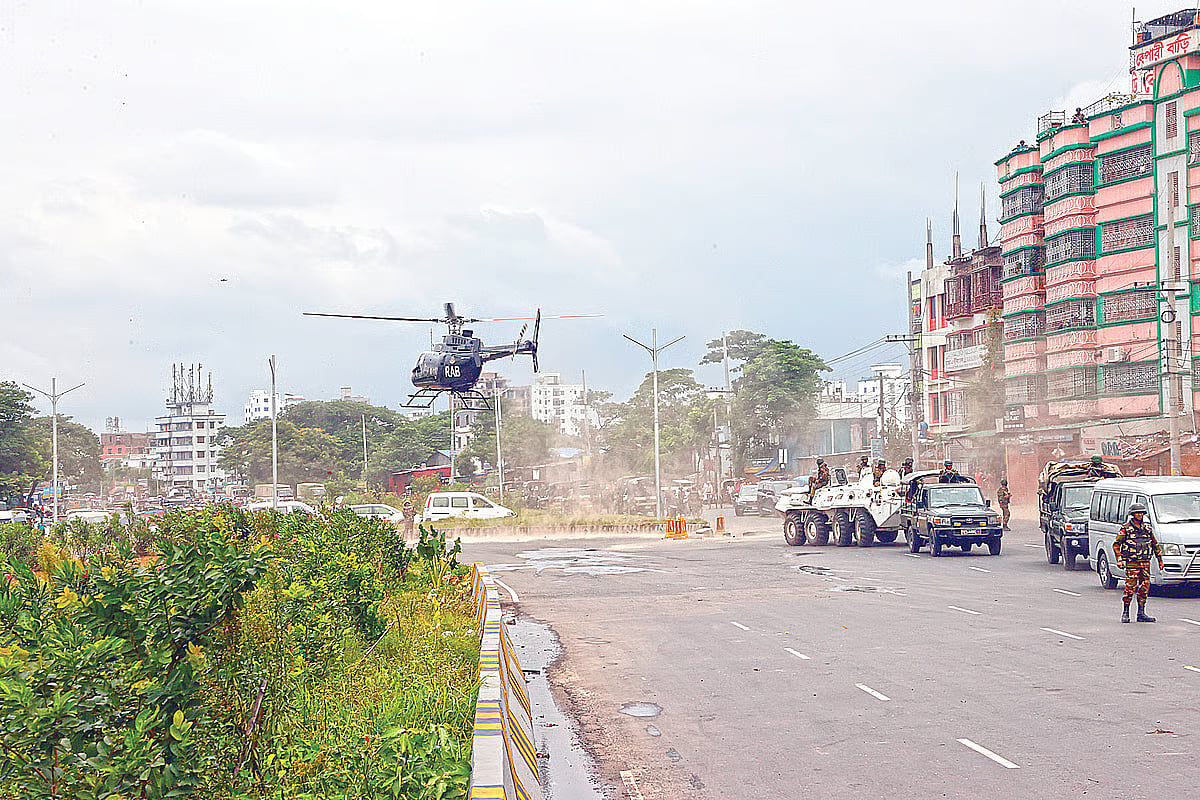
As the days passed, the intensity of the July Mass Uprising continued to escalate. During that period, alongside other state forces, the Rapid Action Battalion (RAB) also used force to push protesters off the streets.
On 19, 20 and 21 July, RAB helicopters flying over the capital were equipped with submachine guns (SMGs), shotguns and gas guns. Ammunition for those firearms and sound grenades were also loaded onto the helicopters. Gas guns and sound grenades were deployed from the helicopters in an effort to suppress the movement that started with the demand to reform quota system in government jobs.
These findings have emerged from the preliminary investigation conducted by the investigation agency of the International Crimes Tribunal. Tribunal prosecutor Tanvir Hasan Zoha confirmed the matter to Prothom Alo.
Tanvir Hasan, who is also serving as a special investigation officer for the tribunal, told Prothom Alo that investigators are also examining allegations that SMGs and shotguns were fired from the helicopters.
According to information obtained so far, a total of 3,555 rounds of ammunition were loaded onto RAB helicopters over those three days of the uprising—19, 20 and 21 July 2024. Of these, 1,542 rounds were used against protesters.
The tribunal’s investigation agency is probing the use of helicopters during crackdown on the July Mass Uprising. According to information obtained so far, a total of 3,555 rounds of ammunition were loaded onto RAB helicopters over those three days of the uprising—19, 20 and 21 July 2024. Of these, 1,542 rounds were used against protesters.
The prosecution’s investigation has found that helicopters were flown around Dhaka between 18 and 22 July under a mutual arrangement between the Bangladesh Army and RAB.
Investigators have also obtained information confirming that weapons and ammunition were loaded onto the helicopters and used on 19, 20 and 21 July.
RAB provided the tribunal's investigation agency with an inventory of the weapons and ammunition in response to its request. The force also supplied records of helicopter operations. Investigators have identified those who were aboard the helicopters.
On 19 July 2024, Ayman Uddin, 24, and his cousin Nasima Akter, 24, were shot after going onto the roof of their house in Dhanmondi 1 of the capital.
Speaking to Prothom Alo on Wednesday, Ayman’s mother, Rehena Akter, said some people claimed the shots came from a helicopter, while others said they were fired from a rooftop.
Describing the incident, Rehena Akter said she saw a helicopter flying while Ayman and Nasima were inside the house. A few minutes later, they went up to the roof. As soon as they stepped onto the rooftop, they were struck by bullets.
A bullet entered the right side of Ayman’s chest and exited through his back. Nasima was also shot. They were rushed to hospital, but Nasima died the following day, on 20 July. Ayman recovered after treatment, although he still occasionally suffers from breathing difficulties and chest pain.
The helicopters flew at low altitude, allowing the passengers' mobile phone numbers to be detected by BTS (Base Transceiver Station) towers. By analysing the IMEI numbers of those mobile phones, investigators identified the individuals who had been on board.
Weapons loaded onto helicopters and used
Experts say shotguns are used to fire rubber bullets or lead pellets, while gas guns launch tear gas shells. Sound grenades create loud explosions. Shotguns, gas guns and sound grenades are generally considered non-lethal, but submachine guns (SMGs) that are used to fire live ammunition are lethal.
Sources involved in the investigation said RAB provided the tribunal's investigation agency with an inventory of the weapons and ammunition in response to its request. The force also supplied records of helicopter operations. Investigators have identified those who were aboard the helicopters.
Based on information provided by RAB, sources in the tribunal's investigation agency said RAB helicopters flew over different parts of Dhaka on 19 July 2024.
To suppress the Anti-Discrimination Student Movement, 13 shotguns, 13 gas guns and four SMGs were loaded onto the helicopters that day. They also carried 340 sound grenades, along with 260 rounds of shotgun ammunition, 558 rounds for gas guns and 240 rounds for the SMGs.
As many as 218 gas-gun rounds and 122 sound grenades were fired during the operations.
The 19 July of 2024 was a Friday. The following day, Saturday, Prothom Alo published a front-page report on the operations. Citing local residents and witnesses, the report said sound grenades and tear gas shells were fired from RAB the helicopters at protesters in Rampura, Science Lab and New Market.
Tear gas shells were also fired from helicopters at demonstrators near Mohammadpur Bus Stand, Satmasjid Road and Chand Mia Housing. In addition, sound grenades and tear gas shells were deployed from helicopters in Mohakhali and Mirpur-10, the report added.
According to a Prothom Alo report, on 20 July helicopters operated by the law enforcement agencies repeatedly flew at very low altitude above the area from Jatrabari Police Station to Rayerbagh.
Investigation sources also said that on 20 July, four shotguns, nine gas guns and one SMG were loaded onto helicopters to suppress the movement. The helicopters carried 80 rounds of shotgun ammunition, 684 rounds for gas guns and 60 rounds for the SMG, along with 200 sound grenades. That day, 512 gas-gun rounds and 152 sound grenades were fired from the helicopters.
According to a Prothom Alo report, on 20 July helicopters operated by the law enforcement agencies repeatedly flew at very low altitude above the area from Jatrabari police station to Rayerbagh.
The sounds of gunfire and sound grenades were heard during the flights. Tear gas shells were fired as well. The report also said that later that night, sound grenades were launched from a helicopter near Zamzam Tower in Uttara.
Investigation sources further said that on 21 July, one shotgun, eight gas guns and one SMG were loaded onto a RAB helicopter to suppress the protests. The helicopter also carried 400 sound grenades, along with 20 rounds of shotgun ammunition, 653 rounds for the gas guns and 60 rounds for the SMG.
That day, 255 gas-gun rounds and 283 sound grenades were fired from the helicopter at student protesters and members of the public.
A Prothom Alo report said that on 21 July, tear gas shells and sound grenades were fired from a helicopter to disperse demonstrators blockading the Dhaka–Chattogram Highway near the Signboard area.
When asked for comment on the matter, RAB's director of the Legal and Media Wing and spokesperson, Wing Commander MZM Entekhab Chowdhury, told Prothom Alo on Wednesday that they were unable to comment because the matter was under judicial consideration.
The official said RAB had been responding, to the best of its ability, to every request for information and every official communication received from the tribunal.
In response to the letter of the tribunal investigation agency, RAB initially said it had not kept records relating to helicopter operations during the mass uprising because of the sudden onset of events and the emergency situation.
‘Who were on the helicopters, identified’
In response to the letter of the tribunal investigation agency, RAB initially said it had not kept records relating to helicopter operations during the mass uprising because of the sudden onset of events and the emergency situation.
However, ICT prosecutor Tanvir Hasan said the helicopters flew at low altitude, allowing the passengers' mobile phone numbers to be detected by BTS (Base Transceiver Station) towers.
He further said, by analysing the IMEI numbers of those mobile phones, investigators identified the individuals who had been on board. Based on those specific findings, they sought detailed information from RAB.
The force then disclosed what weapons had been loaded onto the helicopters and what ammunition had been used, the ICT prosecutor added.
Tanvir Hasan also said investigators have recovered a list of the names of more than 20 individuals who had served on RAB helicopters at different times during that period.