Bangladesh signs 5-year trade deal with Pakistan to import rice, onions, potatoes, oil
A new avenue for government-to-government (G2G) trade cooperation with Pakistan has opened up, aimed at strengthening the supply of essential commodities, ensuring food security and diversifying sources of imports.
To this end, a five-year memorandum of understanding (MoU) has been signed between the Trading Corporation of Bangladesh (TCB) and the Trading Corporation of Pakistan (TCP).
Under the agreement, the two countries will be able to import and export various essential commodities, including rice, wheat, sugar, edible oil and pulses, along with agricultural products and agricultural inputs, according to their respective needs.
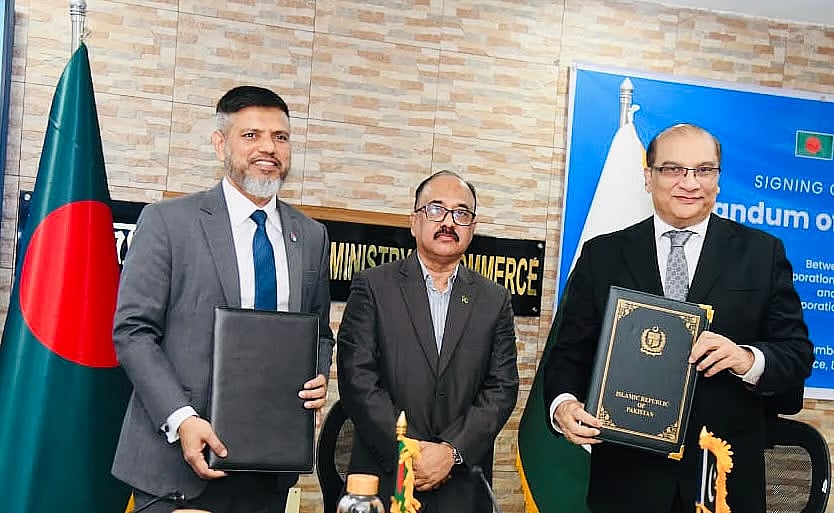
The MoU was signed at a ceremony held in the conference room of the Ministry of Commerce at the Secretariat today, Sunday. TCB Chairman Brigadier General Mohammad Foyshol Azad and Pakistan’s High Commissioner to Bangladesh Imran Haider, signed the MoU on behalf of their respective countries.
Commerce Secretary Sharaf Uddin Ahmed Chowdhury and relevant officials from the governments of Bangladesh and Pakistan were present at the ceremony.
Under the MoU, the state-owned trading corporations of the two countries will be able to buy and sell various products based on their respective needs and mutual consent. The list of potential products includes all types of rice, wheat, refined and raw sugar, and various types of edible oil, including canola, soybean, sunflower, rice bran and palm olein.
In addition, sesame, potatoes, onions, lentils, chickpeas, tea, pineapples, jackfruit, dates, fertiliser and various other agricultural products and inputs will also be covered by this trading cooperation.
According to a press release from the Ministry of Commerce, if either party wishes to procure a particular product, it must submit a written proposal to the other party specifying the product’s quality, quantity, specifications and potential delivery schedule.
Separate product-specific agreements will subsequently be concluded through discussions and negotiations to determine the terms of supply. Thus, while the agreement establishes an institutional framework for direct government-to-government trade between the two countries, the price, quantity, quality and delivery schedule of each transaction will be finalised separately.
At the ceremony, Commerce Secretary Sharaf Uddin Ahmed Chowdhury said the agreement would create new opportunities for mutual cooperation in the import and export of essential commodities and agricultural products, while safeguarding the economic interests of both countries.
Pakistan’s High Commissioner Imran Haider said the MoU would establish a direct institutional relationship between the state-owned trading organisations of the two countries, helping to better organise the import, export and supply of essential commodities.
He said Pakistan had surplus stocks of various agricultural products, including basmati rice, onions, potatoes and spices. Pakistan was ready to supply these products according to Bangladesh’s needs.
The high commissioner also said cooperation has increased in recent times in various areas, including trade, education and connectivity. Pakistan has withdrawn anti-dumping duties on hydrogen peroxide imported from Bangladesh.
It has also retained a duty-free quota allowing the annual import of 10,000 tonnes of tea from Bangladesh. The high commissioner further noted that the first consignment of Bangladeshi pineapples arrived in Karachi from Dhaka in October.
TCB Chairman Brigadier General Mohammad Foyshol Azad said TCB and TCP would work closely to identify specific products, set competitive prices, ensure quality and deliver goods on time in line with the needs of both countries.
He expressed hope that this would further strengthen mutual trust and facilitate the expansion of practical trade between the two countries.