RMG sector
Garment workers’ minimum wage: Owners propose Tk 15,800
Ready-made garment (RMG) factory owners have proposed a minimum monthly wage of Tk 15,800 for workers in the sector. After several hours of talks and two rounds of revisions at the third meeting of the Minimum Wage Board yesterday, Monday, the owners came up with the proposal.
At the beginning of the meeting, however, they had proposed Tk 15,000. Earlier, at the board’s second meeting, the workers’ representatives submitted a proposal demanding a minimum wage of Tk 32,000. The workers’ proposal was also revised at yesterday’s meeting.
The information was obtained after speaking to the people from the Minimum Wage Board, the Bangladesh Garment Manufacturers and Exporters Association (BGMEA), and several labour leaders.
According to sources concerned, after lengthy discussions at yesterday’s meeting, both the owners and workers revised their proposed wages several times. In the latest proposals, the workers demanded a minimum wage of Tk 22,000, while the owners proposed Tk 15,800.
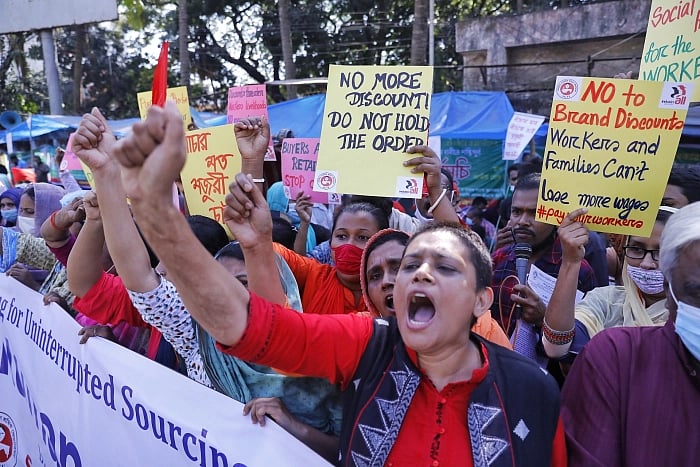
Meanwhile, garment workers staged protests in Gazipur and Savar yesterday, demanding higher wages. In Sreepur, Gazipur, workers blocked the Dhaka-Mymensingh Highway in the Gargaria Masterbari area in the morning.
Later, members of law enforcement agencies dispersed them by firing sound grenades and tear gas shells. The workers then moved to several connecting roads alongside the highway. Traffic on the highway was disrupted during the protest. Vehicle movement returned to normal after the situation came under control.
Mohammad Jahedul Islam, assistant superintendent of police at Gazipur Industrial Police, told Prothom Alo, “Workers blocked the roads at different points. We dispersed them. The situation is under control.”
According to Industrial Police, there are 1,723 factories across different sectors in Savar, Ashulia and Dhamrai under the jurisdiction of Ashulia Industrial Police-1. Of these, 736 are garment factories.
Meanwhile, authorities declared 33 factories closed yesterday due to labour unrest in Ashulia, Savar. In addition, 22 factories in the area remain closed under Section 13(1) of the Bangladesh Labour Act. Three workers were injured in the morning when protesters took to the streets and threw bricks and stones in the Nischintapur area.
At around 9:15 am, a group of protesters attempted to block the road in the Nischintapur area of the Abdullahpur-Baipail Road. They threw bricks and stones at a bus and targeted several nearby factories. Police later chased the protesters and dispersed them by firing sound grenades and tear gas shells.
According to Industrial Police, there are 1,723 factories across different sectors in Savar, Ashulia and Dhamrai under the jurisdiction of Ashulia Industrial Police-1. Of these, 736 are garment factories.
Minimum Wage Board meeting
The third meeting of the government-formed Minimum Wage Board, which had earlier been postponed, began at 11:45 am yesterday to determine wages in the garment sector.
After several breaks, the meeting continued until 8:30 pm. However, neither side could reach an agreement on the wage issue. The meeting was therefore adjourned for further discussions. According to sources at the Minimum Wage Board, the adjourned meeting will resume at 2:00 pm today, Tuesday.
According to board sources, the meeting was held at the Minimum Wage Board office in Segunbagicha, Dhaka, under the chairmanship of board chairman Syed Azad Subhani.
Those present included the board's independent member Mosleh Uddin Ahmed, owners' representative ABM Shamsuddin, workers' representative Babul Akhtar, permanent workers' representative Anwar Hossain and permanent owners' representative Asif Ayub.
BGMEA President Mahmud Hasan Khan and Rashedul Alam, general secretary of the Bangladesh Mukto Garments Sramik Union Federation, also attended yesterday's meeting as experts representing the owners and workers, respectively.
Meeting sources said that, at one stage of the lengthy discussions, both the owners and workers agreed to submit revised wage proposals. As part of this process, workers' representative Babul Akhtar revised the workers' proposed minimum wage from Tk 32,000 to Tk 22,000 in two rounds after evening. The owners also revised their proposal twice, eventually offering a minimum wage of Tk 15,800.
Following the garment workers' movement demanding higher wages, the government formed a six-member Minimum Wage Board on 1 November. The first meeting was held on 4 November. At the board's second meeting on 9 November, the workers' representatives submitted their initial wage proposal.
The owners' side has submitted its proposal. Discussions are underway on it, and we have also presented the information and data gathered during our visits to small, large and medium-sized factories in different industrial areas across the country. Arguments and counterarguments are taking place based on those findings.Syed Azad Subhani, chairman of Minimum Wage Board
The third meeting of the board was scheduled for 16 November, when the owners' representatives were supposed to submit their proposal. However, the meeting was postponed just hours before it was due to begin. The postponed meeting was held yesterday, with lengthy discussions on the wage proposals submitted by both sides.
During a break in the meeting, board chairman Syed Azad Subhani briefed journalists alongside other board members at around 4:45 pm yesterday. Journalists asked how much the owners had proposed as the minimum wage, but he declined to disclose the figure.
The board chairman said, “The owners' side has submitted its proposal. Discussions are underway on it, and we have also presented the information and data gathered during our visits to small, large and medium-sized factories in different industrial areas across the country. Arguments and counterarguments are taking place based on those findings.”
The board chairman further said, “At today's (yesterday's) meeting, it was unanimously decided that we would not disclose the owners' proposal at this stage. This is because the owners will ultimately implement the wage recommended by the board and determined by the government.”
Asked what factors were being considered in determining the minimum wage, the board chairman said, “We are discussing the issue by taking into account inflation, the number of dependants workers have, the financial capacity of factory owners, particularly the conditions of small and medium-sized industries, and where we stand in terms of competitiveness in the global market, among other factors.”
Speaking about the owners' proposal at the briefing, workers' representative Babul Akhtar said, “The owners always start by proposing a slightly lower amount. We did not find the proposal submitted by the owners acceptable or reasonable. Similarly, the owners did not accept our proposal either. We will now consult our senior labour leaders and submit a revised proposal. We hope the owners' representatives will also submit a revised proposal.”
Regarding the workers' movement, Babul Akhtar said, “The movement has been going on since 1 November this month, or even earlier. We believe workers intend to continue the movement until the final wage gazette is published.”
He therefore urged workers, saying, “Please return to work and keep production going.”
At the briefing, owners' representative ABM Shamsuzzaman said, “Suppose, a duck lays one golden egg every day. When the duck falls ill, can you still expect it to lay one golden egg every day? That is all I have to say.”
* Prothom Alo’s Staff correspondents in Savar and Correspondent in Sreepur, Gazipur, contributed reporting.