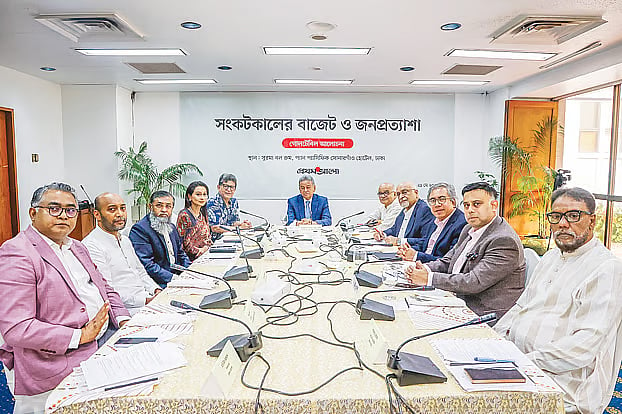
Prothom Alo Roundtable
Budget must bring relief to the people
Controlling inflation should be the guiding principal— the central objective — of the budget for the 2026–27 fiscal year. The upcoming budget should provide relief to general people.
Business leaders also urged that high interest rates should no longer continue, while tax burdens and harassment in tax collection should be reduced. Economists, businesspeople, researchers, and representatives from various sectors raised these issues in front of Finance and Planning Minister Amir Khasru Mahmud Chowdhury.
In response, the finance minister said the country’s economy would recover within the next two years and that gradually transforming Bangladesh into a welfare state is the goal of the BNP government. He said there is little value in merely citing growth figures. What matters to him is how much general people actually benefit. According to him, growth has no real meaning if it does not improve people’s quality of life.
The remarks were made yesterday, Thursday, at a roundtable discussion titled “Budget in Times of Crisis and Public Expectations,” organised by Prothom Alo at the Sonargaon Hotel in the capital. Prothom Alo Editor Matiur Rahman delivered the opening speech welcoming the guests. The entire event was moderated by Prothom Alo Head of Online Shawkat Hossain.
The finance minister responded to various issues raised by discussants during the session. At the outset, he said he wanted to move away from an oligarchic economy. His vision, he said, is for every citizen to have equal opportunities and meaningful participation so that the benefits of the economy reach everyone. To achieve this, he plans to bring the creative economy into the mainstream from the next fiscal year and allocate a dedicated fund for it in the upcoming budget.
Stressing that the prime minister possesses political goodwill, the finance minister said: “The government is working toward a tax policy where people will pay taxes and feel that they are genuine taxpayers. A system where you simply grab money from one sector and then another cannot be called a tax policy.”
He also said the global financing structure has changed, meaning the country can no longer operate the way it once did. Raising a question, he said: “Should we keep chasing the IMF for loans at 1 to 2 per cent interest? Or should we instead create a fund tomorrow morning and inject it into our own domestic market? If we can get good returns on investment, why should we wait for someone else to decide when to give us money and under what conditions? Why would we need that?”
Speaking about financing in the industrial sector, the finance minister said banks can provide working capital and loans for purchasing houses or cars. Yet they are also extending loans for projects worth Tk 20 billion. If one bank cannot finance such a project alone, four banks come together to do so. He described this as inefficiency. Questioning why the government should finance everything, he said: “Why should the government bear the cost of Bangladesh Biman purchasing 12 aircraft? Biman is an enterprise. It can raise funds from the capital market.”
For large-scale financing, the minister advised businesses to rely more on the capital market. He said: “Instead of taking Tk 20 billion in loans from banks at high interest, companies should raise funds from the capital market. I understand the capital market has collapsed. But it will be revived very quickly. If money is raised from the capital market, no interest has to be paid until the company starts earning profits. Once it earns, dividends can be paid. Then there is the bond market, from which loans can be obtained at lower interest rates than banks. This is how we will reduce the cost of doing business.”
Discussing good governance versus reform, the finance minister said: “It’s somewhat like the question of whether the egg came first or the chicken. But we are moving toward comprehensive reforms. Businesses will no longer need 13 separate approvals. Even if approvals are required, they will come from a single place within a fixed timeframe.”
Mentioning the customs department and ports, he added: “Everything must move toward automation. I have seen that costs start increasing from Chattogram Port itself. Payments have to be made here and there, this fee and that fee — and eventually prices rise by 10 per cent. Our goal is to reduce the overall cost of doing business.”
“An anchor is needed”
Debapriya Bhattacharya, Distinguished Fellow of the Centre for Policy Dialogue (CPD), described the upcoming budget as a difficult balancing test. He said that if macroeconomic stability is to be maintained, inflation control must become the “guiding star” of the next budget.
He said the finance minister must formulate the budget under fourfold pressure: the absence of structural reforms, an adverse global environment, IMF conditions, and high public anticipations. There will be both a large budget deficit and a major revenue shortfall. To move from a fragile economy toward prosperity, the macroeconomic framework needs an “anchor.”
However, he warned that allocations to education and healthcare should not be reduced in the process of cutting the budget deficit. He also criticised the tendency to keep projects alive in the Annual Development Programme (ADP) with minimal allocations.
Debapriya Bhattacharya noted that corporate tax exemptions currently amount to Tk 250 billion. He suggested that the National Board of Revenue (NBR) should thoroughly reassess these exemptions. He also said there is room to reconsider tax waivers in the power sector.
To reduce economic inequality, he called for the introduction of wealth tax and inheritance tax instead of relying solely on income tax. He further proposed that the government sell shares of profitable multinational and industrial enterprises under its ownership through the stock market as an alternative source of revenue. However, he noted that resistance from bureaucrats has prevented this from happening.
Agriculture could become the new growth driver
Former caretaker government adviser and PPRC Chairman Hossain Zillur Rahman urged Finance Minister Amir Khasru Mahmud Chowdhury to place greater importance on making the budget successful rather than using it to gain popularity.
“We would rather see the finance minister successful than popular,” he said.
Hossain Zillur said the public expectation is for a budget that provides relief, not an overly ambitious one. There is currently a crisis of confidence among everyone — from investors to general citizens — and the budget must help restore that confidence.
He noted that multiple sectors of the economy are facing crises, but the greatest challenge in budgeting is implementation.
Hossain Zillur Rahman said: “Bangladesh needs a new engine of growth for GDP expansion. At present, the service sector is the country’s main growth driver. The agricultural sector could become the next major driver of growth.”
He added that general people are now struggling to balance their income and expenditure. The budget must therefore give special attention to this issue of affordability and survival. Increasing budget allocations alone is not enough; improving the capacity to spend effectively in education and healthcare is more important. Otherwise, additional allocations will merely result in more buildings being constructed.
Budget should reflect a five-year vision
Selim Jahan, Professorial Fellow at the BRAC Institute of Governance and Development (BIGD), said: “I want to see the budget as a five-year plan. A budget should not merely be an account of income and expenditure; it should embody a development philosophy.”
He said budgetary balance must be maintained in a way that does not destroy the balance of people’s lives. If subsidies are reduced, living standards will decline. Therefore, reforms must proceed alongside investment in growth and human resources.
Selim Jahan said: “We need reforms that are manageable. Tax collection must increase, and expenditure must decrease. But alongside reforms, public expectations must also be managed. A balance between stability and dynamism must be established. Along with controlling inflation, the goal should be to expand employment opportunities.”
He argued that the budget should focus not on public popularity but on fulfilling people’s actual needs. Some initiatives may not be popular with everyone, he said, but in such cases the public should be prepared in advance. He also called for democratisation of the economy and easier public participation across sectors. Women’s development issues, he said, must also be included in budget discussions.
“High interest rates are holding us back”
Mohammad Mustafa Haider, Director of TK Group, said there is currently only a 5 to 10 per cent tariff gap between imported raw materials and finished products. According to him, the difference should be at least 10 per cent.
Mustafa Haider said: “Because of high interest rates, we are falling behind China, Vietnam, and India. In such a situation, if tariffs on imported finished products remain low, it becomes difficult to do business.”
He added: “Interest rates in Bangladesh range from 12 to 14.5 per cent, whereas they are around 4 per cent in China, 6 to 8 per cent in Vietnam, and 8 to 9 per cent in India. This is where we are lagging behind. Moreover, we are also given less time to repay bank loans.”
Calling for solutions to the gas crisis and urging the government not to increase electricity prices, Mostafa Haider said electricity costs in Bangladesh are already higher than in neighbouring countries. He also complained that businesses are unable to recover advance income tax and VAT refunds, urging authorities to address the matter.
He further remarked that misuse of bonded warehouse facilities is preventing the development of linkage industries in the country.
Tax and duty burdens in the pharmaceutical sector
Simeen Rahman, CEO of Transcom Group, called for reducing advance income tax on pharmaceutical raw materials from 5 per cent to 3 per cent. She said advance taxes paid to the NBR are often not refunded, creating additional pressure on businesses.
To increase the tax-to-GDP ratio, she emphasised expanding the tax net and recommended digitising and automating the tax system.
Simeen Rahman also said bonded warehouse facilities should be introduced for the pharmaceutical industry. In her view, the pharmaceutical sector should receive export-oriented incentives similar to those enjoyed by the garment sector.
Calling for research and development expenses to be fully tax-exempt, she said developing new medicines takes a long time, yet companies have to bear tax burdens from the very beginning.
She further stated that reforming the financial sector is now a necessity of the times. “These reforms are not easy,” she said, “but we must move toward the right reforms.”
Expressing concern over taxation in the beverage industry, she noted that the total tax burden in Bangladesh is 54 per cent, compared to 40 per cent in India and only 20 per cent in Vietnam.
Investment climate in disarray
M Masrur Reaz, Chairman of Policy Exchange Bangladesh, said: “During the interim government’s 18 months in office, no visible steps have been taken toward meaningful reforms. The investment climate is now like a broken house. If we try to find tenants or investors without repairing the house first, they will leave disappointed.”
He said some scattered reforms had taken place during the interim government period, which he described as “Mickey Mouse reforms.” Such minor measures, he argued, cannot remove the major barriers to investment.
According to Masrur Reaz, the investment situation has now reached “rock bottom,” making large-scale reforms essential. Reviving investment must become the top priority if the fragile economy is to recover. Otherwise, employment, exports, diversification, and productivity will all remain stalled.
Describing the current period as one of multidimensional crisis, he said: “The wheels of our economy have slowed down. Growth in private-sector credit flow has fallen to the lowest level in history. This is a grave warning sign for investment.”
Factories fighting for survival
Mohammad Hatem, President of the Bangladesh Knitwear Manufacturers and Exporters Association (BKMEA), said many operational garment factories are now at risk of shutting down. Many business owners, he added, are seeking a “safe exit” from the sector.
To keep factories running, he called for the creation of a special fund and separate budgetary arrangements for entrepreneurs wishing to exit the business.
Criticising the advance income tax system, Mohammad Hatem said businesses are being taxed on sales even when they make no profit, putting entrepreneurs under severe pressure.
He also demanded the withdrawal of duties on batteries to encourage solar and renewable energy. According to him, rapid investment in renewable energy is necessary to reduce energy costs.
Child deaths due to lack of treatment are alarming
Mahbub ur Rahman, Managing Director of HSBC Bangladesh, said: “As a citizen of Bangladesh, it pains me deeply when I see small children dying due to lack of treatment.”
For this reason, he urged the government to place special emphasis on education and healthcare in the next budget.
He also noted that while family-owned businesses in Bangladesh have created significant assets, they often lack cash liquidity. Most businesses, he said, have become heavily dependent on loans, making interest rates the most critical issue for them.
Mahbub ur Rahman called for increasing offshore banking and foreign investment to boost foreign currency reserves, alongside diversifying exports.
Consumer goods market dominated by a few groups
Golam Mawla, General Secretary of the Moulvibazar Traders’ Association, said the country’s consumer goods market is increasingly falling under the control of a handful of large conglomerates.
“Eighteen to twenty crore people are becoming dependent on just four or five groups. This is dangerous,” he warned.
Criticizing the customs valuation system, he said there is a major mismatch between international market prices and the NBR’s tariff values, causing traders to face accusations of under-invoicing and over-invoicing.
Golam Mawla also questioned the high duties imposed on everyday essentials such as cumin and cardamom, arguing that excessive taxation on such products increases the burden on ordinary consumers.
Corporate dominance in restaurant sector
Imran Hasan, Secretary General of the Bangladesh Restaurant Owners Association, said small restaurant owners are struggling to survive because of aggressive expansion by large corporate groups.
He alleged that a few major companies now control large portions of the bakery and restaurant sector and create unfair competition by using raw materials imported through bonded warehouse facilities.
According to him, although Bangladesh has around 480,000 restaurants, only 10,000 are VAT-registered.
Imran Hasan said operating a restaurant requires approvals from 13 to 14 government agencies. Business owners face harassment due to complications involving DC licenses, fire licenses, environmental clearances, and other approvals.
He called for a separate fund for the restaurant sector, easier access to loans, and the introduction of a one-stop service system.