Bangladesh’s economy could grow more slowly than those of other South Asian countries, while inflationary pressure is likely to remain the highest in the region.
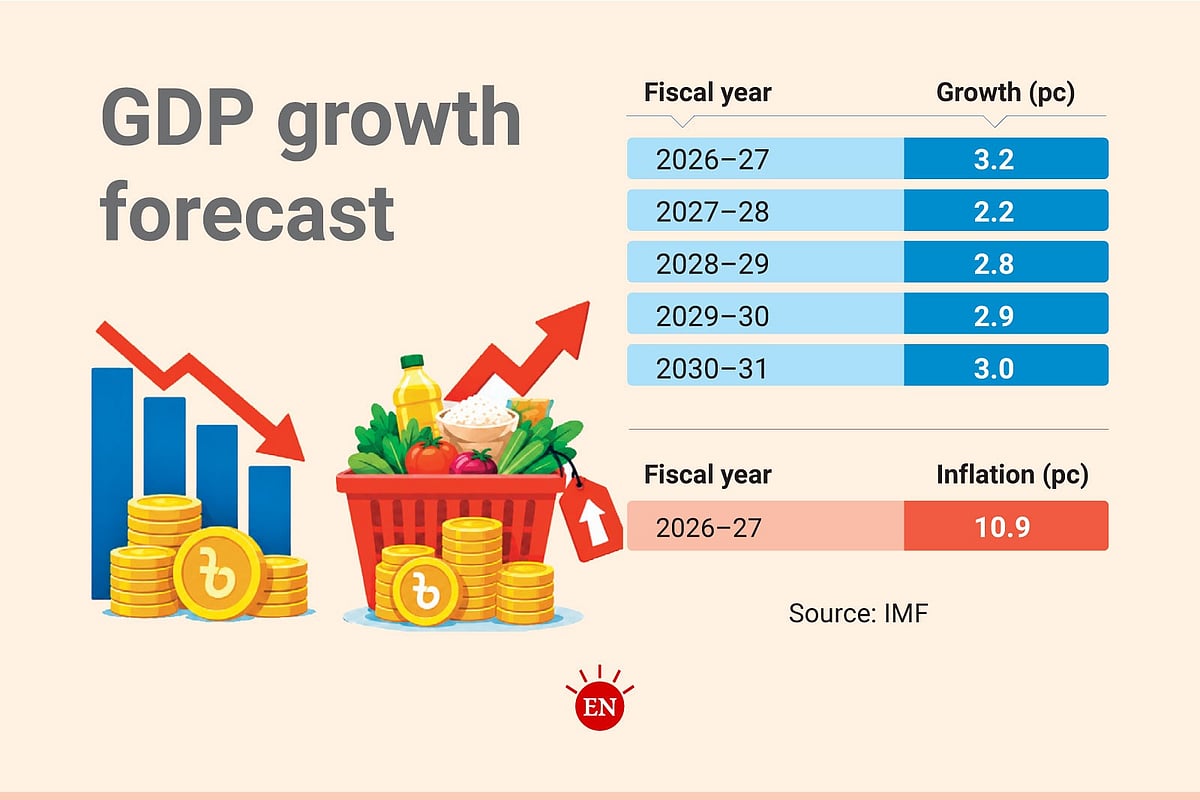
According to forecasts by the International Monetary Fund (IMF), Bangladesh’s gross domestic product (GDP) growth could fall to 3.2 per cent in the current fiscal year, while average annual inflation could reach 10.9 per cent.
There is little indication of a strong economic recovery over the next few years. The IMF expects growth to fall further, to 2.2 per cent in the following fiscal year. On Tuesday, the organisation published its World Economic Outlook, which included GDP growth and inflation forecasts for Bangladesh and other countries.
Sluggish growth will put further pressure on investment and employment, while high inflation will erode people’s purchasing power. The World Bank recently reported that around eight million people had fallen below the poverty line over the past four years. Approximately 62.5 million people in Bangladesh are at risk of falling into poverty.
Official figures put growth at 4.14 per cent in the previous fiscal year. If the IMF’s forecast for the current fiscal year proves accurate, Bangladesh will not have recorded such a low growth rate in the past three and a half decades. Its inflation forecast would also imply the highest average annual inflation in 15 years.
The strain caused by economic weakness is therefore not confined to growth figures; it is directly affecting people’s living standards. Weakness in the banking sector, energy shortages, stagnant private investment and shortfalls in revenue collection are making the situation more complicated. Taken together, these factors are fuelling concerns about economic recovery, job creation and people’s quality of life.
The IMF is not alone in projecting relatively weak growth. The World Bank and the Asian Development Bank (ADB) have also issued modest forecasts. The World Bank’s Bangladesh Development Update, published on 6 September, projected growth of 3.4 per cent in the current fiscal year.
Last month, the ADB forecast growth of 4 per cent. The IMF’s projection is lower than both. The government, however, has set a growth target of 6.5 per cent for the current fiscal year.
Official figures put growth at 4.14 per cent in the previous fiscal year. If the IMF’s forecast for the current fiscal year proves accurate, Bangladesh will not have recorded such a low growth rate in the past three and a half decades. Its inflation forecast would also imply the highest average annual inflation in 15 years.
The annual meetings of the IMF and the World Bank are under way in Bangkok, the capital of Thailand. Finance Minister Amir Khosru Mahmud Chowdhury met World Bank representatives there on Tuesday.
Asked after the meeting about the growth and inflation forecasts, he told journalists that the two institutions had issued their projections and that he did not want to dispute them. The government was working towards the targets set in the budget, he said.
Zahid Hussain, former lead economist at the World Bank’s Dhaka office, told Prothom Alo that, given the current trajectory of the economy, growth would be weak and inflation would rise to a high level.
Inflation must be brought under control and the obstacles to growth and job creation must be removed. These include a weak banking sector, energy shortages, disorderly budget management and inadequate social protection programmes. Reforms are needed in all these areas.Zahid Hussain, former Lead Economist at the World Bank’s Dhaka office
He further said the IMF, World Bank and other organisations were all saying that the country’s economy was going through a difficult period. Ordinary people were already under pressure, and that pressure would intensify. Inflation would reduce their purchasing power and push more people into poverty, he added.
Growth could fall further
The IMF has issued forecasts for Bangladesh’s GDP growth and inflation, including projections for the next four fiscal years. According to its forecasts, growth could fall to 2.2 per cent in fiscal year 2027–28, below the rate recorded during the Covid-19 pandemic.
The IMF projects growth of 2.8 per cent and 2.9 per cent in the following two fiscal years, respectively, before it rises to 3 per cent in fiscal year 2030–31. In other words, the economy is unlikely to gain much momentum over the next three years.
In its report published on Tuesday, the IMF also provided growth and inflation forecasts for other South Asian countries, including India, Pakistan and Sri Lanka. According to the report, India’s growth in fiscal year 2026–27 could reach 7 per cent, with inflation at 4.4 per cent. Pakistan’s growth is projected at 3.5 per cent.
The World Bank considers weakness in the banking sector one of the major risks facing Bangladesh’s economy. The non-performing loan ratio stood at 20.2 per cent at the end of December 2024. By June 2026, it had risen to 33.2 per cent.
Sri Lanka could record growth of 3.7 per cent and inflation of 5.4 per cent, while Nepal’s growth and inflation are projected at 3.7 per cent and 5.8 per cent, respectively. The Maldives could see growth of 3.8 per cent and inflation of 2.5 per cent, while Bhutan’s growth could reach 6.9 per cent, with inflation at 6.5 per cent.
What are the risks to the economy?
The IMF report did not provide an analysis of Bangladesh’s economy or discuss the challenges it faces. The World Bank, however, analysed the country’s economic situation in its Bangladesh Development Update, published on 6 September.
The World Bank report said several pressures were building up simultaneously. Economic growth was slowing, investment and employment were weakening, and inflation was reducing people’s real incomes. Weakness in the banking sector, energy shortages and revenue shortfalls were adding to the risks.
The World Bank identified weaknesses in the banking sector as one of the biggest threats to the economy.
The World Bank report further said poverty had increased because of factors including declining real incomes caused by high inflation and a slowdown in employment. Around eight million people had fallen below the poverty line over the past four years, while approximately 2.1 million more fell below it in the previous fiscal year alone.
According to the report, the national poverty rate has risen for four consecutive years, increasing from 18.7 per cent in 2022 to an estimated 22.5 per cent in the previous fiscal year. It could rise further to 22.8 per cent in the current fiscal year. Income inequality has also increased over the same period.
The World Bank considers weakness in the banking sector one of the major risks facing Bangladesh’s economy. The non-performing loan ratio stood at 20.2 per cent at the end of December 2024. By June 2026, it had risen to 33.2 per cent.
According to the World Bank, private-sector credit growth is at its lowest level in 33 years. Shortages of gas and electricity have forced many factories to operate below capacity. Some businesses have reduced working hours, suspended production or laid off workers. Foreign investment fell by 15 per cent last year.
The government has also had to spend several billion dollars more to import fuel. Meanwhile, revenue collection has made little progress. The National Board of Revenue (NBR) has been unable to meet its targets, with the revenue shortfall exceeding Tk 250 billion in the first two months of the fiscal year, July and August. These factors have combined to create mounting pressure on the economy.
Asked what should be done to overcome the situation, economist Zahid Hussain said inflation must be brought under control and the obstacles to growth and job creation must be removed.
These include a weak banking sector, energy shortages, disorderly budget management and inadequate social protection programmes. Reforms are needed in all these areas, he said.