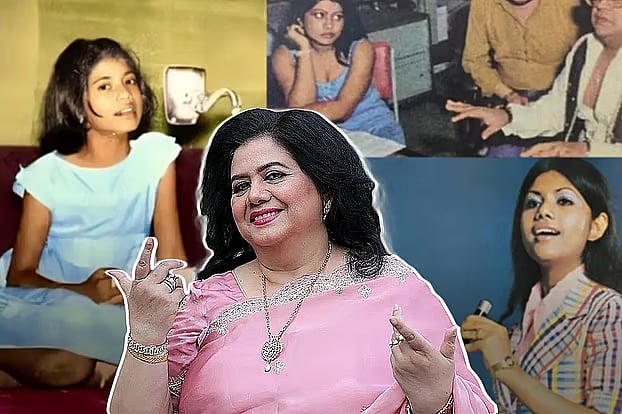
Runa Laila was boycotted, but nothing could hold her back
Six decades!
It's a rare achievement for anyone to remain in the limelight for such a long span of time, to win over millions of listeners with song after song. But that is Runa Laila! Equally gifted in Urdu, Hindi and Bangla, she is now a living legend in the music history of the subcontinent.
Things were not always easy. When she returned to Bangladesh from Pakistan in the 1970s, she faced many obstacles. There was envy, rejection and boycotts. Yet, despite all such adversities, music remained her support, refuge and strength.
The girl who danced
Runa Laila is known as a singer, but she started off with dance. She loved dancing. Little Runa Laila spent much of her childhood in Karachi, Pakistan. Her father, Emdad Ali, was a senior government official. Her mother, Amina Laila, enrolled her at the Bulbul Academy of Fine Arts there to learn dance. Runa trained for four years under teacher Afroza Bulbul, learning kathak and bharatnatyam.
Runa says, “I don’t remember much of it now. But when I perform on stage, a few dance moves slip in unconsciously.”
When she was a child, her grandmother once gave all the grandchildren money. They all bought goodies, but Runa bought herself bells for her ankles. She's wear these anklets, dancing all around the house. Her mother was well aware how much Runa loved to dance and so got her admitted to an academy where she trained for four years. She took part in many performances then too.
Runa Laila may have been a passionate dancer, but she was destined to become one of the most beloved singers of the Bengali people. How could she remain confined to dance alone! Her elder sister, Dina Laila, trained in music under Abdul Kader and Habib Uddin Ahmed. Little Runa would run around and memorise whatever songs her sister sang. Later, she too would sing them.
One day, Ustad Abdul Kader happened to hear Runa singing. He was enchanted and astonished. He predicted that one day Runa Laila would earn great fame as a singer. His prophecy came true. The Runa Laila who had once trained in dance went on to become a superstar of Bangla music.
The Pakistan chapter
Because of her father’s government posting, Runa’s childhood was spent in Pakistan. That was where she studied grew up, and began her musical career. On 24 June 1964, Runa recorded her first song at Eastern Studio in Karachi. The following year, in 1965, the song was released in the film Jugnu. Runa was only twelve then. She recalls, “A proposal came from Lahore to sing for a film. My father refused right away. He had no objection to my singing, but at that time many people looked down upon working in films. Still, I wanted it very much. All the famous artistes used to sing for radio then. I used to dream that one day my name would be announced on the radio, and everyone would hear my songs. My mother managed to persuade my father and he consented. That’s how I got the chance to sing for a film.”
The Urdu film song was titled 'Guriya Si Munni Meri'. On screen, it was lip-synced by a twelve-year-old boy. At a very young age, Runa began working with renowned composers like Masroor Anwar and Safdar Hussain. Even as a teenager, her voice carried the depth and maturity of a seasoned singer. Gradually, Runa became a well-known name in Pakistan’s music world. By the early 1970s, her popularity had spread to India as well. After the legendary Noor Jehan, if there was any singer in Pakistan who captured the public’s imagination, it was Runa Laila.
Back to Bangladesh and a boycott
Runa Laila has brought Bangladesh glory at home and abroad. Alongside Bangladeshi musicians, she shares warm friendship with some of the most celebrated artistes of the subcontinent. Many of the younger generation regard her as a role model. Yet, in the 1970s, this eminent Bangladeshi singer was once boycotted. Many of her contemporaries refused to share the stage with her or sing alongside her.
But Runa Laila was not the least bothered. She kept singing, true to herself. “Everyone saw that I was singing for films, and no one was really sticking to the boycott. The musicians kept playing, the music directors kept working. To be honest, the audience’s love made that boycott impossible to sustain,” she recalled during a conversation with Prothom Alo.
I have never broken down. I’ve always had deep faith in the Almighty. I’ve always believed that if I truly have talent, I’ll overcome any challenge. My greatest strength has been the love and respect of peopleRuna Laila , renowned singer
During her early years, living in Pakistan because of her father’s government posting, Runa Laila led a busy and fulfilling musical career. In the mid-1970s, she returned to Bangladesh. While many welcomed her back with good wishes, some were envious of her success and she often faced obstacles.
When asked how she overcame those challenges, Runa Laila told Prothom Alo, “Life means seeing everything in a positive light. If you stay positive, everything falls into place. You must have inner strength. When your mind is strong, you can overcome many hurdles. My life revolves around my music and my family. That’s what my life is about. The truth is, I’ve faced many obstacles, but I’ve never had to go to anyone asking for work. I’ve never had to say, ‘Please let me sing.’ By the grace of Allah, people have always come to me with offers to sing. Whenever there were obstacles, the Almighty was there. He sees everything.”
Runa Laila added, “I have never broken down. I’ve always had deep faith in the Almighty. I’ve always believed that if I truly have talent, I’ll overcome any challenge. My greatest strength has been the love and respect of people. That has never allowed me to feel sad or hopeless. Above all, my family has always been by my side.”
Singing through it all
Just as Runa Laila has won the love of her listeners through her songs, she has also been aware of the ugly politics that sometimes in the music world. Yet she has always chosen to face everything through her music and continues to sing through it all.
Runa Laila explained, “There was a lot written about the obstacles I faced. So, just as the audience knew about my songs, they also knew what was happening to me. My family knew too. There was so much written that I didn’t even have to explain anything. My fans understood very well why such things were happening. And I was never upset or frightened by those negative situations. I always believed that those who spread negativity about me would one day realise their mistake.
"I’ve always maintained that Allah sees everything. If you do good, you’ll see justice in this world. If you do wrong, that too has its consequences. So I’ve never cursed anyone, and I never will. Even about those who opposed me, I’ve only spoken kindly.
"I’m happy with my songs, happy with my family. What others say or do doesn’t matter to me. I don’t care. I’ve always walked a straight path. I’ve never harmed anyone, nor have I ever wanted to, and I never will. As much as I can, I’ll continue to do good for others, no matter how badly they treat me. I’ve never had the urge to take revenge, and I never will. That’s just not who I am.”
Speaking to Prothom Alo, Runa said that these were lessons she learnt from her family. She said, "When children are young, they learn from their parents, how to proceed in life, which path to take and which to avoid. That is how we grow up. We were taught never to harm anyone, rather to help people in any way we can. The three of us siblings always followed this in our lives. I still do."