In the Sundarbans, the world’s largest mangrove forest, tigers are mostly being killed by traffickers.
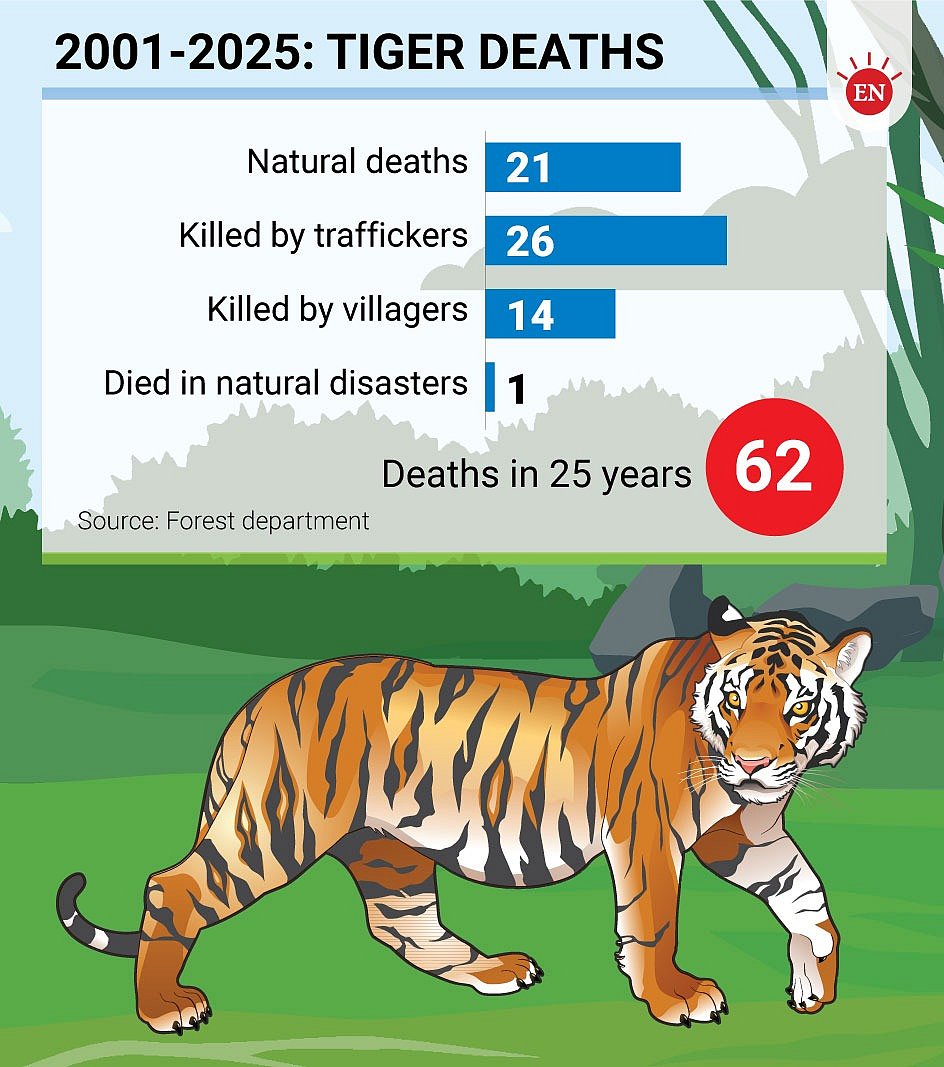
Despite various conservation efforts, over the past two and a half decades, 21 tigers have died of natural causes, while 26 have been killed by traffickers.
During the same period, authorities have recovered 24 tiger skins, four tiger skulls and 296 tiger bones.
In addition to the killings by traffickers, 14 tigers have been killed by villagers after straying into human settlements near the Sundarbans.
Despite various conservation efforts, over the past two and a half decades, 21 tigers have died of natural causes, while 26 have been killed by traffickers. .During the same period, authorities have recovered 24 tiger skins, four tiger skulls and 296 tiger bones.
However, according to the 'Tiger Action Plan (2018–2027)', between 2008 and 2015, villagers killed an average of three tigers each year when these animals entered local communities. One tiger has also died as a result of natural disaster.
According to the forest department, a total of 62 tigers have died over the past two and a half decades. In the most recent tiger census conducted in 2024, the number of tigers in the Sundarbans was recorded at 125, that is, 11 more than in the previous survey.
Although the forest department files cases when tiger skins and body parts are recovered, in most instances, the accused are acquitted due to loopholes in the lawsuits. According to the department's records, over the past 15 years, verdicts have been delivered in 10 out of 19 cases related to tiger killings and the recovery of body parts. Of these, defendants were acquitted in six cases, while various prison sentences were handed down in the remaining four. The other nine cases are still pending trial.
Field-level officials of the Forest Department in the Sundarbans report that although 74 individuals have been accused in these cases, many of them are released on bail and subsequently return to the same criminal activities. In addition, deer poaching in the Sundarbans has seen a rise in recent times.
Speaking to Prothom Alo, Divisional Forest Officer of the Sundarbans West Forest Division, AZM Hasanur Rahman said, “In response to the rise in deer poaching in the Sundarbans, we’ve changed our patrolling strategy. Previously, field-level forest officers used to patrol by boat. Now, we’ve introduced foot patrols inside the forest. As a result, traps set for deer are being detected more easily. In June alone, the Sundarbans West Forest Division seized 142 deer traps. They also recovered 41 kilograms of venison.”
Hasanur Rahman added, “Deer poaching is most active in Koyra, Khulna. We are holding yard meetings with members of our Village Tiger Response Team to raise awareness.”
In the meantime, International Tiger Day is being observed across the country today. This year’s theme here is: “Increase in Tiger Population, Growth of the Sundarbans.”
Although the forest department files cases when tiger skins and body parts are recovered, the accused are mostly acquitted due to loopholes in the lawsuits
Traffickers get away
A study conducted in August 2023 by the US-based wildlife research organisation Panthera and the China-based Chinese Academy of Sciences found that tiger-hunting criminals are still active in the Sundarbans. Tiger body parts from the Sundarbans are being trafficked to 15 countries around the world. Yet, in most of these cases, the accused manage to get acquitted through legal loopholes.
A forest official, speaking on condition of anonymity, said that several flaws persist in the way the forest department prepares its cases. For example, according to Section 72 (1) (Gha) of the Forest Act, the investigating officer must record the accused’s statement in a prescribed format. However, it is often found that, even when there are multiple accused, all their statements are nearly identical.
While the forest department claims that verdicts in four cases have been in their favour, records from the forest court suggest otherwise.
Retainer of the Khulna Forest Court (responsible for handling forest-related cases), GM Kamruzzaman, told Prothom Alo, “I have been in the forest court for 16 years. In one case involving the recovery of a tiger skin, three individuals from Sher-e-Bangla Road in Khulna were sentenced to five years each. Apart from that, I don’t recall any other such case.”
When asked whether there are legal weaknesses in how the forest department files cases, he declined to comment.
A forest official, speaking on condition of anonymity, said that several flaws persist in the way the forest department prepares its cases. For example, according to Section 72 (1) (Gha) of the Forest Act, the investigating officer must record the accused’s statement in a prescribed format. However, it is often found that, even when there are multiple accused, all their statements are nearly identical.
If we fail to control the spread of industrialisation around the Sundarbans, the functionality of the ecosystem will collapse and as the apex predator, the tiger will inevitably be affectedMA Aziz, professor of zoology, Jahangirnagar University, and a tiger researcher
This becomes a point of weakness during court arguments, the official noted. He added that most of the witnesses presented by the forest department fail to provide strong, consistent testimony under cross-examination. This allows the accused to walk free.
He cited the example of two accused individuals from Dhangmari in Dacope upazila who were arrested in December 2012 with tiger teeth and later acquitted in court in this manner.
Khulna Regional Forest Conservator Imran Ahmed told Prothom Alo, “We do observe such weaknesses in case preparation. To overcome these issues, we are now bringing our field-level officers under training programmes as part of the Sundarbans Protection Project. In several phases, we are providing training with the help of government prosecutors to address these legal shortcomings.”
Climate crisis and salinity threaten tigers
Beyond poachers, tigers are increasingly threatened by rampant deer hunting, rising salinity due to climate change, sea level rise and a decline in biodiversity, all of which are intensifying the their existential crisis.
Professor MA Aziz of the Zoology department at Jahangirnagar University and a tiger researcher told Prothom Alo that the illegal hunting of deer is the primary threat to tigers in the Sundarbans.
“Deer make up 78 per cent of a tiger’s diet. The rest is supplemented by wild boar. If this poaching cannot be stopped, a food crisis for tigers is inevitable,” he said.
According to Aziz, the long-term threat to tigers stems from the reduced upstream flow of freshwater into the Sundarbans' rivers.
Seawater salinity is creeping further into the forest, leading to a decline in plant biodiversity.
“The eastern part of the Sundarbans has a higher deer population than the west. If we fail to control the spread of industrialisation around the Sundarbans, the functionality of the ecosystem will collapse and as the apex predator, the tiger will inevitably be affected,” he warned.