Water pollution
Pollution in Agartala, suffering in Brahmanbaria
Five canals and two rivers of Brahmanbaria have become polluted with industrial and household waste from Agartala
India's state of Tripura is situated along the border of Akhaura of Brahmanbaria in Bangladesh. The rivers of Tripura's capital, Agartala, are being polluted by industrial and household waste there, and that polluted water is flowing into Bangladesh. The people are Brahmanbaria are bearing the brunt of this pollution.
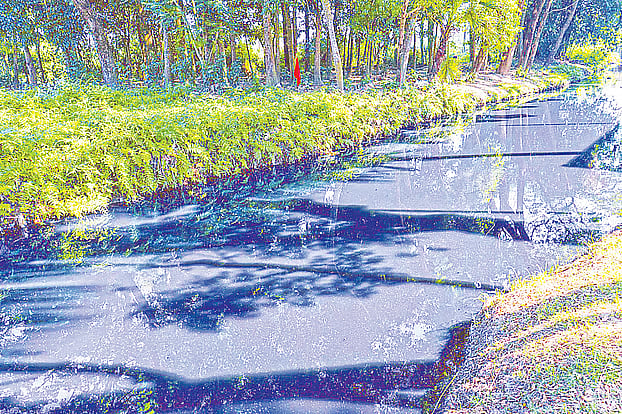
On 18 December, a visit to the Akhaura border revealed that the Kalandi canal enters Bangladesh from India alongside the immigration checkpoint. Pitch-black water is flowing through the canal, and the surrounding area is filled with a pungent stench. Physicians and local residents say that this prolonged pollution is causing skin and stomach ailments among people in 15 villages of Akhaura upazila in Brahmanbaria.
Altogether, five canals and two rivers are facing this pollution. These are the Kalandi, Mora Gang, Kata canal, Kalikapur canal and Gangasagar canal, as well as the Howrah and Jaji rivers.
The pollution is not new; it has been continuing for three decades. At a meeting of the Joint Rivers Commission held in March this year, India had assured Bangladesh that the pollution would be stopped. However, the situation has not improved.
In 2020, a committee of the Department of Environment tested the water of these canals and rivers for the first time and found evidence of pollution. The report stated that even during the peak monsoon, pollution levels in the canals on the Bangladesh side of the border were far above permissible limits. It also noted that the impact of the pollution had reached as far as the Titas River.
The committee’s report recommended holding discussions with India to ensure the installation of waste treatment facilities, sewage treatment plants and effluent treatment plants—on the Indian side to stop the pollution. Most recently, the Department of Environment tested the water again in April this year, and pollution was found there as well.
The committee formed in 2020 was headed by Fahmida Khanam, who was then a director at the Department of Environment. She is now serving as an additional secretary at the Ministry of Environment, Forest and Climate Change. Speaking to Prothom Alo, she said, “In October 2020, we first tested water samples from the border-area canals and rivers and found pollution beyond acceptable standards. At that time, we put in place a system under the Department of Environment to monitor the situation regularly.”
Fahmida added, “From our side, we then asked the Joint Rivers Commission to contact India to take measures to stop this pollution. The commission has been raising the issue regularly at its meetings. The Joint Rivers Commission would be in a better position to give an update on the latest outcome.”
Speaking in this regard to Prothom Alo, Engineer Mohammad Abu Sayeed, director of the Joint Rivers Commission, told Prothom Alo that for several years India has been urged at Joint Rivers Commission meetings to take measures to stop the pollution. Each time, India has assured that steps would be taken to curb it. The issue of taking action to halt the pollution has also been raised at meetings at the director general level of the Border Guard Bangladesh (BGB).
Mohammad Abu Sayeed added that at the most recent Joint Rivers Commission meeting held in March this year, India informed Bangladesh that work had begun on installing a sewage treatment plant in Agartala city to stop the pollution. The plant is currently under construction. Once completed, a team from Bangladesh is expected to visit and inspect the facility.
The state of pollution
Dissolved oxygen is an essential element for aquatic life and microorganisms to breathe in water. At least 5 milligrams of dissolved oxygen (DO) per litre are required.
Tests conducted by the Department of Environment in April this year show that in six of the seven samples taken from different locations, dissolved oxygen levels were far below acceptable standards. In five samples, DO levels ranged between 0.61 and 1.20 milligrams per litre. At one location, the level was 4.15 milligrams per litre. Acceptable levels were found at only one site.
Biochemical oxygen demand (BOD) is an indicator used to measure the level of organic pollution in water. The acceptable limit is a maximum of 6 milligrams per litre. All seven samples exceeded this limit, with levels ranging from 8 to 27 milligrams per litre.
Another indicator for assessing pollution levels is chemical oxygen demand (COD). The acceptable limit for COD in water is up to 50 milligrams per litre. Of the seven samples, only one was within the acceptable limit. The remaining six exceeded it, with levels ranging from 52 to 116 milligrams per litre.
Rubel Ahmed, convenor of the Akhaura Nature and Environment Club, told Prothom Alo that polluted water is flowing in from India and that pollution has increased over the past three decades.
Health and livelihood losses
The pollution is having various harmful effects on daily life in Akhaura upazila of Brahmanbaria. Akhaura Upazila Health and Family Planning Officer Himel Khan told Prothom Alo that polluted water mixed with chemical substances is entering through the Akhaura border. This poses the highest risk of diseases such as diarrhoea, typhoid and skin ailments. In addition, chemicals present in the water could cause serious illnesses such as cancer. “We are eating toxic fish and vegetables. All kinds of health risks have emerged,” he said.
Local farmers said that in about 15 border villages, rice is cultivated on roughly 1,500 hectares of land using polluted water. The southern union of the upazila has the largest area of paddy fields. Some land in Mogara union and Akhaura pourashava is also affected.
Musa Bhuiyan, a farmer from Sahebnagar village in the upazila’s southern union, told Prothom Alo that people in the area are suffering from various illnesses, including fever, diarrhoea and itching. Some have developed sores on their legs.
According to the Akhaura upazila office of the Department of Agricultural Extension, rice is cultivated on 4,710 hectares of land for Aman, 5,705 hectares for Boro, and 210 hectares for Aus. The upazila has a total cultivable area of 6,666 hectares. There are 16,000 farming households.
Ainun Nishat said that the waste coming through Agartala contains large amounts of dirty water and polythene. Bangladesh has lodged numerous complaints with India about this, but so far no solution has been found
Upazila Agriculture Officer Md. Masud Rana could not provide information on how many acres of land have been affected by this pollution.
Akhaura is well known for fish farming. According to sources at the Upazila Fisheries Officer’s office, more than 5,000 tons of fish are produced in the upazila each year. There are 1,430 professional fishers and 3,557 fish farmers in the area.
Upazila Fisheries Extension Officer Md. Rezaul Karim told Prothom Alo that the black toxic water coming from India is extremely harmful to fish. This water contains almost no oxygen, and toxic gases and ammonia in it prevent fish from surviving. There is no fish in the canals of the upazila.
“No solution found”
Research shows that polluted air coming from India is a major contributor to air pollution in Bangladesh. Although it is difficult to prevent this air pollution, stopping pollution in Agartala could reduce water pollution in Bangladesh.
Emeritus Professor Ainun Nishat, an expert on river management and international water law, told Prothom Alo that the Joint Rivers Commission does not only discuss the waters of the Ganges and Teesta, but also all common rivers between the two countries. Engineers from both countries can raise issues like pollution at various levels of meetings in the commission.
Ainun Nishat said that the waste coming through Agartala contains large amounts of dirty water and polythene. Bangladesh has lodged numerous complaints with India about this, but so far no solution has been found.