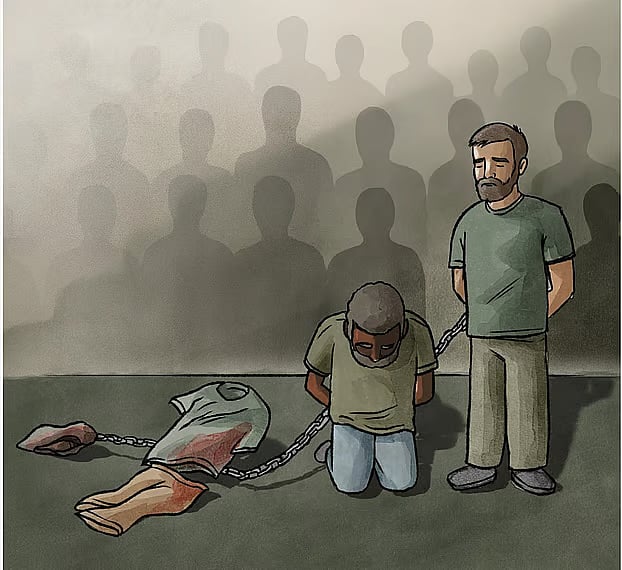
Death penalty for expatriates in Saudi Arabia
‘They do not understand the language, cannot get lawyers, and their bodies are never returned’
Death penalty for expatriates in saudi arabia: ‘They do not understand the language, cannot get lawyers, and their bodies are never returned’
The execution of foreign nationals is rising at an alarming rate in Saudi Arabia, with two Bangladeshis among those recently executed. In the first six months of this year alone, the country executed 59 foreign nationals. The imposition of the death penalty, particularly for drug-related offences, the transparency of judicial proceedings involving foreign defendants, allegations of torture and the limited opportunities to defend themselves have raised questions around the world. Against this backdrop, this is the final instalment of the series on Saudi Arabia’s judicial system and the way the death penalty is imposed.
One day in May last year, an Ethiopian prisoner was executed in Saudi Arabia. Before his execution, he called his mother back home and told her that he would be taken away the following morning. That would be his last breath. Hearing this, his mother burst into tears.
But the story did not end there. The Ethiopian man was executed, yet weeks passed without his body being returned to his family. Meanwhile, as his mother waited desperately for one last chance to see her son, she began showing signs of severe psychological distress. Eventually, she had to be admitted to a hospital’s psychiatric ward.
The incident was reported to London-based international human rights organisation Amnesty International by a member of the Ethiopian community. His own brother was also awaiting execution in Saudi Arabia. He said, “They [the Saudi rulers] are not just killing our brothers; they are killing us too.”
It is worth noting that 58 Ethiopians are currently being held in Khamis Mushait Prison in Saudi Arabia, facing the death penalty.
The heartbreaking case of the Ethiopian prisoner is not an isolated incident. A look at Saudi Arabia’s execution figures reveals a striking number of foreign nationals. Of the country’s total population of 35.3 million, around 44 per cent—approximately 15.7 million people—are foreign nationals or expatriates. Yet, between January 2014 and June 2025, Saudi Arabia executed 597 people for drug-related offences alone, nearly 75 per cent of whom were foreign nationals, according to Amnesty International.
According to data from the Berlin-based international human rights organisation European Saudi Organisation for Human Rights (ESOHR), of the 108 people executed in the first six months of this year (January–June), 59—or approximately 54 per cent—were foreign nationals. During the same period, 49 of the 71 executions carried out for drug-related offences involved foreign nationals.
How many were from each country?
The picture becomes clearer when the figures are examined more closely. According to Amnesty International, over the past decade, in addition to 150 Saudi nationals, those executed solely for drug-related offences included 155 Pakistanis, 66 Syrians, 50 Jordanians, 39 Yemenis, 33 Egyptians, 32 Nigerians, 22 Somalis and 13 Ethiopians.
Nationals of Iran, Afghanistan, Chad, Bahrain, Lebanon, Sudan, Türkiye, India and Palestine have also been executed. In other words, during this period, the number of Pakistani nationals executed exceeded the number of Saudi nationals.
However, these figures have limitations, as Amnesty International acknowledges. Its analysis is based solely on executions publicly announced by the Saudi authorities through the official news agency; the actual number is higher. The data do not capture whether discrimination occurs at every stage, from arrest and investigation to trial and sentencing.
The organisation also does not have access to official statistics on offences, arrests, charges or sentences. For these reasons, Amnesty International has called for an independent and transparent investigation into discrimination in the imposition of the death penalty on foreign nationals.
Risks begin long before trial
The vulnerability of these expatriates begins long before they reach the courtroom—starting when they leave their home countries. Migrant workers make up approximately 77 per cent of Saudi Arabia’s total workforce.
According to Amnesty International’s analysis, their difficulties begin in their home countries, where they encounter fraudulent recruitment practices, and continue after they arrive in Saudi Arabia under the kafala, or sponsorship, system.
Kafala is a restrictive and exploitative migration system that places particular pressure on, and has a disproportionately negative impact on, migrant workers from African and Asian countries.
According to the guidelines of the International Organization for Migration (IOM), recruiting, transporting or harbouring a person for the purpose of exploitation through threats, force, coercion or deception falls within the definition of human trafficking. Such exploitation includes both forced labour and compelling people to engage in illegal activities.
The IOM has identified several factors that place expatriates in Saudi Arabia at risk. These include irregular migration; work hidden from public view, such as domestic work, maritime labour and employment in the informal sector; improper control by employers; corruption in recruitment; dependence on third-party brokers; and gaps in state protection.
These risks are not merely theoretical. In two cases documented by Amnesty International, the accused said they had been forced to transport prohibited drugs. However, the courts neither investigated nor accepted their accounts of the circumstances.
The organisation’s documented findings indicate that migrant workers in Saudi Arabia have been deceived by recruitment agents, forced to work excessive hours and subjected to wage theft. In some cases, these practices may amount to human trafficking for the purpose of labour exploitation.
United Nations human rights experts have also said that the impact of the death penalty falls disproportionately on foreign nationals. They have called for an end to this unequal impact on socially and economically disadvantaged groups, as these people are often unable to secure effective legal protection during trial and appeals.
Moreover, when someone experiences discrimination on multiple grounds at the same time, these disadvantages can intensify one another. For example, a person may face various difficulties simply because they are a migrant.
But if that person also belongs to a particular ethnic group and is a woman, obtaining legal assistance, asserting workplace rights or avoiding discrimination can become two or three times more difficult. In other words, rather than reducing one another, these disadvantages compound and multiply.
Alone in court, unable to understand the language
To understand how these vulnerabilities manifest in court, Amnesty International, with support from ESOHR and JPP (Justice Project Pakistan), documented 25 cases involving foreign nationals from Egypt, Ethiopia, Jordan, Pakistan and Somalia. All had been convicted of drug-related offences; some were awaiting execution, while others had already been executed.
Amnesty examined how the prisoners and their families navigated the Saudi judicial system, from arrest through sentencing and, in some cases, even after the executions.
Interviews were conducted with 13 family members, four members of the prisoners’ respective communities and one consular official. The organisation also reviewed court records relating to 15 other individuals.
The findings show that these people suffer a double disadvantage because of their limited education, language skills and financial resources. First, they face difficulties during migration. With little money and limited understanding of their rights and the relevant rules, they become vulnerable to fraud and exploitation by brokers from the very beginning of their journey to Saudi Arabia.
Second, once in Saudi Arabia, if they become involved in a legal dispute or criminal case, their limited financial means and education prevent them from hiring good lawyers or mounting an effective defence. In most cases, their opportunities to obtain consular assistance are also reduced. As a result, securing the right to a fair trial becomes difficult.
Many of the 25 individuals navigated the judicial system alone. They could not understand the court documents or the charges brought against them, and in some cases they were not even given copies of those documents. They received no consular assistance. Their unfamiliarity with Saudi Arabia’s criminal justice system, culture and language; their limited knowledge of their rights at the time of arrest; the risk of confessions being obtained without adequate interpretation or legal representation; and the lack of support—all combined to make it extremely difficult, and in some cases impossible, for them to navigate complex legal proceedings and mount an effective defence.
Rights are documented on paper. Saudi Arabia’s 2013 Law of Criminal Procedure grants defendants the right to legal assistance during both investigation and trial, and prohibits torture.
However, the situation documented by ESOHR in cases involving prisoners facing the death penalty in Khamis Mushait, Najran and Tabuk prisons tells a different story. They have no professional interpreters or legal assistance, do not understand the judicial proceedings and have no effective opportunity to defend themselves. In many cases, prisoners did not even know when their sentences had been upheld or when their requests for clemency had been rejected.
Moved together, then taken away one by one...
In December 2024, United Nations human rights experts expressed grave concern over the imminent executions of three Egyptians. All three were executed on 3 December. They were part of a large group of at least 40 Egyptians awaiting execution in Tabuk Prison.
In November that year, the three Egyptians were moved, along with several other prisoners from Arab, African and Asian countries, including South Asia, to a separate ward. There, they witnessed fellow prisoners being taken away one by one for execution.
The other prisoners lived in fear of their own turn. According to Amnesty International, since 2024, 23 of those Egyptians have been executed, while 19 remain at risk of execution.
In November, two United Nations special rapporteurs also sent a joint letter to the Saudi government raising the issue of the three Egyptians and 29 other foreign men facing execution.
Of those 29 men, 28 were Egyptian and one was Jordanian. According to the latest information from ESOHR, eight Egyptians are currently being held in Tabuk Prison facing the death penalty.
The practice of moving foreign prisoners convicted of similar offences to separate wards together—as happened to Egyptians in Tabuk and Ethiopians and Somalis in Najran—is viewed by prisoners and their families as a grim indication that executions are imminent.
Prisoners interviewed by ESOHR also said they live in constant fear of execution. The United Nations and various experts have repeatedly condemned the practice of failing to provide advance notice of impending executions. In their view, this constitutes a form of ill-treatment that violates the absolute prohibition on torture and cruel, inhuman or degrading treatment.
“Your Turn Has Come”: A lifetime of uncertainty and fear
Families of prisoners often have no idea when an execution will take place. Amnesty International says Saudi law contains no clear provision requiring advance notice to be given to prisoners or their families. At most, family members have said, prisoners may be able to call home and inform them as little as 24 hours before an execution.
In some cases, prison officials have informed prisoners the previous day, saying, “Your turn has come.” Many prisoners have told their families how fellow inmates were taken from their cells in the middle of the night, without any warning.
Other families learned of an execution through phone calls from fellow prisoners or through the media, after Saudi Arabia’s Ministry of Interior announced it through the state news agency. In the case of one Pakistani prisoner, his family learned of the execution several days later through phone calls from others who were awaiting execution.
In some cases, prison officials themselves asked prisoners to convey the news. Because of the distance and infrequent phone contact, such families can spend years living with uncertainty.
For families whose loved ones have spent years awaiting execution, the lack of transparency about the progress of their cases, irregular communication and the constant fear of execution combine to create a state of “lifelong anxiety and despair”.
The financial burden adds to their suffering: following an arrest, the family loses its primary breadwinner. They must also endure the pain of watching their loved one’s physical and mental condition deteriorate from afar.
Bodies never returned
For some families, the suffering is compounded by the withholding of their loved ones’ bodies. Saudi law does not guarantee that remains will be handed over to families.
Three of the 25 individuals documented by Amnesty International were executed between January and June 2025. In all three cases, Saudi Arabia did not return the bodies to their families or disclose where they had been buried. As a result, the families were deprived even of the fundamental right to mourn in accordance with their cultural and religious traditions, the organisation said.
For the family of Hussein Abu al-Khair, a Jordanian prisoner, the ordeal was even more complicated. When executions for drug-related offences were suspended, he received conflicting information about the status of his case. In March 2023, he was executed without any advance notice.
Upon hearing the news, his family in the capital, Amman, initially sat in silence before beginning to “scream like mad”, his sister said. She recalled, “We were devastated, especially because there was no body of our brother in front of us to mourn. There was no opportunity to hold a final farewell either.”
Concerns among Bangladeshi families
The situation surrounding judicial proceedings and the death penalty for expatriates in Saudi Arabia has a profound and direct impact on Bangladeshi families as well.
Bangladeshis make up the largest group of foreign workers in Saudi Arabia, numbering at least 2.5 million. They are followed by Indians, Pakistanis, Yemenis and Egyptians.
According to ESOHR, Bangladeshi nationals were among the 108 people executed in the first six months of 2026. More recently, two Bangladeshis convicted of “immoral acts” at a mosque in the holy city of Mecca were executed; they are not included in the figures for those six months. The number of Bangladeshis executed during that period is not known.
As noted earlier, Amnesty International documented 25 cases to examine in detail the discrimination and legal challenges faced by expatriates sentenced to death in Saudi courts and under the country’s judicial system. The cases involved prisoners from Egypt, Ethiopia, Jordan, Pakistan and Somalia.
Bangladesh was also absent from the list of nationalities mentioned by the organisation among those whose citizens had been executed for drug-related offences. This does not mean Bangladeshis are excluded from the figures, as their names appear on ESOHR’s list. Rather, the problem is a lack of information.
ESOHR has reported that it was unable to obtain or document any information before the executions in 91 of the 108 cases, or 84.2 per cent. Amnesty International also lacks official statistics on arrests, charges or sentences. As a result, there are no answers about the number of Bangladeshi prisoners, the nature of the charges against them, their access to lawyers and interpreters, or the consular assistance they receive.
Conclusion
In December 2024, the United Nations Committee on the Elimination of Racial Discrimination identified racial and ethnic discrimination in Saudi Arabia’s criminal justice system. The committee expressed concern that Shia minorities, migrant workers and domestic workers, including women, were being subjected to arbitrary detention, torture and ill-treatment.
The committee called on Saudi Arabia to impose a moratorium on executions and move towards abolishing the death penalty. Amnesty International has also called for an independent and transparent investigation into whether discrimination or bias occurs in the country’s judicial proceedings and the imposition of the death penalty.
Not understanding the language, being unable to obtain a lawyer, receiving the final news too late and never getting the body back—these stages are all links in the same chain.
According to Amnesty International, expatriates arrested or detained in Saudi Arabia face multiple complex and interconnected problems at the same time. They find themselves in an unfamiliar judicial system, cannot understand its language and culture, and have no one to provide legal assistance or interpretation. Taken together, these barriers make their struggle to prove their innocence or save their lives almost impossible.
At the far end of this chain is the Ethiopian mother mentioned at the beginning of this report, who heard her son speak of his “last breath”. After weeks passed without his body being returned, she eventually had to be admitted to a hospital’s psychiatric ward.
Sources
1. World Intellectual Property Organization (WIPO), Law of Criminal Procedure (promulgated by Royal Decree No. M/39 of 28 Rajab 1422 [16 October 2001]), Saudi Arabia.
2. Amnesty International, Saudi Arabia: “If We Had Money and a Lawyer, Maybe My Brother Would Be Alive”: Saudi Arabia’s Execution Crisis, 7 July 2025.
3. Joint report by MENA Rights Group, ALQST for Human Rights and the European Saudi Organisation for Human Rights (ESOHR), Death Penalty in Saudi Arabia: Joint Submission to the Special Rapporteur on Extrajudicial, Summary or Arbitrary Executions, 10 March 2026.
4. ESOHR, 108 Saudi Arabia: Executions in the First Half of 2026.