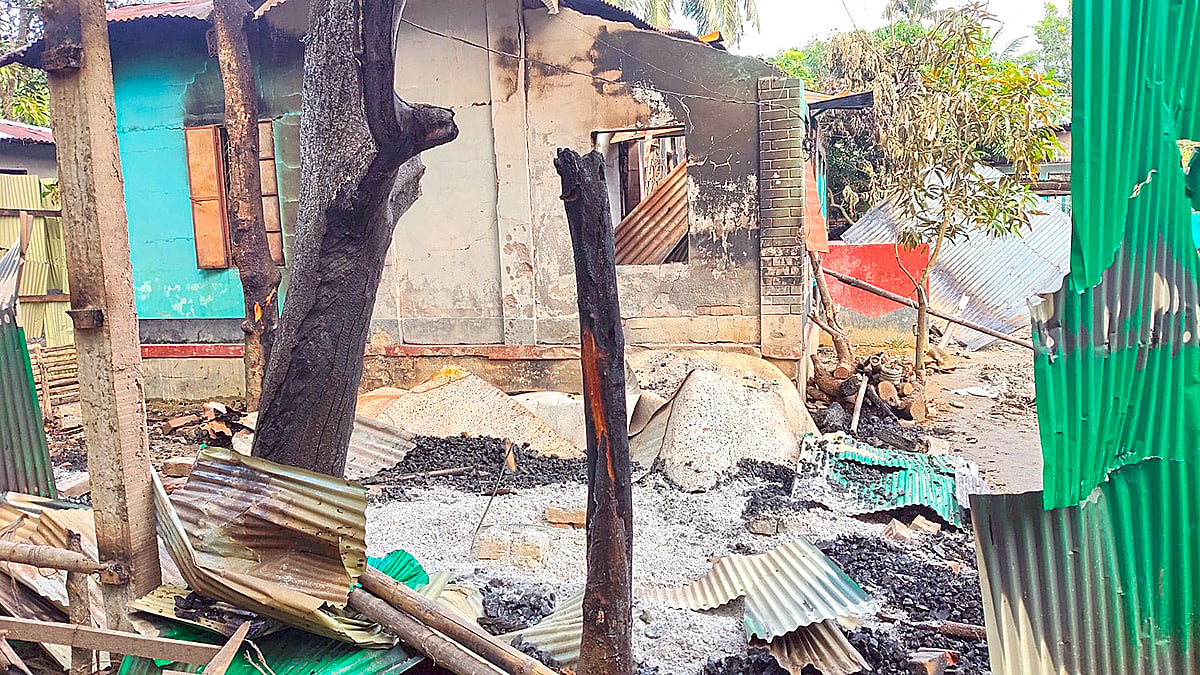
Standing in front of her charred single-storey home in Bendarchar village of Kalia, Narail, Rabeya Begum told Prothom Alo, “This building of mine had six rooms; they burned every single one of them.” She added, “I am a woman living all alone. I am still living in fear.” Two days before her house was torched—on the evening of 18 November—patients were trapped inside a private hospital in Gopalganj town when it was attacked and set ablaze, while their relatives stood outside wailing. The hospital is owned by a BNP (Bangladesh Nationalist Party) member of parliament, yet it is ordinary local people who go there for treatment. Two districts, two sides, two different slogans—yet the ashes are the exact same colour.
The toll of the past two weeks bears remembering. Violence erupted from of programmes announced by the Awami League, whose activities are banned in the country, surrounding former prime minister Sheikh Hasina’s declaration of returning to the country—she having been sentenced to death for crimes against humanity.
According to district administration figures, between 10 and 25 November, roughly 100 homes and business establishments, two police stations, vehicles, and government installations were vandalised and torched in Gopalganj, causing damages worth billions of taka. On 18 November, two local leaders of Krishak Dal and JASAS (Jatiyatabadi Samajik Sangskritik Sangstha), Shahin and Sohel, were killed in an attack on a BNP procession in Kalia—two families losing their breadwinners.
On 20 November, retaliatory arson saw more than 60 houses and six shops vandalised, looted, and burned down in Bendarchar. Bangladesh Bank reported that during the same period, 104 branches and offices of Grameen Bank were damaged nationwide, forcing 29 branches to close. Depositing savings, paying instalments, or taking new loans in those areas has now been thrown into uncertainty. The vast majority of this bank’s members are poor rural women. Will anyone answer what political objective was achieved by burning their loan ledgers?
In her 1970 book On Violence, Hannah Arendt showed power and violence to be opposites. Power springs from the collective consent of the people; violence can destroy power, but it cannot create it. A party that cannot persuade people resorts to burning. We are trapped in a politics whose grammar is not reason, but fire. In this language, opponents are not defeated; attempts are made to annihilate them. And every fire, in essence, manufactures the rationale for the next.
Preventing suspicious transactions is the duty of the state. However, instead of tracking down criminals, freezing the financial transactions of an entire district takes on the character of collective punishment. Collective punishment is not the rule of law; it is a mockery of the law.
The cruellest aspect of this political language is the unequal distribution of risk and reward. Those who bear responsibility for a decade and a half of misrule, enforced disappearances, and bloodshed are today across the border or at a safe distance. From there come calls for “lockdowns” and “resistance.” Meanwhile, it is village youths, day labourers, and small shopkeepers who take to the streets. Cases will be filed against them, they will serve prison terms, and they are the ones who will die from bullets or hackings. Those who order fires to be lit remain safely out of reach of the smoke. These ordinary people have nothing to gain, and everything to lose.
The suffering of ordinary people in Gopalganj has now escalated a step further. Train services to and from the district have been suspended since 17 November. Since the night of 25 November, numerous personal mobile financial services like bKash, Nagad, and Rocket accounts have begun shutting down. A Prothom Alo report notes that Tamanna Taha, a young college graduate from Gopalganj, cannot pay her admission fee for Rajshahi University, with Friday being the final day to apply. Kazi Akash, who works in Dhaka, asks, “Then why was my account blocked?”
Preventing suspicious transactions is the duty of the state. However, instead of tracking down criminals, freezing the financial transactions of an entire district takes on the character of collective punishment. Collective punishment is not the rule of law; it is a mockery of the law.
In his autobiography Long Walk to Freedom, Nelson Mandela wrote that a man who takes away another man’s freedom is a prisoner of hatred; the oppressed and the oppressor alike are robbed of their humanity. Having spent 27 years in prison, he knew that no nation is liberated through the politics of vengeance.
At the exact same time, another crisis is unfolding silently. The minimum wage for the ready-made garment workers has been fixed at Tk 17,000, up from Tk 12,500, whereas workers had demanded Tk 30,000. On 14 November, the BGMEA (Bangladesh Garment Manufacturers and Exporters Association) reported 147 factories closed; even on 25 November, 35 factories in Gazipur remained shut indefinitely. Under Section 13(1) of the Labour Act, workers receive no wages when factories are closed under such lockouts. To someone whose household survives on a monthly wage, political arson and wage uncertainty are simply two names for the same deprivation.
Max Weber defined the state as the entity claiming the monopoly on the legitimate use of physical force. When the state hesitates to exercise that authority impartially, it fractures into the hands of partisan mobs. Four days after the killing of the two BNP leaders in Kalia—up until 22 November—not a single case had been filed over either the murders or the subsequent arson, according to the local police station’s officer-in-charge. Neither the families of the deceased nor the owners of the burned homes have received justice. When justice is delayed, vengeance arrives right on schedule.
Expectations from the government are clear: whoever lights a fire must be identified not by a party flag, but by their crime. In his autobiography Long Walk to Freedom, Nelson Mandela wrote that a man who takes away another man’s freedom is a prisoner of hatred; the oppressed and the oppressor alike are robbed of their humanity. Having spent 27 years in prison, he knew that no nation is liberated through the politics of vengeance.
The most disheartening spectacle lies in a section of our civil society. Some aligned with the Awami camp see the thrill of resistance in the fires of Gopalganj, while some in the BNP camp explain away the burned homes of Kalia as a “natural reaction.” A conscience that awakens only at the sight of an opponent’s fire is no conscience at all—it is a partisan siren. Those who take satisfaction today in seeing an adversary’s home burn will find no one listening to their protests tomorrow when their own house catches fire.
There is no easy formula to break out of this cycle. We must acknowledge that responsibility for the violence does not rest on one side alone—nor is everyone’s share of guilt equal. The weight of responsibility differs among those who call for arson from a safe distance, those in power who could stop their activists’ hands if they wished, and a state that fails to register even a single case day after day following murder and arson. The rule of law is therefore not anyone’s mercy; it is the test of the state’s moral capacity. And for those who write, teach, and speak, the test sounds simple yet proves difficult: being able to feel equally ashamed standing before both burned homes.
Rabeya Begum of Bendarchar and the relatives of patients trapped inside the Gopalganj hospital—neither asked for a share of power. They simply wanted to sleep in their own homes at night. If a state cannot fulfil this modest wish, the question of who came to power and who returned becomes utterly meaningless.
* Kazi Maruful Islam is a Professor at Dhaka University.
* The views expressed are the author’s own.
* The op-ed has been rewritten in English by Shameem Reza