Opinion
Old-age home and daycares: Modern need or a social failure?
"Mother died today. Or maybe yesterday; I can’t be sure."
Many believe these opening lines from Albert Camus's The Outsider are the most powerful beginnings in literary history. Camus, the existentialist, was delivering a profoundly strong message about the quiet human alienation in modern society. A message that remains timeless.
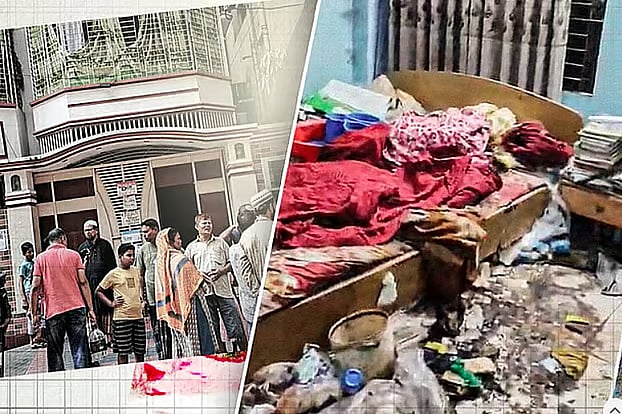
That sense of isolation recently resurfaced in Bangladesh after a disturbing incident went viral on social media. An elderly mother was found dead in a neglected room, her body discovered long after her passing.
The news triggered widespread outrage. Almost instantly, social media erupted in fury towards her established, high-achieving children. One of them, a senior government official, was reportedly transferred following public backlash.
However, beyond binary judgments of ‘guilt’ or ‘innocence’ of those children or social media outrage, it is important to view this issue through a sociological lens.
Bangladesh today stands at a strange crossroads. On one side, we are swept up in global capitalist economy-driven urbanisation, industrialisation and individualism. On the other, century-old traditions of family bonds, religious values and collective social norms. The most visible manifestation of this tension appears when people suggest placing elderly parents in old-age homes or children in daycare centers.
Society immediately responds with collective moral condemnation. But what lies beneath this condemnation? Is it only love? Or a complex interplay of power, structure and history?
Let us begin with historical context. The agrarian economy and land-based social structure of Bengal made the joint family a functional unit of production. During the Mughal and British colonial periods, under the zamindari system, the family acted as the primary holder and transmitter of property. To keep land undivided, families had to stay together. Thus, elderly members were not merely ‘dependents’; they were central repositories of wisdom, experience and wealth.
Given this background, Bangladesh could build more daycare centers and old-age homes while still keeping parts of its traditional family system. This would allow grandparents and grandchildren to stay connected and preserve cultural bonds, while also meeting modern needs.
“It takes a village to raise a child,” goes the familiar saying. In earlier social structures, this was indeed the reality. Grandmothers, aunts, uncles and neighbors all contributed to raising children. The concept of the ‘single mother’ carrying the entire burden alone was non-existent. The joint family was, in effect, a highly efficient social insurance system.
However, British colonial policies, especially the Permanent Settlement of 1793 and later the Partition of 1947 significantly disrupted Bengal’s family structures. Displaced people moved to cities, yet retained the mindset of joint family ideals. Capitalism created a large pool of free labourers but did not provide a safety net. This created a gap between inherited ideals and new structural realities, leaving people nostalgic for the joint family system while having to survive in nuclear families.
When Europe went through a similar transition, sociologist Émile Durkheim studied it closely. He explained that societies are held together in two main ways. One is mechanical solidarity, where people are united by shared beliefs and values. The other is organic solidarity, where society functions through differences and specialised roles.
Bangladesh today is in a transitional stage between these two forms. The old foundation of joint families and wider community-based support is weakening. But the new systems of support, such as state welfare and professional care services are still not strong enough to replace it.
Another sociologist, Pierre Bourdieu, through his concept of habitus, explains that people’s behaviour and preferences are shaped by deeply internalised social structures formed through class and upbringing. In Bangladesh’s middle class, ‘raising children at home’ and ‘keeping parents within the family’ are symbols of high cultural capital.
Putting parents in old-age homes stands to lose this capital. It is seen as a mark of social failure. Consequently, people often take on caregiving responsibilities beyond their means, driven more by the fear of social shame than by economic logic.
The biggest impact of this falls on children, the elderly and women. Society’s traditional role in raising children is no longer fully supported by either the state or the market. Even attempts to address this gap, such as daycare centers or old-age homes are often questioned. Old-age homes are viewed as a sign of failure, while mothers who use daycare are often accused of neglecting their responsibilities. The elderly, meanwhile, find themselves in a limbo. They have neither the access to modern care homes nor the blessings of the old family system.
Children are also affected in the same way, along with their mothers. Marxist theorists have argued that capitalism turns the family into a centre of unpaid reproductive labour. Childcare and eldercare are carried out within the household, mostly by women without financial compensation, which reduces costs for both the state and the market. At the same time, as nuclear families replace joint ones, women are increasingly burdened with both earning an income and providing full-time care at home.
In Bangladesh, caregiving is seen almost exclusively as a woman’s job. Daughters-in-law, mothers or sisters are expected to carry this burden. As a result, when a family chooses an old-age home or daycare, the criticism is often directed mainly at the woman. She is expected to be both income earners for the household and full-time caregivers for children and the elderly. Caught between nostalgia for the old family system and the practical needs of modern life, women often end up trapped in an impossible, utopian demand.
Making old homes or daycares a matter of moral debate is a way to avoid the real question. The real question is, in our current economic structure, who will provide care? How will they do it? And who will pay the price?
In this context, it is notable that more than 4 million women work in Bangladesh’s garment industry, yet the state has not built an affordable daycare network. So the question of where these women will leave their children is a structural problem, but it is often framed as an individual moral failure. The social pressure to be a ‘good mother’ thus becomes an ideological tool that ultimately serves the interests of capital.
Alongside this, there is also the fear of ‘what will people say.’ Michel Foucault showed how societies construct ideas of ‘normal’ and ‘abnormal’ through systems of power. In this process, dominant social norms are constantly reinforced. Even when old practices no longer fit reality, they are still upheld as ideals and deviation from them is punished through social shame. Religious discourse, media narratives and everyday gossip together create a kind of panopticon of surveillance, where maintaining a good social image becomes crucial.
As a result, families who send elderly parents to old-age homes or children to daycare often live under constant psychological pressure, feeling as if neighbors, relatives and even strangers are judging them.
This invisible surveillance pushes people to follow socially ‘approved’ behaviour. Over time, the pressure becomes so strong that people begin to prioritise appearing morally correct in the eyes of society over what may actually be best for themselves, their children or their parents.
Overall, families are paying the price for this situation. Children are not getting proper care and upbringing, while elderly people are not receiving the support they need. Old-age homes and daycare centres are trying to fill this gap but society often sees them as a ‘deviation', because people are not yet mentally ready to move beyond traditional family structures.
We are not alone in this struggle. In many East Asian societies with Confucian values, old-age homes were once also seen as a sign of family failure. But through state-led care systems, professional services and changing social attitudes, these countries have built systems where institutional care is accepted as a complement to the family. They have recognised that children, the elderly and women should not suffer because of an inability to let go of outdated structures.
Making old homes or daycares a matter of moral debate is a way to avoid the real question. The real question is, in our current economic structure, who will provide care? How will they do it? And who will pay the price?
In Bangladesh, it is possible to imagine a system where both daycare centres and old-age homes exist in large numbers. In such a system, grandparents and grandchildren can maintain cultural ties and a sense of continuity, while also meeting the needs of a changing society.
#Syed Faiz Ahmed is a writer and journalist.
#The opinions expressed here are the writer's own.
* This article appeared in Bangla in Prothom Alo Online and has been translated here by Ayesha Waresa for Prothom Alo English Online.