Following the directives of the Chief Advisor, the Election Commission is actively moving to organise the 13th parliamentary elections. Chief Election Commissioner AMM. Nasir Uddin has even outlined how mob violence is to be prevented during the elections. He stated that if mob violence divided across 300 constituencies, it would not be difficult to handle.
However, as a former seasoned bureaucrat, he should realise that in no election does violence take place in all 300 constituencies. Violence typically occurs in constituencies where aggressive candidates are contesting or where the level of competition is low. Therefore, the Election Commission must not only identify high-risk centers but also select high-risk constituencies and take necessary measures.
Former Chief Election Commissioner Justice Abdur Rouf was widely praised for conducting a free, fair, and peaceful election in 1991. However, he lost a by-election to the ruling party’s violence, and the outcome of that election altered the trajectory of national politics.
Similarly, Awami League, which had earlier established the caretaker government through a movement, later abolished the system using its majority, undermining its own effort. After the caretaker system was abolished, in the three subsequent elections, the people were deprived of their voting rights.
One of the notable steps that the Nasir Uddin Commission has taken to ensure a fair election, is the proposal to amend the 1972 Representation of the People Order (RPO). This amendment recognises the armed forces as a law enforcement body, allows for the annulment of elections in an entire constituency in case of serious irregularities, and requires candidates to declare their overseas assets. These proposals are expected to bring candidates under greater accountability and support the conduct of a fair election.
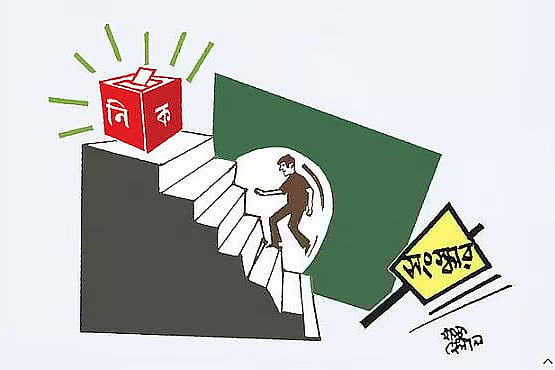
However, the Commission’s proposal to introduce a provision for “no” votes in the case of a single candidate could, instead of ensuring fairness, open the door to manipulation. In the February 1996 election, 49 BNP candidates, and in the 2014 election, 153 Awami League candidates, won uncontested. If a “no” vote provision had existed in those constituencies, would it have made any qualitative difference to the elections? Rather, the winning party could have claimed that they were not elected uncontested. Therefore, the Commission must consider the potential consequences before introducing any such provision. If the Election Commission wants to implement a “no” vote system, it must apply it to all constituencies. In uncontested constituencies, there is no opportunity to demonstrate competition.
The most widely discussed proposal by the Election Commission is the disqualification of fugitives from contesting elections. If a court declares a person a fugitive, they should not have the opportunity to contest elections
The Election Commission has stated that in the case of coalition elections, party symbols will be maintained. This raises the question of how compatible this is with democratic norms. In the Awami League-led grand alliance, the issue of symbols was open: some candidates ran under the coalition’s symbol, while others ran under their party’s symbol.
In 2018, as part of the BNP-led coalition, candidates from Jamaat-e-Islami also voted under the “paddy sheaf” symbol (since Jamaat’s registration was suspended). Smaller parties have expressed negative reactions to the decision to retain party symbols. They fear it could increase the number of rebel candidates from larger parties and create additional difficulties for their own candidates.
The most widely discussed proposal by the Election Commission is the disqualification of fugitives from contesting elections. If a court declares a person a fugitive, they should not have the opportunity to contest elections. The proposal to declare fugitives ineligible for elections originally came from the Electoral Reform Commission, at which time the Election Commission had disagreed.
Last March, the Commission had written to the National Consensus Commission stating that such a provision could be misused for dishonest purposes. When asked why the Election Commission later took a different decision, Commissioner Abul Fazal Md Sanaullah said it was done after discussions with the National Consensus Commission and based on mutual satisfaction. The issue, he clarified, is not about satisfaction or dissatisfaction—it is about the law. Constitutional expert Shahdeen Malik has supported the proposal to disqualify fugitives from elections, emphasising the need for its fair implementation. Political party leaders have stressed ensuring that the law is not misused.
The other amendment proposals put forward by the Election Commission are important as well. These include barring individuals who hold positions in profit-making institutions from contesting elections, requiring resignation from committees of educational institutions, and submitting a declaration of domestic and overseas assets along with the nomination papers. The Commission has also proposed that political parties may receive donations of up to 5 million taka from individuals or institutions, but any donation above 50,000 taka must be received via cheque. This, it is believed, will bring transparency not only to rival parties and candidates but also to the income and expenditure of donors.
Election Commissioner Abul Fazal Md Sanaullah has referred to voters as the “first eyes” of the election. The acceptability and credibility of the election will depend on how many of the 125 million (12.5 crore) voters can actually be brought to the polling stations. Stakeholders must remember that the lack of proper voter mobilisation turned the last three elections into farces. How much scope will there be to mobilise voters this time?
Many have argued that not all parties need to participate for an election to be inclusive; it is enough if the voters participate. However, if voters see that opportunities for candidate selection are limited, they will be neither motivated to go to polling stations, nor to cast their votes.
The government has banned Awami League activities through executive orders. At the same time, some quarters are demanding that Jatiya Party be banned as a collaborator of autocracy. Ultimately, it is unclear what decision the Commission will take. If Awami League and Jatiya Party remain outside the electoral process, what will their supporters do?
No matter how many amendments the Election Commission introduces to the RPO, bringing the majority of voters to the polling stations remains its greatest challenge.
* Sohrab Hassan is a journalist and a poet. He can be reached at sohrabhassan55@gmail.com
* The views expressed here are the author’s own.