Opinion
Why Bangladesh's uprising is different from those of Sri Lanka, Nepal, and India
With India's recent "Cockroach" movement, South Asia has witnessed major anti-government protests and uprisings in four countries over the past four years. Among them, the movements in Sri Lanka, Bangladesh, and Nepal directly resulted in the fall of their respective governments. In contrast, the movement in India ended with only the resignation of the education minister.
Generation Z has attracted particular attention because of its innovative forms of protest and creative tactics. At the same time, this attention can also be seen as an expression of society's enduring hope for the younger generation.
The ways in which movements and protests have unfolded across different parts of the contemporary world are reflected in these four South Asian cases as well. Despite their local differences, they share the defining characteristics of a new generation of social movements in terms of how they were organised, the tactics they employed, and the ways they communicated their messages.
According to a survey of protest movements that took place across different parts of the world between 2006 and 2020, the demands of these movements can broadly be grouped into four categories.
The first was the failure of political representation. Across Asia, Africa, the Middle East, Europe, and Latin America, many people felt that the existing political system no longer represented or accommodated them. As a result, in response to the global trend of democratic backsliding, the demand for "real" or genuine democracy became the central rallying cry of most movements during this period.
The second issue was economic justice. The adoption of neoliberal policies had led to the contraction of economies, resulting in growing inequality as well as rising unemployment. Consequently, economic grievances were deeply intertwined with these movements.
The third major issue was civil rights. Many states faced widespread allegations of violating civil liberties and human rights in various ways. These grievances played a significant role in motivating people to take to the streets.
The fourth issue was the idea of global justice. Concerns over climate change and globalisation were particularly important components of protest movements in many countries across Europe and Latin America. Simply put, decades of neoliberal policies have widened social inequality. As a result, the incomes of lower- and middle-class people have declined, while access to public services and state benefits has been reduced.
These protest movements were an expression of public frustration stemming from dysfunctional politics, failures in socioeconomic development, and the erosion of trust in government. It is worth noting that, in most cases, these protests emerged spontaneously rather than under the leadership of any particular political party.
In all four South Asian countries, the issues of political representation and economic inequality featured prominently. Although they differed in scale and intensity, it is not surprising that in both Bangladesh and India the immediate triggers for mass mobilisation were employment-related issues: in Bangladesh, the demand for quota reform in public-sector recruitment, and in India, the leakage of recruitment examination papers. In Sri Lanka and Nepal, severe economic crises and corruption among political leaders were the dominant issues.
Moreover, in Bangladesh, the perceived impossibility of a peaceful transfer of power was an important factor, while in India, the experience of the recent elections also contributed to the unrest. These are the broad similarities among the movements.
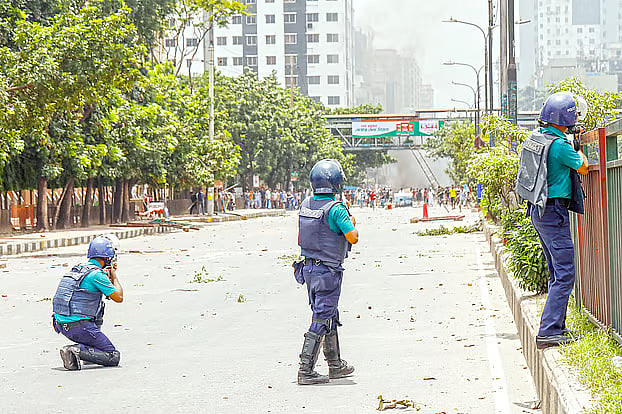
The recent protest movements have also revealed a major difference between Bangladesh and the other three South Asian countries: state violence, or the state's lethal use of force. There are, of course, many other differences, but this one distinction alone presents a deeply troubling picture of the Bangladeshi state.
In Sri Lanka's Aragalaya movement, between 10 and 12 people lost their lives; in Nepal's protests, the death toll was 76. In contrast, although many people were injured during India's Cockroach People's Party movement, there were no fatalities. Bangladesh presents a starkly different picture. In just 20 days, nearly 1,000 citizens were killed at the hands of the police and other state security forces. Countless others were injured.
It is this state violence and police brutality that sets Bangladesh apart from the rest of South Asia. The contrast also lays bare the lethal character of the Bangladeshi state. India, too, has been criticised, both domestically and internationally, for its use of force in dealing with armed insurgencies. However, is exceptionally difficult to find a parallel for the scale on which lethal weapons were deployed against a peaceful protest movement in Bangladesh.
It is this state violence, more precisely, the excessive use of force against peaceful assemblies, that distinguishes the events in Bangladesh from those in the rest of South Asia
During the protests, the Indian newspaper The Wire raised a number of questions: "Why were water cannons not used? Why were nail-studded batons used?" Reflecting on these questions, and comparing them with the situation in Bangladesh, makes Bangladesh's circumstances strikingly clear. Our situation was so dire that even this debate in India seems almost surreal.
In Bangladesh, the use of lethal weapons by the police against virtually any protest had become almost routine. The previous regime has been described by various labels, fascist, authoritarian, hybrid, and dictatorial, but there is broad agreement that one of its defining characteristics was its transformation into a police state. The use of lethal force by the police against demonstrations and public gatherings was not unprecedented, but under the previous Awami League government it became institutionalised and reached an unprecedented level.
A simple comparison of the numbers makes this difference unmistakable. During the Language Movement of 1952, the Mass Uprising of 1969, and the pro-democracy movement of 1990, the streets never witnessed the scale of loss of life that occurred in July 2024. Indeed, even when compared with other protest movements during the Awami League's years in power, the level of force employed was extraordinary, rare even in Bangladesh's own history.
Recently, The Daily Star, after reviewing police procurement records, reported that between 2021 and 2023 the police purchased seven times more lethal weapons than non-lethal ones. The report also found that the militarisation of the police force had steadily increased since 2013. As a result, the arming of the police with lethal weapons, the excessive use of force, enforced disappearances, and extrajudicial killings effectively placed the lives and deaths of the citizens in the hands of the state security forces. The most extreme manifestation of the state's arbitrary power to take the lives of its citizens was witnessed in July 2024.
It is this state violence, more precisely, the excessive use of force against peaceful assemblies, that distinguishes the events in Bangladesh from those in the rest of South Asia. The consequences of this violence also continued to shape the post-uprising period. First, the sheer intensity of state violence created what was effectively a war-like situation, while at the same time provoking a wave of violence in the aftermath of the uprising. The state violence of July has become a source of collective trauma for the people of Bangladesh.
Second, the experience of violence also played a central role in shaping the post-uprising debate in Bangladesh over institutional reform, particularly the question of state reform. Just as the prosecution of crimes against humanity emerged as a key issue, discussions of transitional justice also gained prominence.
In my view, the foremost priority should have been the reform of the police and other state security forces. Yet not only did police reform fail to materialise, even the changes that had been made to police uniforms were subsequently reversed. At the same time, rather than abolishing a force such as the Rapid Action Battalion (RAB), which has long been accused of systematic human rights violations, there has instead been discussion of retaining it under a different name.
More fundamentally, a major question remains: Has the uprising truly changed the direction of the state? If nothing else, the state must be able to guarantee the protection of its citizens' lives and property. Failing to provide that basic assurance would be the greatest tragedy of all.
* Sohul Ahmed is a writer and researcher.
* The views expressed here are those of the author.
* This article appeared in Prothom Alo print and online and has been translated into English by Ayesha Kabir for Prothom Alo English Online