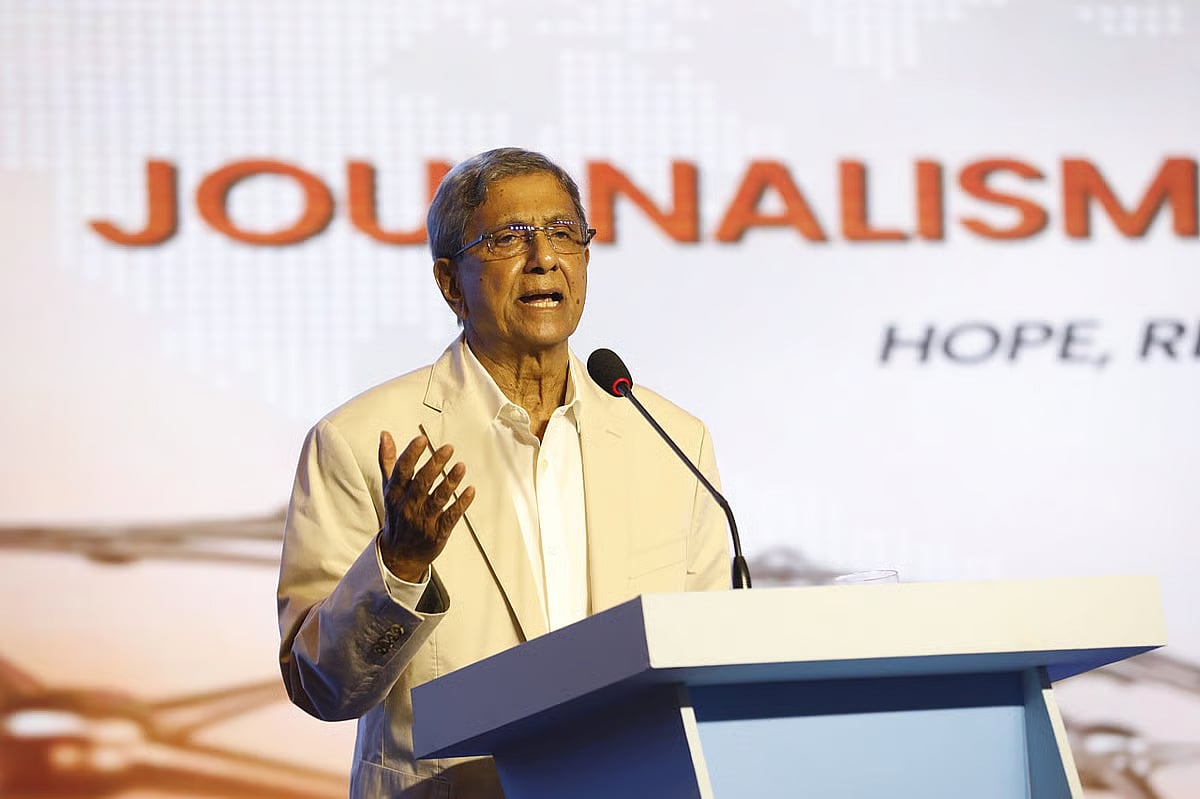
Matiur Rahman's speech
How much longer will we have to wait for media freedom?
I would like to begin by recalling an event from sixty-four years ago. On 1 February 1962, the first student strike and protest movement against the military rule of Pakistan took place at the University of Dhaka. Among the many demands raised that day was a very simple but fundamental demand: we must have the right to speak. We must have freedom of the press. I was one of the participants in that protest and strike.
After that, through years of struggle and sacrifice, Bangladesh achieved independence. Over the past fifty-five years, the country has experienced many ups and downs. Governments have changed, political leaders have changed, and the political landscape has changed.
In July-August 2024, a nationwide mass uprising brought down an authoritarian ruler and the system that had been entrenched in the country. The ruler fled the country. It was an extraordinary and almost unbelievable moment in our history.
Then the interim government ran the country for nearly 18 months. People had high expectations from that government. But in many respects, those expectations were not fulfilled. As a result, the current government also continues to bear the mark of failure in managing and running the state. There were initiatives towards political and constitutional reform, but many did not progress very far. Some important recommendations of the reform commissions were also not implemented.
During the interim government, newspapers, television channels and other media outlets faced considerable difficulties in operating freely. Under various forms of pressure and fear, managements changed, editors were replaced, and many journalists were forced to leave their jobs.
The media industry became increasingly unstable. Some media owners sought relationships with influential people of the new government and placed their followers in positions of responsibility. As a result, newspapers and other media outlets often had to operate in an atmosphere of uncertainty and self-censorship.
Speaking from the experience of Prothom Alo, I can say that we too went through an atmosphere of fear. Throughout that period, we faced pressure and threats from extremist groups. Hateful propaganda was carried out against The Daily Star and Prothom Alo, both inside the country and from abroad. Various groups, both within and outside the government, engaged in multifarious activities. They sought to create instability in the country to achieve their political objectives.
In November 2024, extremists demonstrated in front of the Prothom Alo office for nearly seven days. These activities ultimately culminated in the burning and destruction of Prothom Alo office.
On 18 December 2025, the Prothom Alo office remained on fire for almost the entire night. There was looting and extensive destruction of property. Only after everything had been burned down and destroyed did the law enforcement agencies clear the way for the fire brigade to arrive. Those responsible within the government did not give any direct or effective instructions to the police, RAB or members of the armed forces to prevent the destruction. One or two advisers tried to intervene in their individual capacities, but those efforts were not successful.
By the time dawn broke, the fire and destruction at the Prothom Alo office had ended. Following Prothom Alo, the Daily Star office was also blockaded and set on fire. Its employees were eventually brought out under extremely difficult and suffocating circumstances.
We remember that former Prime Minister Sheikh Hasina in parliament described Prothom Alo as an enemy of the Awami League, enemy of democracy, and enemy of the country. The editor and journalists of Prothom Alo were also barred from entering the Prime Minister’s Office and from attending various national events. Since her defeat in the 2001 election and after 2009, whenever I met Sheikh Hasina, she did not stop at making hateful remarks; she also used aggressive language.
Although the interim government made various encouraging statements, there was no significant change in the actual situation of the media. The interim government did, however, establish a Media Reform Commission. The commission worked extensively on urgent and important issues concerning the media and proposed a range of short- and long-term measures. There was broad and positive consensus among journalists, editors and media managers on many of these proposals. Unfortunately, the interim government took virtually no initiative to implement them.
After all these experiences, a fair general election was held on 12 February 2026. The government, armed forces, police and administration worked together to conduct a fair election. In that election, BNP secured a major victory and, after nearly nineteen years, returned to power.
The most important question before us now is: what direction will Bangladesh take after this change? And, more specifically: how will we ensure freedom of the media, the safety of journalists, and an environment in which an independent and responsible press can operate freely?
During BNP’s two previous terms in government, from 1991 to 1996 and from 2001 to 2006, I was the editor of Bhorer Kagoj and then Prothom Alo, respectively. During both periods, under BNP governments led by Begum Khaleda Zia, we enjoyed considerable freedom in practising journalism.
In particular, during the 2001–2006 government, we strongly criticised many of its policies and actions. Yet this did not prevent us from having access to the Prime Minister or other leaders. We were not subjected to major harassment or legal action simply because of our criticism.
I remember having heated arguments with Begum Khaleda Zia when she was Prime Minister. At times, both of us became quite agitated during our conversations. But I never had to face punishment for expressing my views. During that period, I also had disagreements and arguments with Tarique Rahman, then a young BNP leader and now the Prime Minister. There were debates between us in the pages of the newspaper as well. Those disagreements were ultimately resolved.
In contrast, during the previous authoritarian government, Prothom Alo and I personally faced grudge from the former prime minister. Institutionally also, we had to live under constant fear. The scope for an independent media was extremely shrunken during the rule of Sheikh Hasina. Journalists and editors faced cases and many were imprisoned.
During that authoritarian rule, various efforts were made to reduce the circulation of Prothom Alo. Government advertisements were withdrawn, and at one point advertisements from around fifty major domestic and international companies were also stopped in August 2015. We remember that in 2000 as well, the Awami League government stopped government advertisements in Prothom Alo and shut down our online edition.
On 30 March 2023, a case was brought against me under the Digital Security Act. At one stage, the number of cases filed against me came close to eighty. Some of those cases are still pending in court.
We remember that former Prime Minister Sheikh Hasina in parliament described Prothom Alo as an enemy of the Awami League, enemy of democracy, and enemy of the country. The editor and journalists of Prothom Alo were also barred from entering the Prime Minister’s Office and from attending various national events. Since her defeat in the 2001 election and after 2009, whenever I met Sheikh Hasina, she did not stop at making hateful remarks; she also used aggressive language.
The government has completed only seven months of its tenure, and there is still considerable time ahead. Even taking this into consideration, we can say that the urgent issues facing newspapers and the broader media need to be addressed without delay. Otherwise, the freedom and aspirations of journalists and editors in this country could face a crisis. And in such a situation, I repeatedly find myself thinking of that day sixty-four years ago, 1 February 1962. That day, we raised the demand: we must have the right to speak. We must have freedom of the press.
After all that, in early 2024, the military intelligence agency exerted tremendous pressure on the chief executive of our company to give up ownership of Prothom Alo. Behind that pressure was also an effort to remove the editor. There was effort to take ownership of Prothom Alo away and hand it over to a highly discredited and notorious business group involved in money laundering. All of this was done at the direction of Sheikh Hasina.
The situation had reached such a point that, had that government remained in power for a few more months, the management of Prothom Alo could have been taken away from us, and I might no longer have been able to remain its editor. We had to pass through those extremely painful and difficult days. Those experiences have left an indelible scar on our minds.
After the authoritarian Awami League government and the multiple crises experienced during the interim government, the return of BNP to power has created a sense of optimism among the people. Given BNP’s past experience with newspapers and the media, we hope that Prime Minister Tarique Rahman and the BNP government will, during this important transitional period, continue to adopt a tolerant and constructive attitude towards newspapers, television and the broader media.
BNP’s commitments concerning the media in its 31-point political programme and election manifesto have strengthened this expectation. In our multiple meetings and candid discussions with Prime Minister Tarique Rahman, we have had quite positive discussions about the present and future of newspapers and the media. Point 11 of the BNP’s 31-point reform programme specifically addresses the media. It proposes establishing a Media Commission headed by a Supreme Court judge to ensure full media freedom and comprehensive reform of the sector. It also commits to restoring an environment for honest and independent journalism.
BNP’s election manifesto also outlines several other initiatives under the heading ‘Media’. It states that fearless and impartial journalism will be protected and recognised, and that objective criticism will be welcomed. It says that ensuring the professional independence and security of journalists who engage in constructive and objective criticism is a responsibility of the state. It also proposes legal mechanisms and a special cell to prevent harassment and persecution of journalists.
But despite these commitments by BNP as a political party and by the government, no significant steps have yet been taken to reform the newspaper and broader media sector. The Ministry of Information has expressed interest in introducing a system for auditing newspapers and clearing long-outstanding bills, but these initiatives have yet to be implemented. There was also a meeting to discuss urgent reforms needed in newspapers, television and the wider media sector following the proposal to establish a Media Commission. Since then, however, we have heard little about the matter.
Over the past few months, there have also been reports of unwelcome interference and changes in the internal management of some newspapers and television channels. Some editors and senior journalists are saying that they continue to operate under uncertainty and pressure. In some cases, journalists are exercising self-censorship or excessive caution over particular reports and opinions. There are reports that, in some newspapers, pressure is being exerted over independent journalism and freedom of expression. This is undermining the environment for independent journalism.
Some public or private discussions by senior government figures have also become a cause of concern for us. There are also concerns about the way the government is dealing with the Cyber Security Act and the possibility that journalism and freedom of expression could, under certain circumstances, be placed at risk.
The government has completed only seven months of its tenure, and there is still considerable time ahead. Even taking this into consideration, we can say that the urgent issues facing newspapers and the broader media need to be addressed without delay. Otherwise, the freedom and aspirations of journalists and editors in this country could face a crisis. And in such a situation, I repeatedly find myself thinking of that day sixty-four years ago, 1 February 1962. That day, we raised the demand: we must have the right to speak. We must have freedom of the press.
Over this long period, governments have changed. Political leaders have changed. The political landscape has changed. Yet the fundamental issues behind our demands seem to have remained largely where they were. At the end of my 56-year career in journalism, I find myself standing in the same place once again. Unfortunatly, we still have to speak about those demands. We still have to ask for them. How much longer will we have to wait?
* Matiur Rahman, editor, Prothom Alo