Sohrab Hassan's column
Ordinance: Not everything should be done by force of a majority
Article 93 of the Constitution of Bangladesh grants the President of Bangladesh the power to issue ordinances in case of emergency when the national parliament is dissolved or not in session.
However, any ordinance issued must be presented in the first session of the parliament and must be passed by the parliament within 30 days to become law; otherwise, the ordinance will cease to be effective.
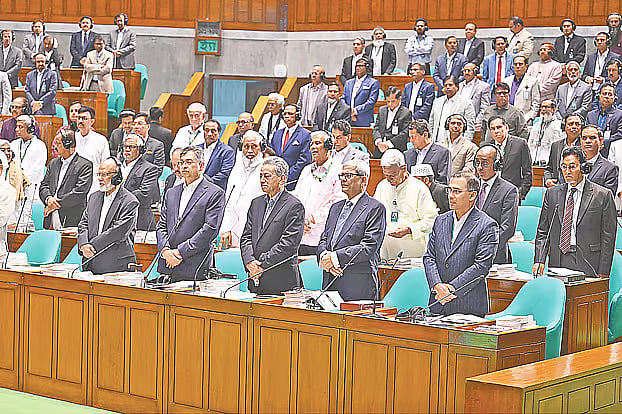
With this in mind, on the first day of the first session of the 13th National Parliament, a special committee was formed to determine the fate of 133 ordinances made during the tenure of the interim government. A glaring issue here is the lack of representation from parties other than BNP and Jamaat-e-Islami in the 14-member committee. The committee includes 11 members from BNP and 3 from Jamaat. However, outside of these two parties, there were the NCP, the Gono Odhikar Parishad, and the Bangladesh Jatiya Party. There were also seven independent members. Including members from among these independent members would have enriched the committee and given it a multi-party character.
Out of 133 ordinances, the committee accepted 98 without change. But what was the rationale behind annulling the ordinances that ensured the independence of the judiciary, such as the Supreme Court Judges Appointment Ordinance 2025 and the Supreme Court Secretariat (Amendment) Ordinance 2026? Is it because the BNP government wishes to maintain the government’s exclusive power over the appointment of Supreme Court judges, as was the practice until now? They seem keen to follow the previous government’s practice of blatant interference by the executive branch in the appointments and postings of the lower judiciary.
Is it because the BNP government wishes to maintain the government’s exclusive power over the appointment of Supreme Court judges, as was the practice until now? They seem keen to follow the previous government’s practice of blatant interference by the executive branch in the appointments and postings of the lower judiciary.
In addition, the committee decided not to present 20 ordinances issued during the interim government’s tenure, including those on referendums, prevention and remedy of enforced disappearance, the Anti-Corruption Commission (ACC), the National Human Rights Commission Ordinance, and the Police Commission Ordinance, in the current session, which makes them ineffective.
The committee stated these ordinances would be re-evaluated and presented in an amended form in the future, transitioning them from interim government ordinances to BNP government laws.
The special committee's report recommended bringing four ordinances to parliament for annulment and safekeeping, which would render any prior implementation of these ordinances invalid. When the Supreme Court annulled the Fifth and Seventh Amendments to the Constitution, it likewise validated past actions taken under those provisions.
Despite a constitutional provision for a law on judge appointments, this has not occurred to date. Appointments have been made at the discretion of the Prime Minister, reflecting the executive branch's desires. In this context, the interim government issued the Supreme Court Judges Appointment Ordinance for the first time in 2025. It called for a ''Supreme Judicial Appointment Council'' to select suitable individuals for appointments to the Supreme Court’s Appellate and High Court Divisions.
Led by the Chief Justice, this independent council would recommend eligible individuals to the President. If any weaknesses or deficiencies existed in the ordinance, the government could have addressed them through amendments, but instead, they opted to annul the law entirely, indicating a desire to subordinate the judiciary as previous governments did. They also seem disinterested in implementing the Masdar Hossain case ruling.
The Supreme Court Secretariat Ordinance aimed to establish an independent secretariat to effectively implement judicial independence through oversight, control, and discipline over subordinate courts. What rationale could there be for annulling such an ordinance? Doesn’t the government favour a judiciary that functions independently, like in other democratic countries?
Supreme Court lawyer Dr. Shahdeen Malik believes that revising and reevaluating these two ordinances to create new laws is advisable, though annulling them is not correct.
Furthermore, the interim government issued ordinances, such as the National Human Rights Commission (Amendment) Ordinance and the Revenue Policy and Administration Ordinance, among others, to enhance administrative accountability. However, the committee ''suspended'' these without approval.
In 2025, the Anti-Corruption Commission (Amendment) Ordinance was issued, expanding the ACC’s investigative and covert inquiry powers. It authorised direct filing of complaints, broadened the scope to include severe financial crimes, including those committed abroad, and increased commission membership.
If the BNP government truly intends to reduce corruption, an ineffective ACC won’t suffice. Over the past two decades, the agency has been hesitant to investigate ruling party corruption, often harassing opposition leaders and activists under the guise of corruption charges. Despite BNP being a victim of this, their reluctance to amend the existing law is perplexing.
The argument for annulling or amending the ordinance on the prevention and remedy of enforced disappearances points to requiring governmental pre-approval to investigate the security forces. BNP representatives suggest that for national security reasons, detention should not be classified as disappearance. They themselves have been victims of this rationale in the past. In Bangladesh, national security definitions change with each regime change.
The government deserves appreciation for adopting 98 ordinances unchanged. However, excluding and suspending many for further review lacks strong justification, with few exceptions.
Under the interim government, the Anti-Terrorism Ordinance was amended to ban the Awami League’s political activities, incorporating provisions to prohibit specific entity activities. The special committee recommended passing it in amended form.
The question is whether such amendments support or oppose inclusive democracy. An individual can be tried for a crime, perhaps even a party, but only judicial bodies decide that, not executive orders.
Currently, parliamentary discussions are heated over two issues: implementing the July Charter and deciding the fate of ordinances issued under the interim government. Not all ordinances were necessarily for public welfare, but those intended to hold the democratic government more accountable should not be annulled or suspended without cause.
The BNP holds a two-thirds majority in parliament and can pass any law through sheer numbers. However, if these laws weaken rather than strengthen the democratic framework, why did so many die in recent mass uprisings?
#Sohrab Hassan is a journalist and poet
*Opinions expressed are the author's own
#This article, originally published in Prothom Alo print and online editions, has been rewritten in English by Rabiul Islam