Opinion
The hunt for a fair garment wage does not stop at Tk 17,000
"I pity the man who wants a coat so cheap that the man or woman who produces the cloth or shapes it into a garment will starve in the process." Benjamin Harrison said these words in 1888, and the recent scenario of Bangladesh shows how true they still are.
On 25 November 2026, after a meeting that ran from the afternoon until two in the morning, the Minimum Wage Board sets the minimum wage for entry-level (grade four) garment workers at Tk 17,000, up from Tk 12,500. Workers in grades one to three will get between Tk 19,200 and Tk 21,500. The workers' representative had proposed Tk 18,000, but four of the six board members voted for Tk 17,000. The number is now fixed, but the problem is not resolved.
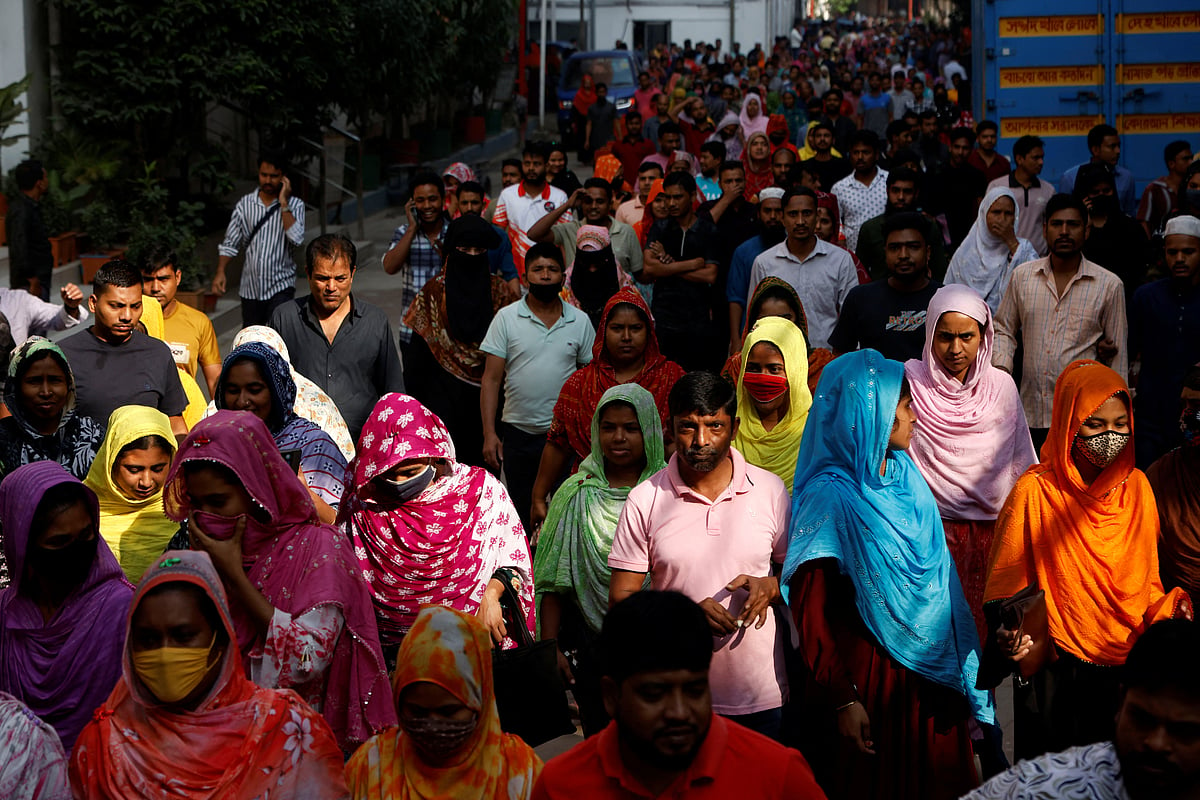
On the same day, 140 factories in Gazipur, Savar and Ashulia remained closed as workers blocked highways, saying the raise is still not enough to support their families. The question is no longer only how large the raise should be, but what a 36 per cent increase will do to workers, to factories and to the wider economy?
The reason behind this demand has not changed. High inflation has sharply increased the cost of food, housing, transport, healthcare and other daily necessities. Point to point inflation stood at 8.27 per cent in October 2026, according to Bangladesh Bureau of Statistics (BBS) data show that inflation has outpaced wage growth for 57 consecutive months. Workers' representatives had earlier demanded Tk 32,000.
The Centre for Policy Dialogue (CPD) estimated that a family of four needs Tk 18,578 to stay above the upper poverty line and Tk 24,204 for a living wage. BGMEA questioned CPD's assumptions about household size and earning members, and CPD itself cautioned that its figures were illustrative, since there is no large, representative survey of RMG workers. Even so, it is worth noticing that the final wage of Tk 17,000 sits below even the lower end of CPD's range.
For workers, the first question is how much of this 36 per cent is a real gain. A raise in Taka is not the same as a raise in what Taka can buy. The Tk 12,500 wage was set in December 2023, and prices have kept rising for almost three years since then, hence a large portion of the new increase only makes up for ground that was already lost. Workers with longer service have recovered some of it through the yearly increment, which the government raised from 5 per cent to 9 per cent in December 2024, but new entrants have not. If inflation stays near 8 per cent, the real value of Tk 17,000 will also shrink every month until the next review.
The risk is that a higher minimum wage creates fewer but better paid formal jobs, while those who lose them move to informal work with no wage protection at all. At the same time, a rise in RMG wages could pull workers away from other sectors, creating labour shortages elsewhere and making those industries less efficient.
There is also the question of who finally keeps the raise. A study by Awaj Foundation on the 2023 wage increase, covering 60 factories, found that most workers did receive the revised wage, but rising rent, transport, education and healthcare costs reduced their purchasing power, and many still depended on loans to meet basic needs.
In industrial areas, most workers rent rooms near the factory and buy from the same local shops. When their income rises and there is no change in the supply of housing, a part of the raise can pass to landlords through higher rent. A wage increase on paper may therefore become a smaller increase in the worker's actual living standard.
Unemployment is another vital concern, as the higher cost burden may push businesses to lay off workers and cut production. The same Awaj study found that around one third of workers reported layoffs after the last wage increase, along with higher production targets and more pressure at the workplace. In other words, factories adjust not only by cutting jobs but also by asking fewer workers to produce more.
At a Daily Star discussion on 15 November 2026, Fazlee Shamim Ehsan of the Bangladesh Employers' Federation said the number of helpers on one production line in his factory had fallen from about 26 to just 3, and that many workers are now looking for informal jobs, such as driving electric rickshaws. The risk is that a higher minimum wage creates fewer but better paid formal jobs, while those who lose them move to informal work with no wage protection at all. At the same time, a rise in RMG wages could pull workers away from other sectors, creating labour shortages elsewhere and making those industries less efficient.
For the industry, BGMEA says production costs have already risen by 25 to 30 per cent over the last three years, and 287 factories have closed during that period. At a dialogue organised by Voice for Reform on 25 November 2026, BGMEA vice-president Md Shehab Udduza Chowdhury said that a minimum wage of Tk 17,000 actually costs a factory about Tk 25,000 per worker each month after accounting bonuses and overtime. Former BGMEA president Rubana Huq warned that many small and medium factories could shut down in the coming months. The burden will not fall equally. Large factories with modern machines, direct buyers and access to credit can absorb some of the cost by raising productivity. Small subcontracting factories, which already work on thin margins, cannot do this easily. The raise may therefore speed up a shift towards fewer and bigger factories. That may improve average productivity over time, but sudden closures without an orderly exit system leave workers without jobs and owed wages.
The financial sector would be affected as well. Even before this wage increase, around one third of all bank loans in Bangladesh were non-performing, based on Bangladesh Bank data. If higher costs squeeze factories' profit margins, more of them may struggle to repay their loans, raising default risk for banks. Factories would also find it harder to expand, which would hurt not only employment but also economic growth and living standards.
The wider economy will feel the effect through prices too. A higher wage raises the cost of production, and when workers' spending power rises at the same time, cost-push and demand-pull pressures can work together in the short run. The cost-push effect may be smaller than it first appears, since most garments are sold abroad rather than in local markets. The demand-pull effect is more real. Garment workers spend almost all of their income on food, rent and transport, so nearly every extra Taka goes straight into local markets. The pressure on national inflation is likely to be modest, but prices in industrial areas could rise faster, which takes us back to the problem of the raise being eaten away before it reaches the worker's plate.
The damage could also go beyond the domestic level. Bangladesh's biggest advantage in the world market is low cost. According to H&M Group data reported by Prothom Alo, Bangladesh's minimum wage of USD 102 was lower than India's USD 124, Vietnam's USD 163 and Cambodia's USD 208. At the Bangladesh Bank rate of about Tk 124 per dollar in early November 2026, Tk 17,000 is roughly USD 137. This would place Bangladesh above India, but still below Vietnam and Cambodia. That is a much smaller risk than the Tk 32,000 demand, which would have put Bangladesh above all three. Still, some buyers of basic, low-margin items may shift orders to India, which would put more pressure on Bangladesh's trade balance, which is already in deficit.
Wages should be based on real statistics about what workers spend and what factories can pay, and reviewed every year against inflation, so that anger does not build up for three years at a time. The government should also reduce the costs that have nothing to do with wages, such as gas and electricity shortages, extortion and bureaucratic delays, instead of letting factories pass them on to workers. International buyers, who gain the most from cheap Bangladeshi garments, should also carry part of the cost through fair prices.
The deeper concern is not only the wage but the price that Bangladesh receives for its garments. At the same Voice for Reform dialogue, RAPID chairman Mohammad Abdur Razzaque said Bangladesh receives the lowest unit prices among competing countries, so buyers capture much of the gain from workers' productivity. If buyers paid even slightly more per unit, much of the new wage could be absorbed. But Rubana Huq warned that buyers rarely pay more just because costs have risen, and may ask for price cuts in later seasons.
Voice for Reform proposed a gradual adjustment of the exchange rate to raise exporters' Taka earnings. However, a weaker Taka also makes imported food and fuel more expensive, which pushes up the same living costs that the wage increase was meant to cover. The tool that helps factories can quietly cut into the worker's real wage.
Neither side is wrong to be tensed. Workers find it difficult to live properly even on Tk 17,000 after nearly five years of prices rising faster than wages. Factory owners, meanwhile, say they can barely absorb this increase, while orders are uncertain and banks are already weighed down by bad loans. The answer will not come from a number won on the highway or held back in a boardroom, and this round has shown that clearly, as roads were blocked even after the board had voted.
The real reform needed is in the process. CPD's Towfiqul Islam Khan has argued that wage setting should be based on scientific evidence, not bargaining, with the wage board formed six months before each review and a permanent wage commission supported by BBS. Wages should be based on real statistics about what workers spend and what factories can pay, and reviewed every year against inflation, so that anger does not build up for three years at a time.
The government should also reduce the costs that have nothing to do with wages, such as gas and electricity shortages, extortion and bureaucratic delays, instead of letting factories pass them on to workers. International buyers, who gain the most from cheap Bangladeshi garments, should also carry part of the cost through fair prices.
To conclude, Benjamin Harrison pitied the person who wants a coat so cheap that its maker starves. Bangladesh should remember the other half of that lesson too, as a coat priced so high that no one buys it leaves the same worker without a job. At Tk 17,000, Bangladesh now stands between these two dangers. Whether this becomes a fair wage that depend less on the number itself and more on what is done after it.
Md Sadi Jashim is a student at BRAC University. He can be reached at samsadsadi388@gmail.com.